
Abelmoschus ficulneus
Abelmoschus ficulneus
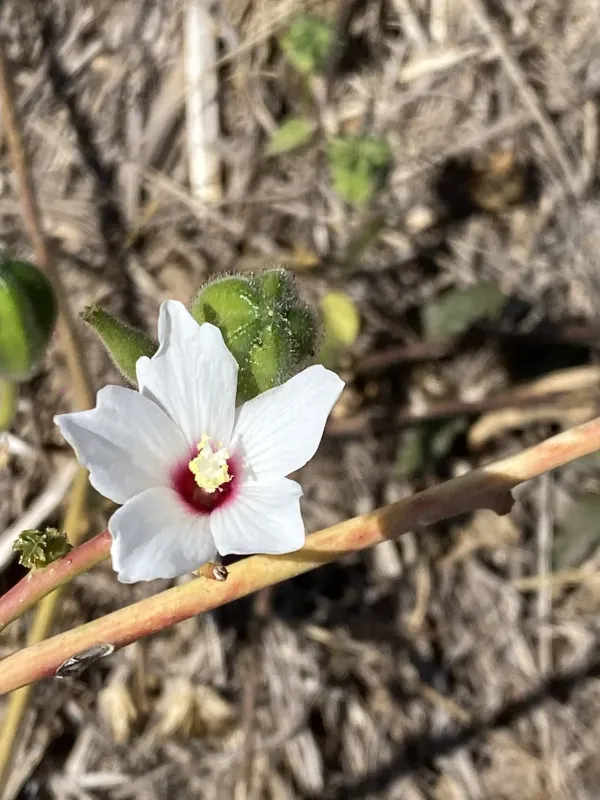
Description
Sowing dates
Abelmoschus ficulneus is a heat-loving annual plant, therefore sowing should be performed only after the soil at the seed depth has warmed up well to a temperature of +15...+18 degrees Celsius.
The optimal period for sowing seeds in open ground is considered to be late spring or early summer, when the threat of nocturnal frost is completely eliminated.
Pre-treatment of seeds, including soaking in warm water for several hours, allows accelerating the germination process and achieving more uniform seedlings 7–10 days after sowing.
The planting pattern should consider the spreading shape of the bush: the row method assumes a distance between rows of about 60–70 centimeters, leaving 30–40 centimeters between plants in a row.
The seeding depth depends on the soil type and varies from 2 to 4 centimeters, with seeds placed shallower in heavy soils compared to light and sandy ones.
Growing requirements
The crop belongs to the Malvaceae family and has high light requirements, preferring open areas protected from strong winds where the plant can develop fully throughout the season.
Abelmoschus grows best in loose, fertile soils with a neutral or slightly acidic reaction, possessing good water and air permeability to prevent moisture stagnation near the roots.
During the active growth period, the plant needs regular watering, especially during the flowering and fruit setting phases, although it is capable of withstanding short dry periods.
For intensive growth and the formation of high-quality fiber or seed yields, Abelmoschus responds well to the application of organic fertilizers, such as compost, during soil preparation.
An important condition for successful cultivation is weed control in the initial stages of growth, as young seedlings can suffer significantly from competition for nutrients.
Main diseases and pests
Typical threats for Abelmoschus ficulneus are fungal diseases, such as root rot, which occurs with excessive soil moisture or low temperatures.
Among pests, insects that damage leaves, specifically aphids and spider mites, pose the greatest danger, especially in hot periods with low air humidity.
In conditions of dense planting and poor ventilation, plants can be affected by powdery mildew, which manifests as a whitish coating on the leaves and leads to premature wilting.
Biological protection includes following proper crop rotation, where Abelmoschus returns to the same field no earlier than after 3–4 years to avoid pathogen accumulation.
Upon detection of the first signs of pests, it is recommended to apply biological insecticides or conduct agricultural measures to thin out the planting for better air circulation.
Harvesting
The fiber harvest is conducted at the stage of mass flowering or immediately after it ends, when the stems reach maximum strength and fiber bundles are best formed.
For seed production, harvesting is carried out when the capsules become dry and start to crack, although it is important not to miss the moment to avoid self-seeding and yield losses.
Stems are cut at the base, after which primary processing is performed, aimed at separating the fiber-rich bark from the woody core of the stem by retting or mechanical action.
After obtaining the fibrous material, it is thoroughly dried under a shaded canopy, ensuring good air circulation to prevent spoilage of the raw material and mold growth.
Cleaned seeds should be stored in dry, cool rooms with good ventilation, using burlap or paper bags, which allows maintaining high germination viability until the next season.