

Pest · Diptera (flies) · affects Maize, Common sunflower, Fodder beet
Especially harmful
Frit fly
Oscinella frit
Description
How to identify
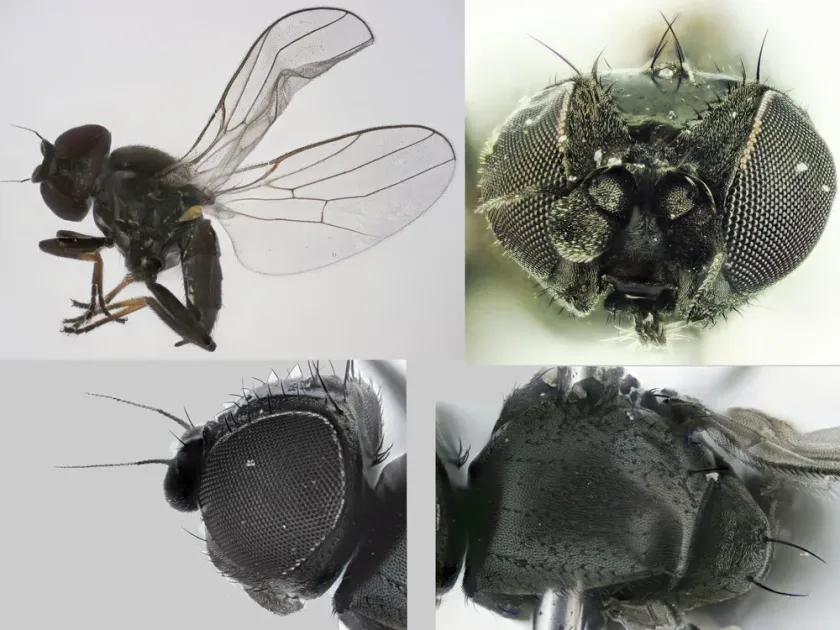
The Frit fly, scientifically known as Oscinella frit, is a small insect belonging to the Chloropidae family. Adult flies are typically 1.5–2 mm long, black in color with yellow tarsi.
The larvae are cream-colored, legless maggots, growing up to 3–4 mm in length. They are characterized by a cylindrical body shape and small mouth hooks used for feeding within plant tissues.
These pests overwinter primarily as larvae inside the stems of winter cereals or wild grasses. The life cycle consists of three to four generations per year depending on the environmental conditions.
Adult flies emerge in early spring, feeding on nectar and honeydew before seeking suitable host plants for oviposition. They prefer moist conditions for successful development.
The pupal stage occurs within brown, cylindrical puparia hidden inside the host plant stems. Proper identification of adults in pheromone or yellow traps is crucial for monitoring population dynamics.
What it damages
Larvae cause significant damage by boring into the stems of cereal crops, including wheat, barley, rye, and oats. In some cases, they can infest maize seedlings.
Research indicates that Frit fly can also affect forage beets, winter rapeseed, and sunflowers when primary cereal hosts are absent or during periods of high pest pressure.
Feeding damage at the tillering stage results in the destruction of the growing point. This leads to the characteristic 'dead heart' symptom, where the central leaf wilts and turns yellow.
In maize, larval activity causes ragged holes in emerging leaves, often described as a 'concertina' pattern. This severe damage significantly reduces plant vigor and growth potential.
Heavy infestations result in substantial yield losses, as plants may fail to tiller or produce stunted and unproductive stems. Weakened plants are also more susceptible to secondary diseases.
Signs of infestation
The most prominent sign is the yellowing and necrosis of the central shoot. This central leaf can be easily pulled out, showing evidence of feeding at the base.
Fields may appear sparse or uneven, with excessive tillering of affected plants. The crop exhibits poor development and stunted growth compared to unaffected areas.
Inside the stem, one can find the larvae along with frass and decaying plant tissue. These internal symptoms confirm the presence of the pest even before external signs are advanced.
Seedling deformation is common, especially in maize. Leaves may appear twisted or stuck together, hindering the normal expansion of the canopy during the early growth stages.
Plant death or the formation of weak, thin spikes at harvest indicate severe infestation levels. Overall crop uniformity is compromised, leading to economic losses at harvest.
Control measures
Cultural control, such as strict crop rotation, is essential to minimize the pest's impact. Avoiding consecutive cereal planting cycles disrupts the overwintering survival of larvae.
Deep autumn plowing helps incorporate plant residues into the soil, effectively reducing the overwintering population. Prompt weed control in field margins eliminates alternative hosts.
Seed treatment with systemic insecticides provides a robust defense against larvae during the crucial early stages of crop establishment, ensuring higher emergence rates.
For late-season infestations, foliar application of insecticides can be effective if the threshold is reached. Monitoring using sticky traps is advised for precise timing.
- Adjusting sowing dates to avoid peak adult flight periods.
- Using vigorous varieties that establish quickly.
- Applying nitrogen fertilizers to boost recovery growth.
- Regular field monitoring for early signs of 'dead heart'.
In brief
5
Damages crops
Content graph
Damages crops · 5
Content graph
Connections · Frit fly
Most often together:
Marketplace
Products · 144
All 144
Wheat 51
Insecticides, Acaricides 47
Barley 14
Oats 11
Corn 6
Sorghum 6
Rye 3
Sudan Grass 2
Triticale 1
Vetch 1
Crested Wheatgrass 1
Sunflower 1


Komanch WP
Nanjing No.1 Pesticide Factory of Red Sun Group Co., Ltd.
Insecticides
1
3
·
2.8K
2 offers
23.14 €per 1 l
Buy




Canonir Ultra
Jiangsu Changqing Biotechnology Co., Ltd.
Insecticides
0
0
·
51
18 offers
3.65 €per 1 l
Buy


Cosmos 500
БАСФ Агро БВ, Швейцарія, на заводі , Франція,Італія (Сієна)
Insecticides
0
0
·
41
1 offer
1 380.87 €per pack
Buy



Attergauer Dinkel
Probstdorfer Saatzucht Ges.m.b.H & Co KG
Wheat
0
0
·
33
2 offers
14.1 €per 1 kg
Buy


SOLNYSHKO
Federal Agrarian Scientific Center of the South-East
Sorghum
0
0
·
30
3 offers
16.33 €per 1 kg
Buy


Biology
Taxonomy
- Latin name
- Oscinella frit
- Order
- Diptera (flies)
- Family
- Chloropidae
- EPPO code
- OSCIFR
Community
Discussion
No discussions yet — be the first.