
Chlorops pumilionis
Chlorops
Description
How to identify
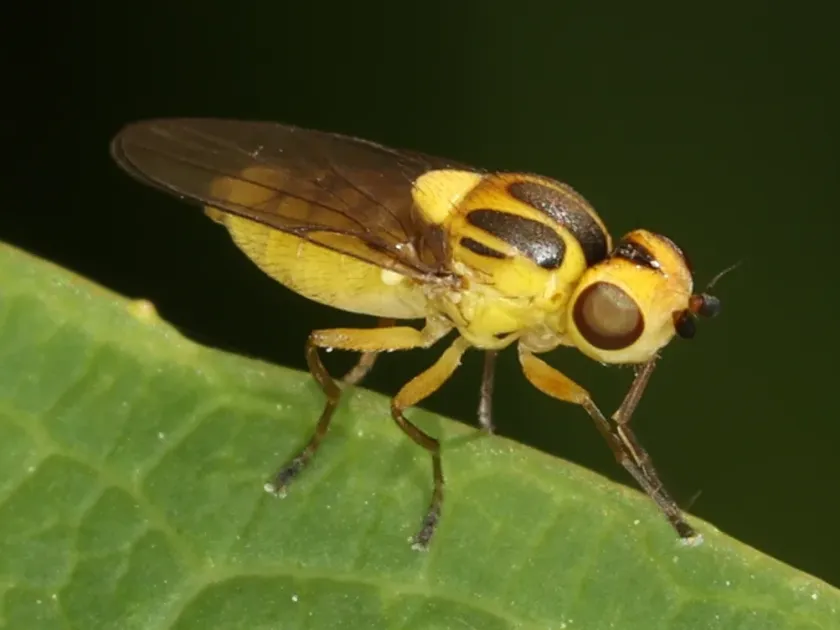
Chlorops pumilionis, commonly known as the gout fly, belongs to the family Chloropidae within the order Diptera. The adult fly is a small insect, measuring 3 to 4 mm, characterized by a bright yellow body with three distinct black longitudinal stripes on the thorax.
Its common name, the "green-eyed fly," refers to the striking emerald-green color of its compound eyes. The insect possesses transparent wings with a simplified venation pattern typical of the Chloropidae family.
The larva is legless, cylindrical, and reaches approximately 7 mm in length. Its body is pale yellow or white, equipped with mouth hooks used for feeding on the internal tissues of cereal stalks.
The puparium is oblong, brown, and hardened. It serves as the overwintering stage for the pest, often found within the remains of stems or in the nodes of dormant grass hosts.
Development involves complete metamorphosis. Depending on geographic latitude, the fly typically completes one to two generations per year, with the emergence of adults highly synchronized with the growth phases of cereals.
What it damages
The primary hosts of Chlorops pumilionis are cultivated cereals, specifically wheat and barley. While rye and oats are also affected, they are generally less preferred by the pest.
Larval feeding occurs inside the stems of young plants. By destroying the growing point (the apical meristem), the larvae prevent normal ear formation, often causing the plant to produce stunted or malformed stems.
A classic sign of damage is the "gouty" appearance of the stem, which becomes shortened and thickened. This malformation prevents the ear from emerging properly from the leaf sheath, leading to significant yield loss.
In addition to direct mechanical damage, the feeding activities of the larvae compromise the structural integrity of the straw, increasing the risk of lodging during strong winds or heavy rain.
Infestation also impacts grain quality. If the second generation attacks the developing ears during the grain-filling stage, the resulting kernels are often shriveled, lightweight, and have lower nutritional value.
When it appears
Adult flies emerge in early spring when temperatures consistently reach 10-12°C. This emergence often aligns with the tillering stage of winter wheat and the early growth stages of spring cereals.
Females lay eggs individually on the leaves of young cereal plants. A single female can produce several hundred eggs during her short lifespan, leading to localized population outbreaks if weather conditions are favorable.
Larvae hatch within a week and immediately migrate toward the central leaf whorl to penetrate the stem. This phase, lasting roughly 30 days, is the most detrimental period for the crop's development.
The second generation of flies appears in mid-summer, coinciding with the flowering and grain-filling stages. They deposit eggs directly onto the developing ears or the flag leaf of the cereal plants.
As harvest approaches, the larvae and pupae within the stubble represent the carry-over population for the next season, highlighting the importance of post-harvest field management.
Signs of infestation
One of the earliest symptoms is the yellowing and necrosis of the central leaf. This indicates that a larva has successfully invaded the stem and is consuming the inner tissues.
Stunted plants that remain significantly shorter than the surrounding crop are a major indicator of an infestation. Such patches often look uneven or patchy across the field.
Upon dissecting the stem, one can observe a internal tunnel, often filled with larval frass and debris. The presence of a creamy-white larva or a brown puparium confirms the cause of the damage.
During the heading phase, plants affected by Chlorops pumilionis often show a "kinked" or bent stem appearance. The ears may remain trapped within the leaf sheath or appear severely deformed.
A general reduction in stand density occurs as damaged plants fail to survive or are unable to produce a viable ear, leading to visible gaps in the crop canopy.
Control measures
Strategic crop rotation is the cornerstone of Chlorops pumilionis management. Avoiding the planting of wheat or barley in fields adjacent to last year's cereal stubble significantly reduces the risk of initial infestation.
Deep plowing after harvest is essential to bury crop residues. This practice ensures that pupae remain deeply buried in the soil, preventing the emergence of adult flies in the following spring.
Adjusting sowing dates can effectively disrupt the life cycle of the pest. Early planting for winter crops and timely planting for spring crops ensure that plants are in a less susceptible stage during the peak flight period.
Chemical control involving systemic insecticides is recommended if monitoring reveals that the number of flies exceeds the economic threshold during the early vegetative stages.
- Use of vigorous varieties that compensate for early damage through increased tillering.
- Balanced nitrogen fertilization to promote rapid plant growth and recovery.
- Control of wild grass weeds that act as alternate hosts during the fly's off-season.
Taxonomy
- Latin name
- Chlorops
- Order
- Diptera (flies)
- Family
- Chloropidae
- EPPO code
- CHLPSP
Discussion
No discussions yet — be the first.