
Anatrichus
Anatrichus
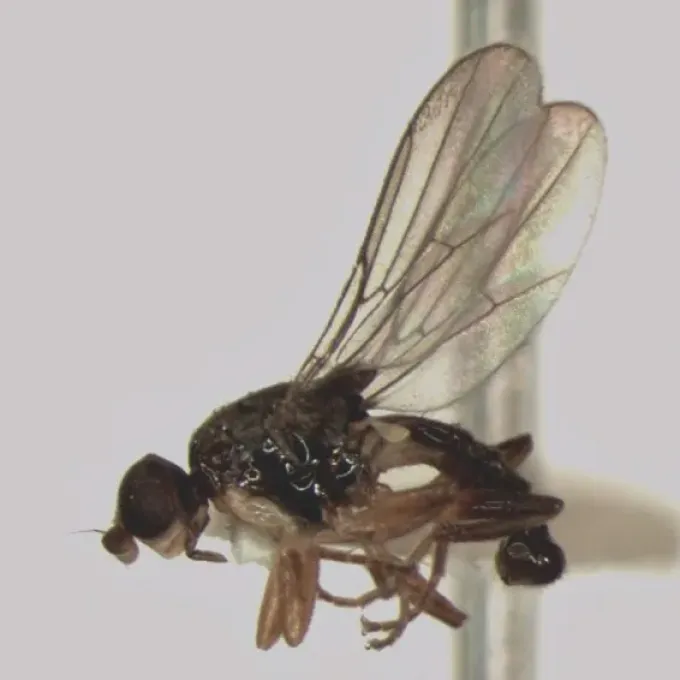
Description
How to identify
Anatrichus is a genus of dipteran insects belonging to the Chloropidae family, commonly known as grass flies or cereal flies. These are small insects that often remain unnoticed due to their tiny size and secretive lifestyle within agricultural ecosystems.
Systematically, this genus is classified under the suborder Brachycera. Morphologically, the adults are characterized by a robust body structure and typically dark or yellowish-black coloration, which allows them to effectively camouflage themselves on plant debris.
The life cycle of this pest is typical for most cereal flies: complete metamorphosis includes the egg, larva, puparium, and adult stages. The main development occurs within plant tissues or in the soil, which complicates field monitoring.
A distinctive feature of the adults is the specific wing venation characteristic of the Chloropidae family, which allows entomologists to perform accurate species-level diagnosis.
Population density is directly dependent on temperature and air humidity, so activity peaks usually occur during periods of moderately warm and humid weather during the crop's growing season.
What it damages
The primary crops attacked by Anatrichus are members of the grass family (Poaceae). Specifically, the pest is frequently recorded on millet, rice, and certain wild grass species.
The larvae of Anatrichus exhibit a specific feeding habit: they develop inside the stems or internodes of grasses, feeding on sap and plant tissues, which disrupts the normal development of the vascular system.
Significant economic damage occurs during the tillering and jointing phases. With heavy infestation, the larvae can cause stem deformation, which leads to lodging or the complete death of the plant.
Affected plants exhibit stunted growth, and the ears may form incompletely or remain empty. This directly reflects a reduction in the total grain yield per unit area of the field.
Beyond direct damage, the injuries caused by Anatrichus often serve as entry points for secondary fungal and bacterial infections, which further exacerbate the weakened state of the crop.
Signs of infestation
One of the first signs of infestation is the yellowing and gradual wilting of the central leaf of the plant. Upon closer inspection, delayed growth of lateral shoots may be observed.
Dissecting the stem often reveals larvae or traces of their activity, such as destroyed internal tissues. Frequently, a characteristic "lag" in the development of internodes can be observed.
During the period of mass emergence, adults can be seen congregating on the upper parts of plants during morning and evening hours. They are active and fly easily from one plant to another.
In fields severely affected by the pest, patches of thin, sparse crops are clearly visible. Plants in these areas appear underdeveloped compared to healthy specimens in neighboring plots.
Visual inspection of the ear often shows the absence of kernels in the lower and middle parts of the inflorescence, which is an indirect sign of nutritional disruption during the generative organ formation.
Control measures
Effective control of Anatrichus begins with agronomic practices. A key method is the implementation of crop rotation, which excludes planting cereal crops on the same field two years in a row.
It is essential to conduct deep autumn plowing after harvest, as this helps destroy puparia hibernating in the soil or crop residues, significantly reducing the population for the next season.
Eliminating wild grass weeds along field borders and ditches is a mandatory step, as these weeds serve as a natural reservoir for the pest population.
Sowing dates play a crucial role: optimal timing allows cereal crops to pass through the most vulnerable developmental stages before the mass emergence of the flies and egg-laying.
If the economic threshold of damage is exceeded, chemical control methods are used. The application of systemic insecticides allows for the neutralization of larvae inside the stems, providing reliable crop protection.
Taxonomy
- Latin name
- Anatrichus
- Order
- Diptera (flies)
- Family
- Chloropidae
- EPPO code
- ANTUSP
Discussion
No discussions yet — be the first.