
Rice chloropid
Chlorops oryzae
Description
How to identify
The rice chloropid (Chlorops oryzae) is a small dipteran fly belonging to the Chloropidae family, often referred to as the rice stem maggot.
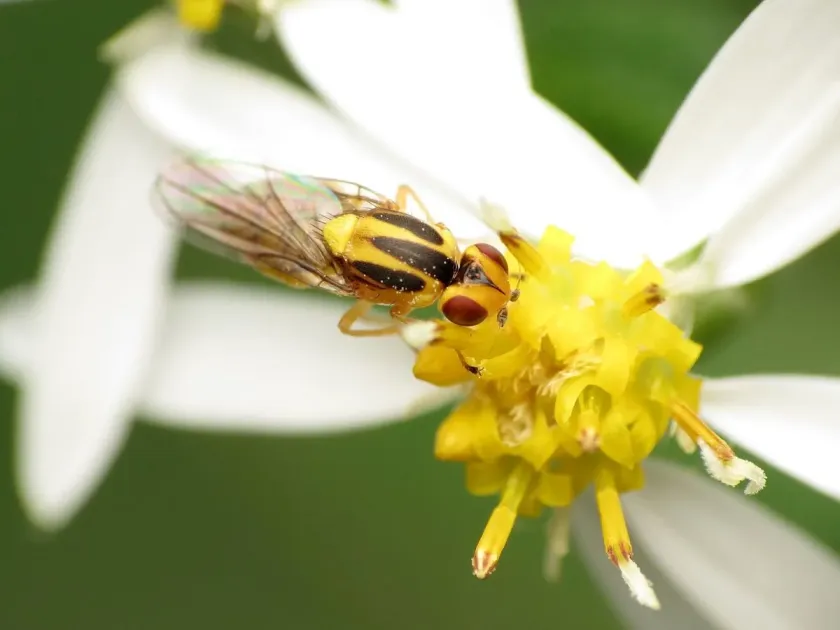
Adult flies are approximately 2–3 mm long, displaying a distinct yellow body with three longitudinal black stripes on the thorax and bright green eyes.
The larvae are legless, maggot-like, and typically creamy-white or yellowish, growing to about 4–5 mm in length before pupation.
Pupae are found within a brown puparium, which is often located inside the leaf sheath or the stem of the host plant.
This pest is easily identified by its unique appearance and the specific patterns of damage it inflicts on cereal crops, particularly rice.
What it damages
The primary host for this pest is rice, though it can also infest various wild grasses that serve as alternative food sources.
The larvae feed on the tender tissues of the central stem, destroying the growing point and preventing the development of the panicle.
Severe infestations lead to stunted growth, reduced tillering, and sometimes the complete death of the main shoot, known as deadheart.
The damage is most severe during the vegetative stage, as the loss of the primary tiller forces the plant to divert energy to secondary shoots.
Infested fields often show patchy growth, with significant yield losses if the pest population density remains unchecked during early development.
When it appears
The rice chloropid overwinters as larvae in the stems of volunteer rice or wild grasses, emerging as adults in the spring.
The timing of the first adult emergence is closely synchronized with the availability of young rice seedlings, allowing for rapid infestation.
Depending on the climatic zone, the pest can complete several generations throughout the rice growing season, leading to overlapping life stages.
Adult flies are most active during the morning and evening, preferring humid conditions and sheltered areas within the canopy.
Temperature fluctuations significantly influence the duration of each life stage, with warmer conditions generally accelerating the development cycle.
Signs of infestation
The most characteristic sign of an infestation is the yellowing and wilting of the central leaf of young rice plants.
- The central shoot can be easily pulled out, revealing internal larval tunnels.
- Stunted growth and distorted plant appearance are common in early infestation stages.
- Increased secondary tillering occurs as the plant attempts to recover from the damage.
- Presence of tiny larvae or brown tunnels within the damaged leaf sheath base.
When observing a field, one may notice circular or irregular spots where plants fail to develop normally compared to the healthy surrounding crop.
Control measures
Cultural control practices include the removal of crop residues and the destruction of wild grasses to eliminate overwintering sites.
Adjusting the planting dates to avoid peak adult activity periods can significantly reduce the risk of primary infestation.
Integrated Pest Management (IPM) involves the use of systematic insecticides only when the damage threshold is reached.
Biological control agents, including parasitic wasps that target larval stages, play a crucial role in maintaining natural population balance.
Field monitoring using insect nets or sticky traps is essential for making informed decisions regarding the application of chemical control measures.
Taxonomy
- Latin name
- Chlorops oryzae
- Order
- Diptera (flies)
- Family
- Chloropidae
- EPPO code
- CHLPOR
Discussion
No discussions yet — be the first.