

Disease
Especially harmful
Fusarium wilt of pea
Fusarium oxysporum f. sp. pisi
Description
Symptoms
Symptoms often appear during the flowering or pod-filling stages. The lower leaves begin to yellow, followed by drooping and curling of the leaflets, eventually leading to necrosis.
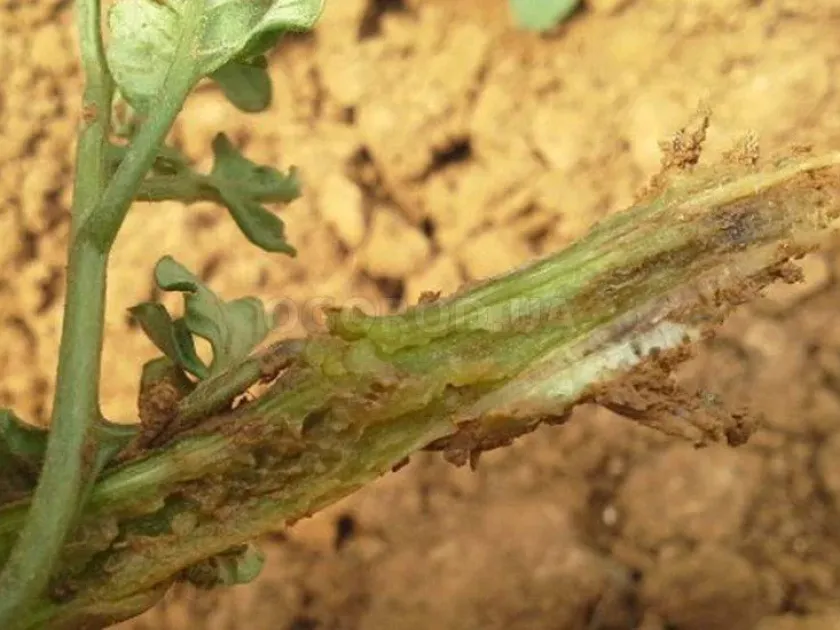
A closer inspection of the crown or root system reveals dark brown, decaying tissues. In some cases, a pinkish, moldy growth of spores can be observed at the base of the stem.
When the stem is cut longitudinally, the vascular bundles appear distinctly discolored, turning a reddish-brown or dark brown color due to the presence of fungal mycelium.
Affected plants are severely stunted compared to healthy ones. In hot, dry weather, symptoms progress quickly, often causing the entire plant to collapse within a few days.
Seedlings infected at an early stage may die pre-emergence or shortly after sprouting, resulting in uneven plant stands and significant yield reduction.
Pathogen
The disease is caused by the fungus Fusarium oxysporum f. sp. pisi, a soil-borne pathogen that persists in the soil for many years in the form of chlamydospores.
The fungus invades the host plant through the root system. Once inside, it colonizes the vascular tissues, specifically the xylem, obstructing the upward flow of water and nutrients.
The pathogen is primarily spread through infested soil moved by farm equipment, water runoff, or contaminated seed lots that carry the fungus on their surface or internally.
As a saprophyte, the fungus can survive on decaying organic matter in the soil, ensuring its persistence even in the absence of a host crop for several seasons.
Race 1 is a highly specific strain that targets garden and field peas, causing systemic vascular infection that leads to rapid wilting and eventual plant death.
Conditions for development
The development of Fusarium wilt is strongly favored by soil temperatures between 20°C and 25°C, which align with the growth stages of the pea crop.
Fluctuating soil moisture levels, specifically high humidity followed by drought stress, are key triggers that accelerate the colonization of the host by the fungus.
The disease tends to be more severe in acidic soils (pH < 6.0), where the fungus outcompetes beneficial soil microorganisms and grows more aggressively.
Short crop rotation cycles, where peas are grown too frequently in the same field, lead to a build-up of the pathogen inoculum to levels that cause massive outbreaks.
Mechanical injuries to the root system, often caused by root-feeding insects or improper soil cultivation, significantly increase the incidence of infection.
Why it matters
Fusarium wilt is considered one of the most economically damaging diseases in pea production, capable of causing yield losses ranging from 20% to over 80%.
Beyond quantity, the infection ruins the quality of the harvested peas, resulting in shriveled, discolored seeds that are unsuitable for future sowing or human consumption.
The persistent nature of the fungus forces farmers to abandon the production of peas on infested fields for up to 7 years, impacting long-term farm planning.
Plants affected by the disease provide poor-quality fodder and biomass, which is a significant drawback for agricultural systems integrated with livestock.
The necessity for intensive fungicidal seed treatments and soil management adds significant costs to the production cycle, reducing overall profitability.
Protection
The most effective strategy is the implementation of a long crop rotation (at least 6–8 years) to minimize the concentration of the fungal inoculum in the soil.
Selecting and planting resistant pea varieties is the cornerstone of disease management, as these cultivars can withstand infection even in previously infested soils.
Treating seeds with high-quality systemic fungicides provides a critical window of protection for the young seedlings against early soil-borne infections.
- Balancing soil nutrients, particularly phosphorus and potassium, to boost plant vigor and systemic resistance.
- Adjusting soil pH through liming to move the soil environment toward a neutral range, which is less favorable for Fusarium.
- Practicing strict field hygiene and cleaning machinery between fields to prevent the spread of contaminated soil.
Field monitoring during the critical growth phases is essential to identify disease patches and prevent further spread by limiting traffic through infected areas.
Reference
Connections · Fusarium wilt of pea
Most often together:
Marketplace
Products · 52





Community
Discussion
No discussions yet — be the first.