
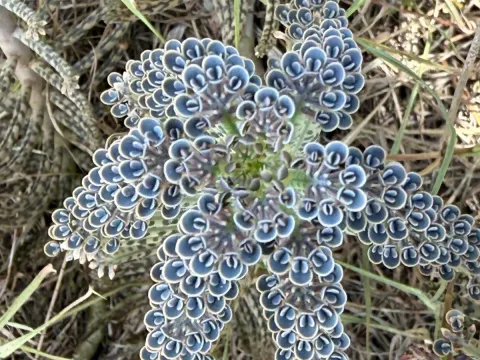
Kalanchoe
Kalanchoe Adans.
Kalanchoe (Kalanchoe Adans.) is a significant genus of succulent plants within the Crassulaceae family. Native to the tropical regions of Africa, Asia, and Madagascar, these plants are highly adapted to rocky terrains and arid environments, making them unique agricultural subjects.
What the section contains
 Crenate-leaf Kalanchoe
Kalanchoe crenata (Andrews) Haw.
Crenate-leaf Kalanchoe
Kalanchoe crenata (Andrews) Haw.
 Flaming Katy
Kalanchoe blossfeldiana Poelln.
Kalanchoe blossfeldiana
Kalanchoe blossfeldiana x Kalanchoe guignardii
Kalanchoe blossfeldiana
Kalanchoe blossfeldiana x kalanchoe laciniata
Flaming Katy
Kalanchoe blossfeldiana Poelln.
Kalanchoe blossfeldiana
Kalanchoe blossfeldiana x Kalanchoe guignardii
Kalanchoe blossfeldiana
Kalanchoe blossfeldiana x kalanchoe laciniata
 Kalanchoe blossfeldiana
 x Kalanchoe spathulata
Kalanchoe blossfeldiana
Kalanchoe blossfeldiana x Kalanchoe spathulata
 Kalanchoe gastonis-bonnieri
 Raym.-Hamet & H. Perrier
Kalanchoe gastonis-bonnieri
Kalanchoe gastonis-bonnieri Raym.-Hamet & H. Perrier
 Kalanchoe globulifera
 H. Perrier
Kalanchoe globulifera
Kalanchoe globulifera H. Perrier
 Kalanchoe guignardii
 Raym.-Hamet & H. Perrier
Kalanchoe guignardii
Kalanchoe guignardii Raym.-Hamet & H. Perrier
 Kalanchoe humilis
 Britten
Kalanchoe hybrid
hybrids between Kalanchoe blossfeldiana Poelln. and Kalanchoe porphyrocalyx (Baker) Baill.
Kalanchoe humilis
Kalanchoe humilis Britten
Kalanchoe hybrid
hybrids between Kalanchoe blossfeldiana Poelln. and Kalanchoe porphyrocalyx (Baker) Baill.
 Kalanchoe hybrid
hybrids between Kalanchoe miniata Hils. & Bojer ex Tul. And Kalanchoe porphyrocalyx (Baker) Baill.
Kalanchoe hybrid
hybrids between Kalanchoe miniata Hils. & Bojer ex Tul. And Kalanchoe porphyrocalyx (Baker) Baill.
 Kalanchoe laciniata
 (L.) DC.
Kalanchoe laciniata
Kalanchoe laciniata (L.) DC.
 Kalanchoe manginii
 Raym.-Hamet & H. Perrier
Kalanchoe manginii
Kalanchoe manginii Raym.-Hamet & H. Perrier
 Kalanchoe miniata
 Hils. & Bojer ex Tul.
Kalanchoe miniata
Kalanchoe miniata Hils. & Bojer ex Tul.
 Kalanchoe porphyrocalyx
 (Baker) Baill.
Kalanchoe porphyrocalyx
Kalanchoe porphyrocalyx (Baker) Baill.
 Kalanchoe spathulata
 DC.
Kalanchoe spathulata
Kalanchoe spathulata DC.
 Kalanchoe thyrsiflora
 Harv.
Kalanchoe thyrsiflora
Kalanchoe thyrsiflora Harv.
 Kalanchoe uniflora
 (Stapf) Raym.-Hamet
Kalanchoe uniflora
Kalanchoe uniflora (Stapf) Raym.-Hamet
 Penwiper plant
Kalanchoe marmorata Baker
Penwiper plant
Kalanchoe marmorata Baker
Kalanchoe
The culture requires bright, indirect sunlight to maintain optimal foliage density and coloration. Temperatures ranging from 18 to 25 degrees Celsius are ideal for vegetative growth, while cooler conditions are often used to trigger the flowering process in commercial greenhouse production.
Soil requirements focus on high permeability and rapid water drainage. A professional substrate usually consists of a peat-based mix amended with perlite, pumice, or coarse sand to prevent compaction, which is a major risk factor for root decay in industrial setups.
Irrigation must be precise, following a dry-to-wet cycle. The substrate should be allowed to dry out significantly between watering sessions. Over-watering is the most common agronomic error, often leading to rapid decline and susceptibility to secondary infections.
Economic utility varies significantly: species like Kalanchoe pinnata are cultivated for their pharmaceutical properties, specifically for producing healing extracts. Other species are mass-produced in horticultural nurseries as high-demand flowering ornamental crops.
Fungal pathogens represent the primary threat to Kalanchoe cultivation, particularly when humidity levels exceed established thresholds. Powdery mildew and various stem rots are the most common diseases that can devastate crop yield if ventilation is inadequate.
Insect pests such as mealybugs, aphids, and spider mites present constant pressure in a controlled environment. These pests damage the succulent tissue, reducing the aesthetic and medicinal value of the plant, and can act as vectors for secondary bacterial infections.
Integrated Pest Management (IPM) is essential for Kalanchoe production. This includes monitoring for early signs of infestation, maintaining strict hygiene protocols for equipment, and using selective insecticides only when biological thresholds are exceeded.
Fungal disease management relies heavily on preventative cultural practices, such as ensuring sufficient spacing between plants to promote airflow. If outbreaks occur, systemic fungicides are applied to restore health to the affected crops.
Sustainable success in cultivating Kalanchoe depends on rigorous adherence to climatic parameters. By balancing light, moisture, and strict sanitation, growers can ensure consistent high-quality production throughout the entire growing season.