
Penwiper plant
Kalanchoe marmorata Baker
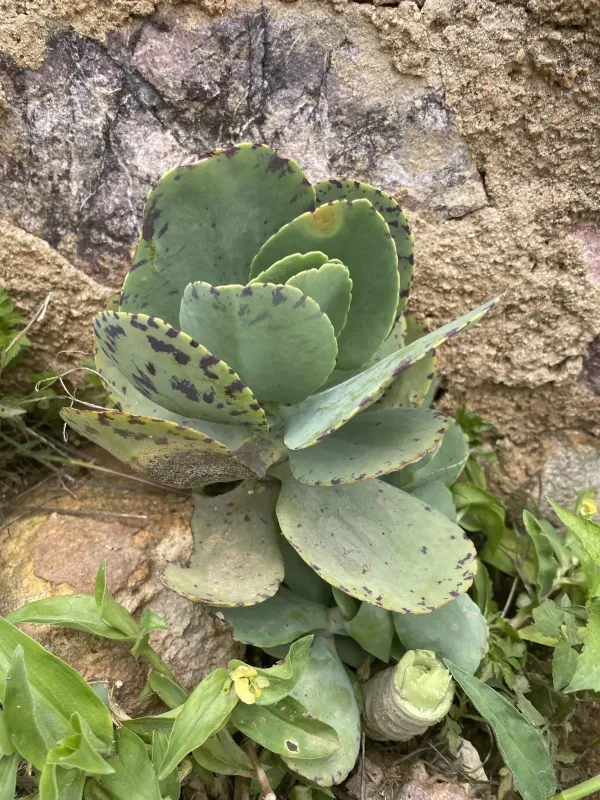
Description
Growing requirements
The Penwiper plant (Kalanchoe marmorata Baker) is a perennial succulent belonging to the Crassulaceae family. It is native to the mountainous regions of East Africa, specifically Ethiopia and Sudan, where it thrives in rocky, arid environments with high sunlight exposure.
For successful cultivation, the species requires a well-lit environment with plenty of bright, indirect sunlight to maintain its characteristic brownish-maroon leaf markings. It prefers daytime temperatures between 18 and 25 degrees Celsius, with cooler nights simulating its native habitat.
The soil must be highly porous and fast-draining, as the plant is extremely susceptible to root rot in waterlogged conditions. A standard mix usually includes high-quality potting soil combined with pumice or perlite to ensure adequate aeration for the root system.
Watering frequency should be strictly regulated, allowing the substrate to dry out completely between sessions. In winter, during the dormant phase, the plant requires very minimal water, which helps in preventing fungal infections and promoting potential flowering in late winter or spring.
Agronomic management involves periodic pruning to maintain the plant's structural integrity and avoid excessive legginess. Propagation is typically achieved through stem cuttings or leaf cuttings, which must be calloused for a few days before being placed in a dry, sterile growing medium.
Main diseases and pests
Fungal diseases are the primary threat to the Penwiper plant, usually triggered by over-irrigation or high humidity levels. Root and stem rots are the most critical issues, often leading to rapid plant decline if the substrate does not allow for efficient moisture evaporation.
Mealybugs are the most persistent pests for this species, often settling deep within the leaf rosettes. They feed on plant sap and secrete honeydew, which can further attract secondary infections; regular physical inspection and targeted insecticide treatment are essential.
Scale insects can also affect the stems, manifesting as small, hard, armored bumps. These pests are difficult to eradicate once they colonize, necessitating the use of systemic insecticides or manual removal with alcohol-soaked cotton swabs.
Spider mites can be problematic in low-humidity indoor environments, causing fine webbing and discoloration of the leaf surfaces. Increasing ventilation and occasionally misting the surrounding air can help prevent mite infestations from becoming an agricultural problem.
Proper sanitation of tools and pots is critical to preventing the spread of pathogens between plants. Ensuring that the crown of the plant remains dry during watering is the most effective cultural practice to minimize the risk of bacterial and fungal outbreaks.