

Reference · Crops
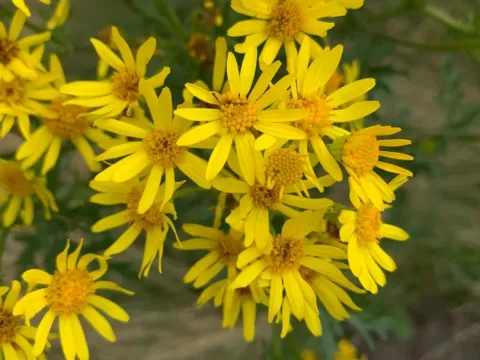
Ragwort
Jacobaea
The genus Jacobaea, commonly known as Ragwort, propagates primarily through seeds, which are highly dispersed by wind due to their light, tufted structure.
23
items
What the section contains
 Alpine ragwort
Jacobaea alpina
Alpine ragwort
Jacobaea alpina
 Fen ragwort
Jacobaea paludosa
Fen ragwort
Jacobaea paludosa
 Grey ragwort
Jacobaea incana
Grey ragwort
Jacobaea incana
 Hoary ragwort
Jacobaea erucifolia
Hoary ragwort
Jacobaea erucifolia
 Jacobaea abrotanifolia
Jacobaea abrotanifolia
Jacobaea abrotanifolia
 Jacobaea adonidifolia
Jacobaea adonidifolia
Jacobaea adonidifolia
 Jacobaea ambigua
Jacobaea ambigua
Jacobaea ambigua
 Jacobaea analoga
Jacobaea analoga
Jacobaea analoga
 Jacobaea arnautorum
Jacobaea arnautorum
Jacobaea arnautorum
 Jacobaea boissieri
Jacobaea boissieri
Jacobaea boissieri
 Jacobaea cannabifolia
Jacobaea cannabifolia
Jacobaea cannabifolia
 Jacobaea erratica
Jacobaea gnaphalioides
Jacobaea gnaphalioides
Jacobaea erratica
Jacobaea erratica
Jacobaea gnaphalioides
Jacobaea gnaphalioides
 Jacobaea graciliflora
Jacobaea graciliflora
Jacobaea graciliflora
 Jacobaea leucophylla
Jacobaea leucophylla
Jacobaea leucophylla
 Jacobaea minuta
Jacobaea minuta
Jacobaea minuta
 Jacobaea othonnae
Jacobaea othonnae
Jacobaea othonnae
 Jacobaea persoonii
Jacobaea persoonii
Jacobaea persoonii
 Jacobaea pseudoarnica
Jacobaea pseudoarnica
Jacobaea pseudoarnica
 Jacobaea racemosa
Jacobaea racemosa
Jacobaea racemosa
 Jacobaea uniflora
Jacobaea uniflora
Jacobaea uniflora
 Marsh ragwort
Jacobaea aquatica
Subalpine ragwort
Jacobaea subalpina
Marsh ragwort
Jacobaea aquatica
Subalpine ragwort
Jacobaea subalpina
Marketplace
Products in this section · 4


Ragwort
Germination typically occurs in early spring, following the first rise in soil temperature and consistent rainfall in temperate regions.
A second flush of germination often appears in autumn, particularly in disturbed soils where sunlight reaches the germinating seeds.
Agronomists emphasize that controlling the plant before the flowering stage is essential, as a single plant can produce thousands of viable seeds.
Mechanical control, such as pulling or hoeing, is most effective when done before the plant establishes a deep and complex taproot system.
Ragwort belongs to the Asteraceae family and is widely distributed across Europe and Asia, adapting to various soil types and moisture levels.
The plant thrives in sunny, open habitats and exhibits significant resilience to fluctuating temperatures and soil nutrient profiles.
While preferring well-drained loamy soils, it is known to colonize roadsides, degraded pastures, and abandoned agricultural fields successfully.
Optimal growth conditions include a moderate climate with adequate moisture, although the plant displays a surprising tolerance for dry spells.
The plant does not require high levels of nitrogen, allowing it to outcompete native species in degraded environments where soil quality is compromised.
Ragwort is well-known for its toxicity to livestock, containing pyrrolizidine alkaloids that cause irreversible liver damage if ingested in large quantities.
Insects like the Cinnabar moth are natural biological controllers, as their larvae feed exclusively on the foliage and accumulate the plant's toxins.
Fungal diseases, including powdery mildew and rusts, can affect the leaves during periods of high humidity and poor air circulation in the field.
Root rots may occur in waterlogged soils, though the seed bank remains a persistent threat for future agricultural seasons.
Effective management requires a combination of early identification, chemical control with targeted herbicides, and improved pasture management practices.