
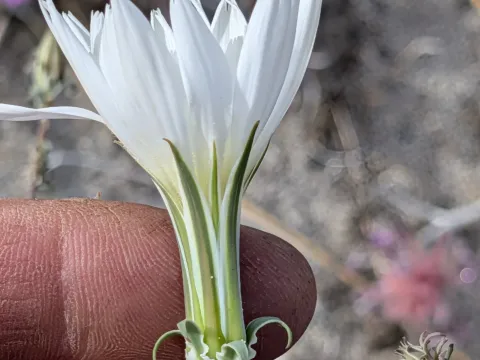
Rafinesquia
Rafinesquia
Rafinesquia is a genus of herbaceous annual plants within the Asteraceae family. It is native to the arid and semi-arid regions of North America, particularly the Southwestern United States and Mexico.
What the section contains


Rafinesquia
When cultivating this plant, seeds should be sown in autumn or early spring to mimic the natural germination cycle, which is triggered by cooler temperatures and winter moisture.
The seeds are relatively small and should be sown at a shallow depth of approximately 1 to 2 centimeters in a well-prepared seedbed with loose structure.
Sowing density should be managed to ensure adequate space for the development of the basal rosette, which is characteristic of this genus.
Proper pre-sowing soil treatment, including loosening and clearing of debris, is essential to establish a good contact between seeds and the soil matrix.
Rafinesquia requires full solar exposure and thrives in open, sunny locations. It is highly adapted to high-light environments and does not tolerate shade.
The ideal soil for this culture is sandy, rocky, or gravelly loam with excellent drainage properties, as the roots are sensitive to waterlogging.
Water requirements are low to moderate. While the plant is drought-tolerant, supplemental irrigation during the seedling stage significantly improves establishment success.
The plant performs best in neutral to slightly alkaline soil conditions, which support the nutrient uptake patterns typical for desert-adapted flora.
Climatic conditions should feature low humidity and clear air, as high atmospheric humidity can interfere with normal transpiration and reproduction processes.
The primary threat to Rafinesquia is the development of root and crown rot, caused by excessive soil moisture and poor drainage conditions.
Pest management is focused on aphids and spider mites, which may infest the plant during prolonged dry spells or in greenhouse conditions.
To prevent disease outbreaks, it is crucial to ensure airflow around the plants and avoid over-irrigation, especially during cloudy weather.
Mechanical damage should be minimized during cultivation activities, as open wounds can easily be invaded by soil-borne pathogens and fungi.
- Use of well-drained, sterile substrate for containers.
- Consistent removal of infected plant residues.
- Monitoring for early signs of chlorosis or wilting.