

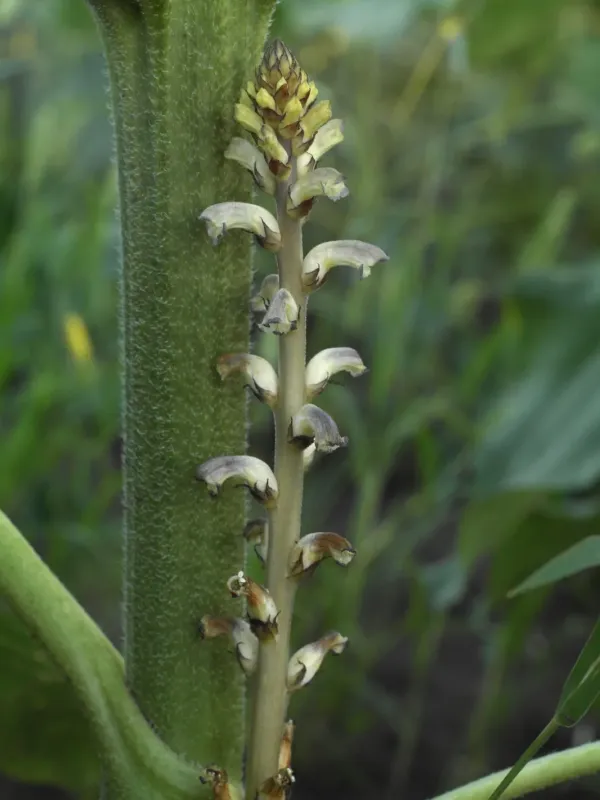
Description
How to tell it apart
Sunflower broomrape is an obligate root parasite that lacks chlorophyll and cannot perform photosynthesis. The plant appears as a yellowish or brownish fleshy stem, usually 10–30 cm tall, emerging directly from the soil near the base of the host plant.
The leaves are reduced to small scales pressed against the stem, giving it a somewhat asparagus-like appearance. The tip of the stem bears a spike-like inflorescence with tubular, purple or blue flowers that produce an enormous amount of dust-like seeds.
The root system is modified into a specialized organ called a haustorium, which physically penetrates the sunflower root and taps into its vascular system to extract nutrients and water directly from the host.
The seeds are microscopic, measuring only about 0.2–0.3 mm in length. This size allows them to be dispersed easily by wind, water, and farm machinery, making them extremely difficult to contain once established in a field.
A single broomrape plant can produce over 100,000 seeds. These seeds remain viable in the soil for 10–15 years, waiting for the specific chemical cues from sunflower roots to germinate.
Where it grows
This species is highly specialized and thrives primarily in sunflower-growing regions, particularly those with arid or semi-arid climates. It is most commonly found in intensive farming areas where crop rotation is poorly managed.
Broomrape infestations are often concentrated in fields where sunflowers have been grown repeatedly. The parasite can also survive on alternative hosts like wormwood, which can act as a reservoir for the weed between cropping seasons.
The germination of broomrape seeds is triggered by exudates from sunflower roots. This process is most active at soil temperatures between 20°C and 25°C, aligning with the peak growth stages of the sunflower crop.
Soil type does not significantly limit the distribution of the weed, though it prefers well-drained, fertile soils. Infestations often begin in small patches, which then expand rapidly as farming operations spread the seeds across the field.
Continuous cropping and a lack of phytosanitary measures contribute to the rapid accumulation of the soil seed bank, making the infestation progressively harder to manage each year.
Harm it causes
The primary damage is caused by the parasite siphoning off water, minerals, and essential photosynthetic products from the sunflower. This leads to severe stunting, reduced head size, and poorly developed seeds.
In cases of high infestation, where dozens of broomrape stalks attach to a single host, the sunflower may die prematurely. This results in significant yield losses, often ranging from 30% to 100% in heavily infested sectors.
Beyond yield reduction, the quality of the harvested sunflower seed is negatively impacted. Infested crops often show reduced oil content and lower seed weight, making the harvest less profitable for industrial processing.
The parasite also acts as a biological stressor, weakening the sunflower and making it more susceptible to various soil-borne diseases and pests, further complicating the overall health of the crop.
The hidden nature of the initial infection—occurring entirely underground—means that significant damage is often already done by the time the broomrape stalks emerge above ground.
How to control
The most reliable control strategy is the use of genetically resistant sunflower hybrids. Plant breeders continuously develop new hybrids that can prevent the parasite from establishing a successful connection.
Chemical control involving herbicide-tolerant sunflower hybrids (such as those using the Clearfield technology) has proven highly effective. These herbicides kill the parasite during its underground development phase.
Crop rotation remains a fundamental practice. Rotating sunflowers with crops that do not host the parasite allows the soil seed bank to naturally deplete over time as the broomrape seeds fail to find a suitable host.
Good agricultural practices, such as deep plowing and thorough cleaning of agricultural machinery between fields, help to minimize the spread of seeds and reduce the density of the parasite in the topsoil.
- Planting resistant sunflower hybrids.
- Using herbicide-tolerant (Clearfield) production systems.
- Extending crop rotation intervals to 6–8 years.
- Deep tillage to bury seeds in the soil.
- Regular inspection of fields for broomrape emergence.
Content graph
Connections · Sunflower broomrape
Most often together:
Marketplace
Products · 2278

















Biology
Taxonomy
- Latin name
- Orobanche cumana
- Family
- Заразиха подсолнечниковая