

Corn root webworm
Crambus caliginosellus
Description
How to identify
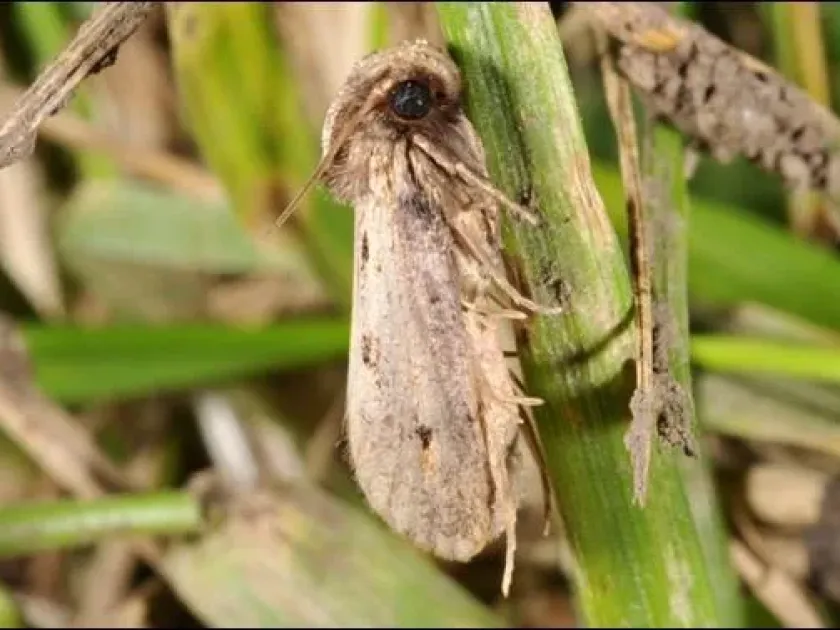
The corn root webworm Crambus caliginosellus is a moth belonging to the family Crambidae. Adult moths are characterized by narrow forewings with brownish or yellowish patterns, held tightly against the body when resting.
The larvae, known as webworms, are the primary damaging stage. They grow up to 20 mm in length and possess a pale, greyish-white or yellowish body covered with distinct dark spots, each bearing a single short seta.
The head capsule of the larva is typically dark brown or black, providing a distinct contrast to the lighter body. They are known for constructing silken tubes mixed with soil particles for protection.
Pupation occurs within these silken, soil-covered cocoons located in the upper soil profile near the host plants. Their cryptic behavior makes monitoring their presence quite difficult for field scouts.
Adult moths are primarily nocturnal, remaining hidden among vegetation or ground cover during the daylight hours, emerging only at dusk for mating and egg-laying.
What it damages
Damage is primarily caused by larvae feeding on the roots and the base of the stems of young seedlings. Corn is a major host, but the pest also attacks tobacco and various vegetable crops.
Larvae often sever the plant stem just below the soil surface, leading to rapid wilting and the subsequent death of the seedling. This results in significant stand losses.
Besides cutting the stems, larvae may bore into the underground parts of the plant, disrupting nutrient transport and severely weakening the development of the corn plant.
Plants that are not killed outright often exhibit stunted growth, reduced vigor, and increased susceptibility to environmental stresses and secondary plant pathogens.
Fields previously utilized as pastures or those with significant grassy weed infestations are at the highest risk, as these environments provide ideal breeding conditions for the webworms.
When it appears
The adult moth flight typically begins in late spring to early summer, depending on regional temperature accumulation and moisture levels, which trigger the emergence from overwintering sites.
Eggs are deposited on the soil surface or on the lower leaves of grasses and host plants. Upon hatching, the larvae immediately begin seeking food, burrowing into the soil to build their protective tubes.
The peak activity of the larvae coincides with the germination and early seedling stages of corn, which is when the crop is most vulnerable to economic damage.
The pest generally completes its life cycle within a single growing season, though some regions may experience partial or complete second generations, extending the window of potential risk.
Overwintering takes place in the larval stage, with the caterpillars remaining dormant within the soil at depths of 10-15 cm until temperatures rise in the following spring.
Signs of infestation
The earliest symptom of an infestation is the thinning of crop rows, with small gaps where plants have disappeared. Growers may initially misidentify this as poor germination or seedling disease.
Careful inspection of the base of wilting seedlings often reveals silken, soil-covered galleries that the larvae have constructed. These tubes are diagnostic for webworm presence.
Stunted growth or the yellowing of the innermost leaves (often referred to as 'dead heart') in young corn plants can indicate that a larva has bored into the stalk.
In infested fields, one can observe adult moths fluttering low above the grass or soil during the evening, which indicates a high likelihood of upcoming larval damage.
The presence of larvae can be confirmed by digging around the root zone of affected plants, where they are typically found curled up inside their protective silk-soil cocoons.
Control measures
Effective management begins with cultural practices, focusing on eliminating the grassy habitats where the moths deposit their eggs prior to planting the primary crop.
Crop rotation is highly recommended; avoiding corn after sod or long-term grassy fallow land significantly reduces the likelihood of severe webworm outbreaks.
Thorough soil tillage prior to planting helps to disrupt the larval protective structures and can physically destroy a significant portion of the population residing in the soil.
When economic thresholds are met, the use of insecticide seed treatments or targeted soil-applied insecticides can provide the necessary protection for the crop's vulnerable early growth stages.
- Proper weed management in and around fields.
- Strategic crop rotation with non-grass species.
- Pre-planting tillage to disturb larval habitats.
- Monitoring for adult flight to time chemical applications.
Content graph
Connections · Corn root webworm
Most often together:
Marketplace
Products · 43


Biology
Taxonomy
- Latin name
- Crambus caliginosellus
- Order
- Lepidoptera (butterflies)
- Family
- Crambidae
- EPPO code
- CRAMCA
Community
Discussion
No discussions yet — be the first.