
Water veneer moth
Acentria ephemerella
Description
How to identify
The water veneer moth (Acentria ephemerella) is a member of the Crambidae family. It is a highly specialized moth species that has adapted to live in aquatic environments.
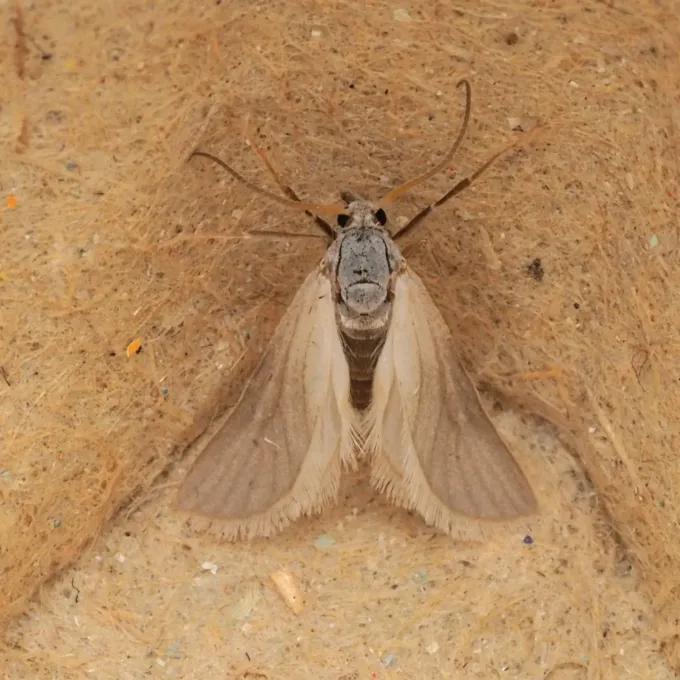
Adult moths have a wingspan ranging from 12 to 16 mm. They possess a silky, white or grayish-white appearance, which acts as camouflage on the water surface.
The species exhibits sexual dimorphism: while males have functional wings for flight, females often have reduced wings and spend their entire life cycle underwater.
The larvae are fully aquatic and are equipped with filamentous tracheal gills, allowing them to extract dissolved oxygen directly from the water.
Pupation occurs underwater within a reinforced, silk-spun cocoon attached to aquatic plants, providing protection against currents and predators.
What it damages
The larvae feed primarily on submerged aquatic vegetation, with a strong preference for Elodea canadensis, Potamogeton species, and other common water weeds.
By consuming the internal tissues of stems and leaves, the larvae disrupt the metabolic processes of the plants, leading to weakened growth and eventual decay.
In ornamental ponds or confined water bodies, large populations can cause significant loss of biomass, rendering the water unsightly and biologically imbalanced.
Damage to the stems often leads to the breakage of plant segments, which can inadvertently assist the further spread of invasive aquatic weeds in the system.
Plants affected by the moth show signs of skeletal leaves, as the larvae consume the soft parenchyma while leaving the leaf veins intact.
When it appears
The life cycle initiates with eggs laid on submerged plant surfaces. The larvae remain active throughout the spring and summer months as they grow.
Depending on the water temperature and local climatic conditions, the moth can produce one or two generations per year, ensuring rapid colonization.
Adult males are typically observed hovering just above the water surface during summer evenings, which is the peak time for mating activity.
The winter season is survived by larvae in their early development stages, hiding in the detritus at the bottom of the pond or within dormant plant remnants.
Activity resumes as water temperatures increase in the spring, coinciding with the rapid vegetative growth phase of their host plants.
Signs of infestation
Visible skeletal or "window-paned" leaves are the most characteristic sign of infestation, caused by larval feeding on the leaf interior.
Small, densely spun silk cocoons found attached to stems or leaf undersides indicate the presence of pupating larvae within the pond environment.
Stunted growth of submerged weed colonies, often accompanied by patches of decaying plant matter, serves as a common indicator of significant larval pressure.
The sight of tiny, white moths fluttering low over the water surface at twilight indicates an active adult population and potential egg-laying activity.
Careful inspection of plant stems can reveal larvae residing inside protective tubes constructed from silk and plant debris.
Control measures
Manual removal of heavily infested plant materials is the most practical and eco-friendly method for managing populations in small ponds.
Chemical insecticides should be avoided entirely in aquatic systems due to their high toxicity to fish, amphibians, and other non-target aquatic life.
Biological control can be enhanced by introducing fish species known to prey on aquatic larvae, which helps maintain a natural balance in the ecosystem.
Regular maintenance, including the thinning of dense submerged vegetation, reduces the available habitat and food supply for the moths.
Monitoring the water quality to prevent excessive nutrient loading helps control the growth of weeds, thereby indirectly limiting the moth's reproductive success.
Taxonomy
- Latin name
- Acentria ephemerella
- Order
- Lepidoptera (butterflies)
- Family
- Crambidae
- EPPO code
- ACENEP
Discussion
No discussions yet — be the first.