
Water veneer
Acentria
Description
How to identify
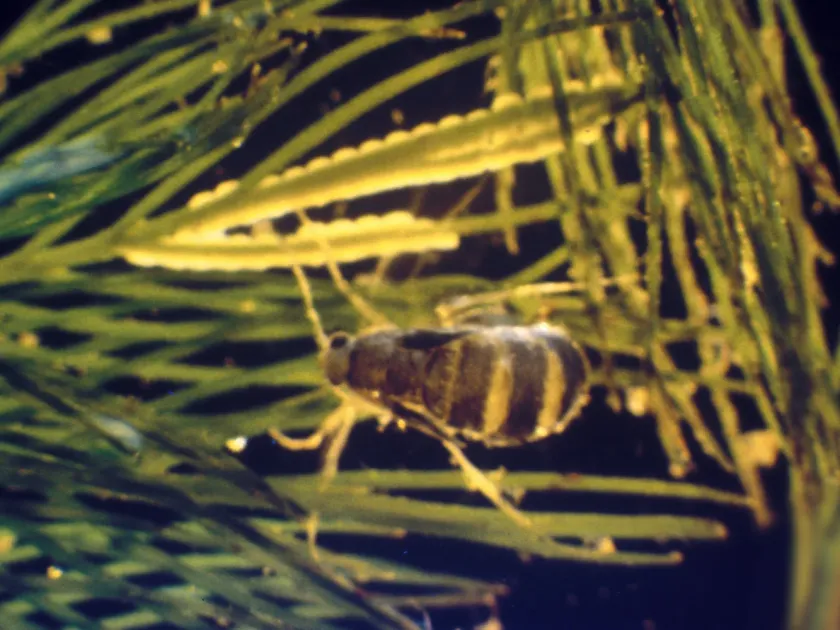
The water veneer (Acentria ephemerella) belongs to the family Crambidae. It is a highly specialized moth with a semi-aquatic lifestyle.
Males of the species are capable of flight, possessing white, glossy wings with a span of approximately 12–15 mm. Females exhibit dimorphism: some have normal wings, while others are flightless and adapted to live entirely underwater.
The larvae are caterpillar-like and develop entirely within the aquatic environment. They lead a cryptic life, making their early detection within a water body quite challenging.
The caterpillar's body is typically transparent or greenish, equipped with specialized mouthparts for consuming submerged aquatic vegetation. Pupation takes place in silk-reinforced cocoons attached to plant stems underwater.
Originally native to Eurasia, this species has been introduced to North America, where it has become an invasive threat to local aquatic plant biodiversity.
What it damages
The primary food source for water veneer larvae is the pondweed (Potamogeton), particularly broad-leaved species. This makes the pest a significant driver of change in aquatic ecosystems.
In addition to pondweed, larvae may consume Elodea, watermilfoil, and other submerged macrophytes. Massive outbreaks of this pest can lead to the complete destruction of underwater plant beds.
Damage is most severe during the summer months when larvae actively graze on leaves, stems, and growing tips. At high population densities, the pest can decimate entire plant colonies.
The water veneer poses a serious risk to ornamental ponds and water bodies housing rare or valuable flora. The resulting loss of vegetation causes habitat degradation and decreases water quality.
While the species can act as a natural regulator of plant biomass, the absence of natural predators in new environments often allows the population to explode, turning it into a destructive pest.
When it appears
The life cycle of the water veneer is strictly regulated by water temperature. Larval development accelerates in the spring as water temperatures begin to rise.
Population peaks are typically observed in mid-summer, coinciding with the rapid development of successive generations. This is when the damage to submerged vegetation becomes most evident.
As autumn approaches, the final generation of larvae prepares for overwintering. They usually hibernate within plant stems or buried in the sediment, demonstrating high tolerance to low temperatures.
Depending on the climatic region, the species may complete one or two generations per season. Warm springs and summers provide the ideal conditions for massive population growth.
Overwintered larvae resume feeding as soon as water temperatures exceed 8–10 degrees Celsius, underscoring the species' high resilience and ability to colonize different water bodies.
Signs of infestation
The first indicator of an infestation is the characteristic "skeletonization" of aquatic leaves. Larvae consume the leaf tissue while leaving the complex network of veins intact.
The presence of protective shelters, woven by larvae using leaf fragments and silk, is a definitive sign of water veneer activity in a pond.
Premature yellowing and die-back of pondweed tips are also clear warning signs. Heavily infested stems often lose structural integrity and snap easily under water.
Close underwater observation may reveal cocoons tightly attached to plant stems. In the evening, the presence of white moths flying low over the water surface confirms a significant local population.
Areas of a pond showing rapid thinning of vegetation without obvious mechanical causes should be inspected closely for the presence of larvae or their protective casings.
Control measures
Mechanical removal of infested plant material is one of the most effective ways to manage populations in smaller ponds, as it helps remove overwintering stages and active larvae.
Biological control involves promoting healthy populations of native fish species that feed on aquatic invertebrates, which can help keep the water veneer population in check.
Chemical control must be approached with extreme caution, as many pesticides are highly toxic to aquatic life and can disrupt the fragile ecological balance of the water body.
Integrated management includes maintaining high biodiversity. Balanced ecosystems with sufficient predator pressure are less likely to experience severe outbreaks of this pest.
Regular monitoring of aquatic flora is essential to detect early infestations and take corrective action before the water veneer causes irreversible damage to the aquatic habitat.
Taxonomy
- Latin name
- Acentria
- Order
- Lepidoptera (butterflies)
- Family
- Crambidae
- EPPO code
- ACENSP
Discussion
No discussions yet — be the first.