
Meadow moth
Achyra interpunctalis
Description
How to identify
The meadow moth (Achyra interpunctalis) is a notorious polyphagous pest belonging to the Crambidae family. It is a lepidopteran insect known for its ability to cause massive damage to agricultural fields due to its high reproductive rate.
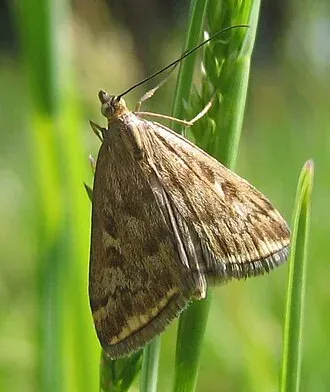
The adult moth has a wingspan of approximately 26 mm. The wings are typically brownish-gray with dark spots and a light margin. They are primarily nocturnal or crepuscular, often attracted to light sources in large numbers during flight peaks.
Larvae develop through five instars, reaching up to 35 mm in length. Their appearance ranges from light green to almost black, featuring a distinct light longitudinal stripe along the back and dark lateral spots.
The species overwinters as mature larvae within dense, silken cocoons buried vertically in the soil. As temperatures rise in spring, pupation occurs, followed by the emergence of the first generation of adults.
The life cycle is highly sensitive to environmental factors like humidity and heat. Under optimal conditions, multiple generations can occur within a single season, leading to sudden outbreaks that are difficult to manage.
What it damages
The meadow moth is an extremely versatile pest, feeding on more than 200 plant species. It exhibits a strong preference for cultivated crops, often moving in mass migrations between fields.
Major host crops highly susceptible to infestation include:
- Sugar beets
- Sunflowers and soybeans
- Maize (corn)
- Legumes and various forage grasses
Young larvae feed on the leaf parenchyma, creating small window-like patches on the foliage. As they grow, their feeding behavior becomes more aggressive, leading to skeletonized leaves where only the primary veins remain.
During severe outbreaks, larvae consume the entire leaf canopy, leaving plants defoliated. This loss of photosynthetic area severely stunts growth, reduces biomass, and can cause total crop failure if infestation occurs early in the season.
The larvae are also known for their collective behavior; they can crawl over long distances to reach new food sources once their current host plant is exhausted, often entering fields in large, visible swarms.
Signs of infestation
The first indication of a meadow moth presence is the appearance of adult moths fluttering near the ground. They are easily disturbed and typically fly short distances when approached by machinery or field workers.
Silken webbing found on the underside of leaves or within growing tips is a characteristic sign. Larvae construct these webs to shield themselves from predators and harsh environmental conditions.
Small dark granular droppings (frass) found on the soil surface or trapped in leaves clearly indicate the presence of feeding larvae. This is a reliable diagnostic feature for scouting operations.
Severe foliage damage, described as skeletonization or complete shredding of the leaves, is a late-stage symptom. At this point, the plants appear withered and show signs of extreme stress.
Pheromone traps are essential for monitoring. Detecting a surge in moth activity through these traps allows farmers to predict larval emergence and intervene before significant crop loss occurs.
Control measures
Deep autumn plowing is the most effective cultural practice to disrupt the life cycle. It exposes the overwintering cocoons to mechanical damage and natural predators, significantly reducing the spring population.
Strict weed management is crucial. Because meadow moths rely on wild host plants for early-season feeding and oviposition, removing weeds around field borders and irrigation ditches limits their population.
Chemical control should be implemented based on economic injury thresholds. Using systemic or contact insecticides is most effective when targeted at early larval stages, as younger caterpillars are far more susceptible to treatments.
Biological control, including the release of egg parasitoids like Trichogramma, can provide sustainable suppression of the pest if coordinated correctly with the moth's egg-laying periods.
Proper scouting and timely intervention are key. Monitoring crop fields twice a week during the flight period enables farmers to spray at the right time, minimizing yield losses while optimizing pesticide application.
Taxonomy
- Latin name
- Achyra interpunctalis
- Order
- Lepidoptera (butterflies)
- Family
- Crambidae
- EPPO code
- AKHYIN
Discussion
No discussions yet — be the first.