
Meadow moth
Achyra
Description
How to identify
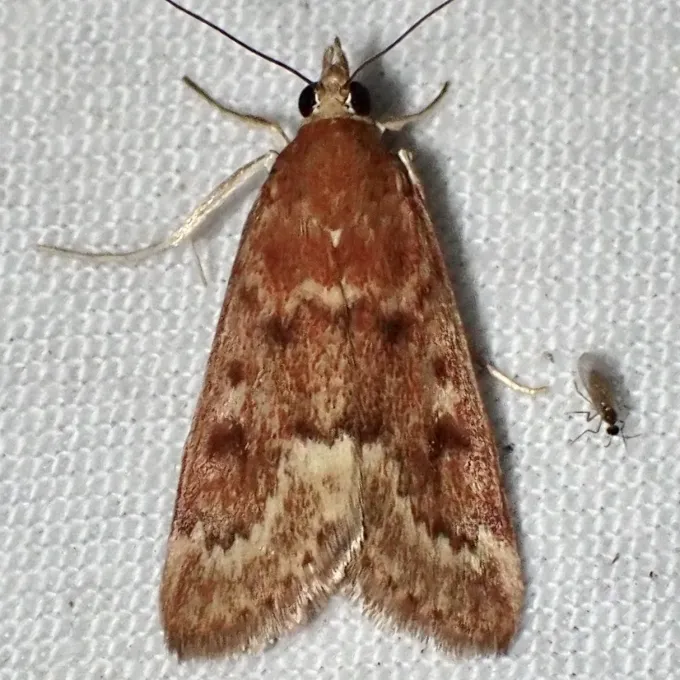
The meadow moth (Loxostege sticticalis, genus Achyra) belongs to the order Lepidoptera, family Crambidae. The adult moth has a wingspan of up to 26 mm, with a coloration ranging from grey-brown to dark brown, featuring distinctive dark stripes and yellow edges.
The larvae of the meadow moth can reach 35 mm in length. Their bodies are covered with fine setae, and the color varies from greenish to nearly black, marked by three light-colored longitudinal stripes along the back and sides.
The pupae develop within dense, tubular silk cocoons positioned vertically in the upper soil layer, which allows them to successfully overwinter in field soils.
The life cycle includes the stages of egg, larva (caterpillar), pupa, and adult. Depending on environmental conditions, the moth can produce between one and four generations per year.
The meadow moth is a migratory species capable of traveling long distances, often appearing in large numbers in regions where favorable host plants and climatic conditions exist.
What it damages
The meadow moth is a serious polyphagous pest that attacks over 30 different plant species. Primary host crops include sugar beets, sunflowers, corn, legumes, buckwheat, and potatoes.
Young larvae feed primarily on the underside of leaves, consuming the epidermis and creating small "windows" or skeletonizing the leaf tissues.
As the larvae mature, they consume the entire leaf blade, leaving only the larger veins. In cases of high population density, they can completely defoliate plants, leaving only stems.
Severe infestations can lead to total crop failure within a few days, representing a significant threat to agricultural productivity in both Europe and North America.
Damage to the apical meristem or total defoliation results in stunted growth, poor yield quality, and often the complete death of the affected plant populations.
When it appears
The emergence of the first generation of adults typically begins in late spring, triggered by rising soil and air temperatures that signal the end of the pupal diapause.
Adult moths are active nectar feeders, requiring food from flowering weeds or crops to reach sexual maturity and successfully begin the egg-laying process.
The developmental speed of the moth is highly dependent on temperature; hot and humid weather significantly accelerates the lifecycle, leading to rapid population growth.
Multiple generations often overlap during the summer, creating a situation where different larval stages coexist on the same field, complicating pest control efforts.
As autumn approaches, the final generation of larvae enters diapause, burrowing into the soil to survive the winter temperatures in a dormant state.
Signs of infestation
The primary indication of a meadow moth presence is the mass flight of adult moths, which can be observed rising in swarms when walking through infested fields.
Finding egg masses on the undersides of leaves or on plant debris is a critical sign that an infestation is beginning and that control measures should be initiated.
The presence of fine webbing on leaves is a hallmark sign of larval activity, as the caterpillars use silk to create protective shelters while feeding on the foliage.
Accumulated larval excrement, appearing as small black or dark-brown pellets on the soil surface under plants, confirms that larvae are actively feeding.
- Irregular holes in leaf blades.
- Skeletonized leaves with visible veins.
- Massive larval presence on stems and leaf stalks.
- Yellowing or premature drying of damaged plant tissues.
Control measures
Agronomic practices, such as deep autumn plowing, are highly effective as they disturb the soil, bringing cocoons to the surface and exposing them to frost or natural predators.
Effective weed management on field margins and within crop areas removes nectar sources for adults, significantly limiting their reproductive success and overall population.
Chemical control should be implemented early, targeting the young larval stages before they mature and cause widespread damage, ensuring better efficacy of applied insecticides.
Biological control, particularly the release of Trichogramma wasps during the peak egg-laying period, serves as an environmentally friendly way to reduce population numbers.
Regular monitoring using pheromone traps is essential for timely decision-making, allowing growers to detect the arrival of the pest and apply treatments precisely when needed.
Taxonomy
- Latin name
- Achyra
- Order
- Lepidoptera (butterflies)
- Family
- Crambidae
- EPPO code
- AKHYSP
Discussion
No discussions yet — be the first.