
Fire blight
Erwinia amylovora
Description
Symptoms
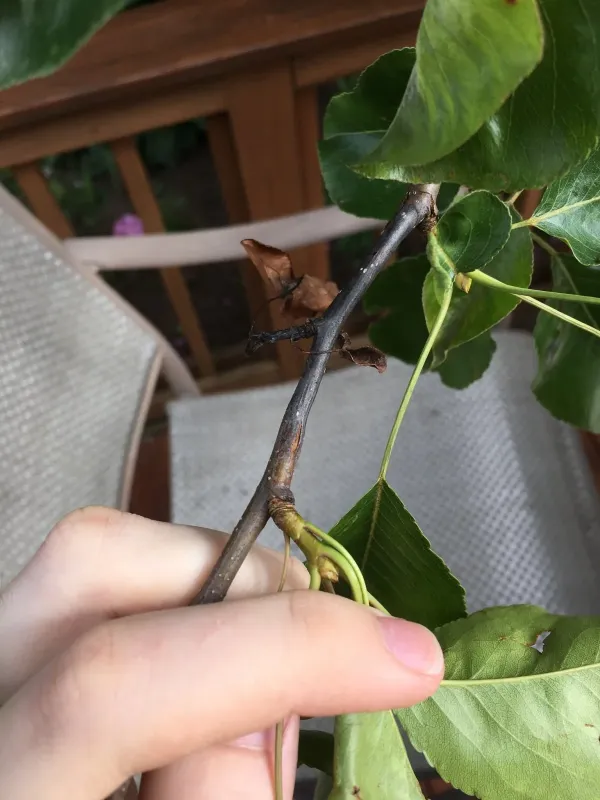
Early symptoms include wilting and necrosis of blossoms, which turn dark brown or black but remain attached to the spur.
Leaves on infected branches appear scorched, as if damaged by fire, which is the primary reason for the common name of the disease.
Young shoots often exhibit a distinctive shepherd's crook, bending downward as the infection progresses down the branch.
Cankers may appear on larger branches and trunks, often resulting in reddish-brown, cracked bark surfaces.
Bacterial ooze is commonly seen on succulent parts of the tree during periods of high humidity, marking the active stage of infection.
Pathogen
The causative agent is the bacterium Erwinia amylovora, which is a significant threat to many members of the Rosaceae family.
This gram-negative pathogen colonizes the vascular tissues, specifically the xylem and phloem, causing rapid tissue necrosis.
The bacterium is known for producing an exopolysaccharide ooze, which is a sticky substance containing high concentrations of the pathogen.
It is classified as a quarantine organism in many countries due to its potential to devastate fruit production within a very short timeframe.
Biological studies show that the bacteria can survive in dormant tree tissues, emerging with the arrival of warmer spring temperatures.
Conditions for development
Warm, moist conditions with temperatures between 18°C and 30°C provide the ideal environment for the multiplication of the bacteria.
Pollinating insects, such as bees, are the primary vectors that facilitate the spread of the pathogen during the blooming period.
High winds and heavy rain events can disperse the bacterial ooze to other susceptible parts of the tree or adjacent trees.
Succulent, rapid vegetative growth triggered by high nitrogen fertilizer applications makes trees more vulnerable to rapid infection.
Wounds caused by hail, pruning, or insect feeding provide easy entry points for the bacteria to infect healthy plant tissues.
Why it matters
Major susceptible crops include the common pear, domestic apple, and red raspberry, among other Rosaceae.
Pears are particularly susceptible to fire blight and can succumb to the infection very quickly, sometimes within a single growing season.
The pathogen causes total loss of fruit, necrosis of blossoms, and can kill entire scaffolds or even the whole tree if not controlled.
Economic losses in commercial orchards are significant, often requiring the removal and destruction of large sections of trees.
The systemic nature of the infection makes it difficult to manage once the bacteria have migrated into the main structural scaffold.
Protection
Management involves aggressive sanitation, including the pruning of infected branches at least 30 cm below the visible symptoms.
Tool disinfection is critical; gardeners must sanitize shears and saws with bleach or isopropyl alcohol between each cut to avoid spread.
Copper-based bactericides can be applied during early spring to reduce the bacterial population on the surface of the tree.
It is vital to manage insect vectors and practice balanced fertilization to avoid the production of excessively succulent tissue.
Routine monitoring of the orchard during the bloom and shoot growth periods is essential for early detection and rapid response.
In brief
3
Affects crops
Biology
Pathogens and affected parts
Pathogens
Content graph
Affects crops · 3
Content graph
Connections · Fire blight
Most often together:
Marketplace
Products · 106
All 106
Oats 31
Pear 20
Apple 12
Fungicides 11
Soybean 7
Walnut 4
Rootstocks 3
Tomato 2
Cabbage 2
Hazelnut 2
Plant Growth Regulators 2
Wild Strawberry, Strawberry 2


Kulon
Три Дельта Компані Інтернешнл, Гонконг, Китай.
Fungicides
0
0
·
986
1 offer
14.37 €per 1 l
Buy


Regalis
БАСФ СЕ., М.Лювігсхфен, Німеччина.
Plant Growth Regulators
0
0
·
59
3 offers
96.42 €per 1 l
Buy


Opora
Приватне підприємство «ПРОМБУДКОМПЛЕКТ», Україна
Plant Growth Regulators
0
0
·
53
3 offers
9.64 €per 1 l
Buy





Copper 2000 w.p.
«Дюпон Інтернешнл Оперейшнз Сарл», Швейцарія
Fungicides
0
0
·
44
6 offers
7.14 €per 1 l
Buy


Community
Discussion
No discussions yet — be the first.