

SKU #46201
·
85 views
Yablunivska
Pear
User rating
0 votes0% positive reviews
No ratings yet — be the first.
Usage Group
Dining
Ripening Period
Winter
Cold Resistance
High (up to -30°C)
Disease Resistance
To the rash, To bacterial burn
Store offers · 4 from 4 stores
Prices are updated on loadLoading offers…
Available at: Agroshop · Biosad · Greendecor · Корець-сад · Летичев-Сад · Олегів сад · Розплідник-Дачник · Саджанці дерев
Aggregator catalog: prices are collected automatically from store websites, normalized by AI and converted at the current exchange rate. Before ordering, confirm the price and availability on the store's website. This block is not indexed by search engines — the data is loaded after the page opens.
About product

The 'Yablunivs'ka' pear — a winter variety developed in Ukrainian breeding through crossing 'Abat Fettel' and 'Decanka du Komis'. The tree is vigorous with a broad, pyramidal, medium-dense crown, compact and suitable for cultivation in various regions. Main scaffold branches diverge from the trunk at an angle of 45–50°. The variety is characterized by relatively high requirements for growing condi…
Usage Group
Dining
Ripening Period
Winter
Cold Resistance
High (up to -30°C)
Disease Resistance
To the rash, To bacterial burn
Description
The 'Yablunivs'ka' pear — a winter variety developed in Ukrainian breeding through crossing 'Abat Fettel' and 'Decanka du Komis'. The tree is vigorous with a broad, pyramidal, medium-dense crown, compact and suitable for cultivation in various regions. Main scaffold branches diverge from the trunk at an angle of 45–50°. The variety is characterized by relatively high requirements for growing conditions, especially heat, but it possesses good winter hardiness. Fruit-bearing begins early: on quince rootstock — at 2–3 years, on seedling — at 4–5 years after planting. Flowering occurs at medium timing, and flower buds form predominantly on 1–4-year-old wood.
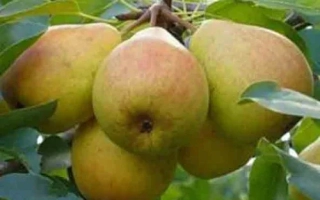
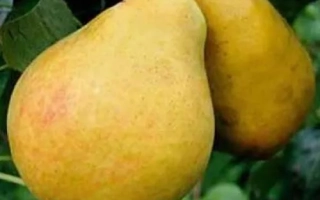
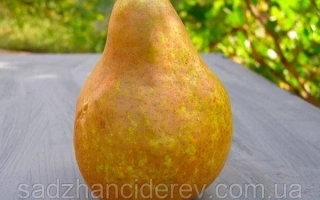
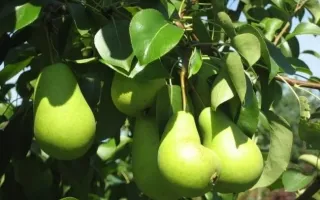
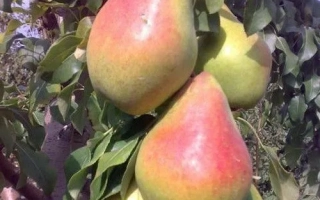
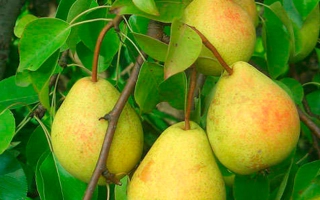
The fruits of the 'Yablunivs'ka' variety have pear-shaped or broad-pear-shaped forms with a weakly expressed neck. Their weight varies from 160 to 195 grams on standard rootstock and reaches 200–250 grams on quince rootstock. The skin is thin but tough, greenish-yellow during harvest maturity, and becomes light-yellow with a faint diffuse orange-red blush and occasionally with delicate rust-colored spots at consumer maturity. Subcutaneous spots are small, light-brown or gray, barely noticeable. The flesh is white or slightly cream-colored, firm, oily, tender, medium-textured, slightly acidic-sweet, without granules, and with high flavor quality.
The variety exhibits high resistance to scab and bacterial leaf blight, which significantly simplifies care and increases yield. Fruits ripen by late September (harvest maturity), while consumer maturity occurs at the end of November — beginning of December. Thanks to good transportability and ability to be stored in refrigeration until March, 'Yablunivs'ka' pears are ideal for winter consumption. Among the advantages of this variety are early fruiting, high yield, attractive appearance, and excellent fruit flavor. Drawbacks include vigorous tree growth and heightened sensitivity of flowers and young fruit set to frost, which may reduce yield.
The fruits of the 'Yablunivs'ka' variety have pear-shaped or broad-pear-shaped forms with a weakly expressed neck. Their weight varies from 160 to 195 grams on standard rootstock and reaches 200–250 grams on quince rootstock. The skin is thin but tough, greenish-yellow during harvest maturity, and becomes light-yellow with a faint diffuse orange-red blush and occasionally with delicate rust-colored spots at consumer maturity. Subcutaneous spots are small, light-brown or gray, barely noticeable. The flesh is white or slightly cream-colored, firm, oily, tender, medium-textured, slightly acidic-sweet, without granules, and with high flavor quality.
The variety exhibits high resistance to scab and bacterial leaf blight, which significantly simplifies care and increases yield. Fruits ripen by late September (harvest maturity), while consumer maturity occurs at the end of November — beginning of December. Thanks to good transportability and ability to be stored in refrigeration until March, 'Yablunivs'ka' pears are ideal for winter consumption. Among the advantages of this variety are early fruiting, high yield, attractive appearance, and excellent fruit flavor. Drawbacks include vigorous tree growth and heightened sensitivity of flowers and young fruit set to frost, which may reduce yield.
Crop & resistance
Crop
Disease resistance
Specifications hover over for a hint about the specification
| Usage Group | |
|---|---|
|
Ripening Period
Ripening Period
It takes 70-100 days until pepper reaches flowering stage, 130-160 days until technical fruit ripeness, and 135-180 days until physiological ripeness. |
Winter |
| Cold Resistance | |
| Disease Resistance | |
| Fetal Size | Large (180–250 g) |
|
Fruit Color
Fruit Color
The fruit color of tomato varieties is influenced by the combination of skin and flesh color. Some varieties have transparent skin, others — yellow. When combined differently, the fruits can acquire quite diverse colors. The fruit color is affected by pigments (lycopene) and thei... |
|
| Flavor | |
| Meat Texture Consistency | |
| Laziness | |
| Transportability | |
| Height and shape of the tree | |
| Assignment | |
| Features | |
| Registration year | 1997 |
| Catalog | Catalog → Pear |
| Legal data |
Show · 1
|
| Country | Ukraine |
Not yet комментариев. Be the first!
Alternatives
Pear saplings · similar varieties





See also
Often considered together with this variety





Recently viewed
Products you’ve viewed on this site
Reviews · 0