
Erwinia amylovora
Erwinia amylovora
Description
How to identify
Erwinia amylovora is a Gram-negative, rod-shaped bacterium that serves as the primary causative agent of fire blight, a destructive disease of pome fruit trees.
Belonging to the Erwiniaceae family, this pathogen is highly specialized in invading the vascular system of host plants, where it multiplies rapidly and produces systemic toxins.
The bacteria thrive in warm, humid conditions and are characterized by the production of a sticky, bacterial ooze that becomes visible on infected plant surfaces under favorable weather.
As a quarantine organism in many regions, Erwinia amylovora poses a significant threat to global apple and pear production, requiring strict surveillance.
Transmission occurs primarily through pollinators, splashing rain, wind, and contaminated pruning tools, making containment extremely challenging once the disease is established.
What it damages
The primary hosts of Erwinia amylovora include members of the Rosaceae family, with pears, apples, quinces, and crabapples being the most susceptible.
The pathogen infects blossoms, shoots, fruits, branches, and the main trunk, leading to rapid tissue death that mimics fire damage, hence the name "fire blight."
Infection results in the blockage of xylem vessels by bacterial biofilms, causing sudden wilting, tissue necrosis, and eventual death of the affected plant parts.
Ornamental plants such as hawthorn, cotoneaster, and pyracantha often act as hidden reservoirs of the pathogen, facilitating its spread to nearby commercial orchards.
Total tree mortality can occur within a single growing season if the infection reaches the rootstock or trunk, leading to massive economic losses for growers.
When it appears
The disease cycle is most active during the spring blossoming period, as bacteria enter the plant primarily through open flowers and natural openings.
Optimal environmental conditions for the development of Erwinia amylovora occur when temperatures are between +18°C and +28°C accompanied by high humidity.
During summer, rapid shoot growth provides succulent tissue that is highly susceptible to secondary infections, especially following heavy rainfall or storms.
In autumn, the pathogen moves into older bark, forming dormant "cankers" where it survives the winter, awaiting the arrival of spring temperatures to restart its life cycle.
Effective management requires focused observation during the blooming phase and early summer, as these are the periods of peak infection risk.
Signs of infestation
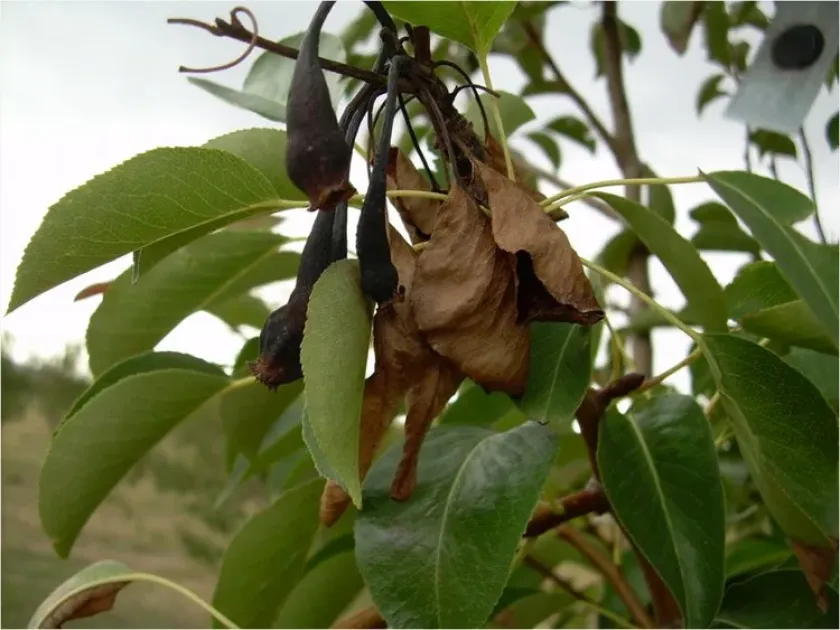
The earliest symptom is the sudden wilting and blackening of flowers, which appear scorched as if they have been burned by fire.
Infected leaves and shoots become necrotic, turn dark brown or black, and curl into a characteristic "shepherd's crook" shape while remaining attached to the tree.
Cankers, which are depressed, discolored areas on the bark, appear on stems and trunks; during humid weather, these spots exude sticky, amber-colored bacterial ooze.
Internal tissue examination of infected branches reveals a distinct reddish-brown discoloration of the cambium layer, a hallmark sign of advanced bacterial colonization.
If the infection progresses to the trunk, it creates large cankers that can girdle the tree, causing systemic collapse and sudden death.
Control measures
Management relies on a rigorous integrated pest management strategy starting with the use of disease-free nursery stock to prevent initial entry into the orchard.
Sanitation is critical; pruning of infected branches must be performed during dry weather, cutting at least 30–50 cm below the visible necrosis, with tools disinfected constantly.
- Application of copper-based sprays during dormancy and blossom stages to reduce bacterial populations.
- Strict control of insect vectors like aphids and leafhoppers that facilitate the spread of the bacteria.
- Removal and destruction of heavily infected trees to eliminate the source of inoculum.
- Implementation of biological control agents where appropriate to compete with the pathogen.
- Selection of resistant or less susceptible cultivars and rootstocks to mitigate the impact of the disease.
Regular monitoring and quick action are the most effective ways to manage the disease, as severe infections are nearly impossible to cure with chemical treatments alone.
Causes diseases · 1
Discussion
No discussions yet — be the first.