

Reference · Crops
Blackberry
Rubus L.
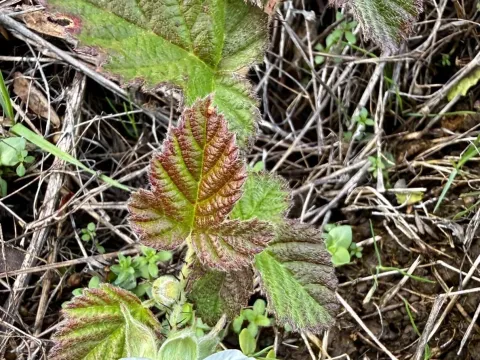
Blackberries (Rubus L.) are perennial plants belonging to the Rosaceae family. They are known for their biennial canes, which grow vegetatively during the first year and produce fruit in the second year before dying back.
31
items
What the section contains
 Raspberry
Rubus idaeus L.
57 products
Raspberry
Rubus idaeus L.
57 products
 Arctic raspberry
Rubus arcticus L. subsp. arcticus
1 product
Arctic raspberry
Rubus arcticus L. subsp. arcticus
1 product
 Allegheny blackberry
Rubus allegheniensis Porter
American red raspberry
Rubus idaeus L. subsp. strigosus (Michx.) Focke
Arctic raspberry
Rubus arcticus L.
Arctic raspberry
Rubus arcticus L. nothosubsp. stellarcticus G. Larss.
Allegheny blackberry
Rubus allegheniensis Porter
American red raspberry
Rubus idaeus L. subsp. strigosus (Michx.) Focke
Arctic raspberry
Rubus arcticus L.
Arctic raspberry
Rubus arcticus L. nothosubsp. stellarcticus G. Larss.
 Balloon berry
Rubus illecebrosus Focke
Balloon berry
Rubus illecebrosus Focke
 Black raspberry
Rubus occidentalis L.
Black raspberry
Rubus occidentalis L.
 Blackberry
Rubus L. subg. Rubus
Blackberry
Rubus L. subg. Rubus
 Cloudberry
Rubus chamaemorus L.
Cloudberry
Rubus chamaemorus L.
 Cutleaf blackberry
Rubus laciniatus Willd.
Cutleaf blackberry
Rubus laciniatus Willd.
 European dewberry
Rubus caesius L.
European dewberry
Rubus caesius L.
 Ghost bramble
Rubus cockburnianus Hemsl.
Ghost bramble
Rubus cockburnianus Hemsl.
 Grabowski's blackberry
Rubus grabowskii Weihe ex Günther et al.
Grabowski's blackberry
Rubus grabowskii Weihe ex Günther et al.
 Hawthorn-leaf raspberry
Rubus crataegifolius Bunge
Hongno Raspberry
Rubus minusculus H. Lév. & Vaniot var. hongnoensis (Nakai) Naruh.
Hawthorn-leaf raspberry
Rubus crataegifolius Bunge
Hongno Raspberry
Rubus minusculus H. Lév. & Vaniot var. hongnoensis (Nakai) Naruh.
 Japanese raspberry
Rubus parvifolius L.
Japanese raspberry
Rubus parvifolius L.
 Loganberry
Rubus loganobaccus L. H. Bailey
Loganberry
Rubus ursinus Cham. & Schltdl.
Purple raspberry
Rubus x neglectus Peck
Raspberry
Rubus idaeus L. x Rubus subg. Eubatus Focke
Red raspberry
Rubus idaeus x R. neglectus
Red raspberry
Rubus idaeus x Rubus parvifolius
Loganberry
Rubus loganobaccus L. H. Bailey
Loganberry
Rubus ursinus Cham. & Schltdl.
Purple raspberry
Rubus x neglectus Peck
Raspberry
Rubus idaeus L. x Rubus subg. Eubatus Focke
Red raspberry
Rubus idaeus x R. neglectus
Red raspberry
Rubus idaeus x Rubus parvifolius
 Roseleaf bramble
Rubus rosifolius Sm.
Roseleaf bramble
Rubus rosifolius Sm.
 Rubus coreanus
 Miq.
Rubus coreanus
Rubus coreanus Miq.
 Rubus minusculus
 H. Lév. & Vaniot
Rubus minusculus
Rubus minusculus H. Lév. & Vaniot
 Rubus pentalobus
 Hayata
Rubus pentalobus
Rubus pentalobus Hayata
 Rubus tricolor
 Focke
Rubus tricolor
Rubus tricolor Focke
 Rubus trifidus
 Thunb.
Starry arctic raspberry
Rubus arcticus L. subsp. stellatus (Sm.) B. Boivin
Rubus trifidus
Rubus trifidus Thunb.
Starry arctic raspberry
Rubus arcticus L. subsp. stellatus (Sm.) B. Boivin
 Wine Raspberry
Rubus phoenicolasius Maxim.
Wine Raspberry
Rubus phoenicolasius Maxim.
Marketplace
Products in this section · 12


Blackberry
These plants thrive in well-drained, fertile soil with a slightly acidic pH level between 5.5 and 6.5. They prefer full sun exposure, although some varieties can tolerate partial shade in hotter climates.
Water management is critical for blackberry cultivation. Consistent irrigation during the fruit set and development stages is necessary to ensure berry size and quality, though standing water must be avoided to prevent root rot.
Trellising is a standard horticultural practice for blackberries. By training the canes onto wire supports, growers improve air circulation and sunlight penetration, which are essential for vigorous growth and disease prevention.
In colder regions, selecting cold-hardy cultivars is essential. Many growers employ winter protection strategies, such as insulating canes with straw or protective fabric, to prevent damage from frost and low temperatures.
Productive commercial blackberry orchards can yield significant quantities of fruit, often exceeding 10–15 tons per hectare depending on the variety and management system. Optimal nutrition and moisture management are key factors in maximizing yield.
Blackberries hold high economic value in the food sector. Beyond the fresh market, they are highly sought after by processors for jams, yogurts, juices, and health-focused supplements due to their dense nutrient profile.
The crop is susceptible to several pathogens, including Botrytis fruit rot and orange rust. Effective management involves maintaining canopy hygiene, removing infected plant parts, and applying appropriate fungicidal sprays when necessary.
Insects like the spotted wing drosophila (SWD) and leafrollers pose significant threats to commercial production. Integrated Pest Management (IPM) programs, involving sticky traps and biological controls, are recommended to minimize chemical reliance.
Harvesting should be performed manually to ensure the delicate berries are not bruised. Once picked, blackberries have a short shelf life and must be stored in a cool environment immediately to maintain freshness and minimize post-harvest decay.