


Prices in stores
from6.85 €per 1 l
pack from 7.13 € per 1 l
7 offers from 7 stores
Last Treatment Interval, Days
1
By type of action
Systemic herbicide
By Mode of Action
Non-selective herbicide
By Application Timing
Post-emergence herbicide
Your mark
1 vote
0% positive ratings
Store offers · 7 from 7 stores
7 offers in 7 stores — from 6.85 € per 1 l.
Available at: Агроексперт-Трейд · agromaxgrains-ro · Agroopt · Агро Пионер · ePole · Grano · Sredstva
Prices are collected automatically from store websites and converted at the current exchange rate. Check the price and availability on the store website before ordering.
Description
Highly technological concentrated systemic herbicide with broad spectrum of action for controlling annual and perennial broadleaf and grassy weeds in fallow land and prior to crop sowing.
Base unit
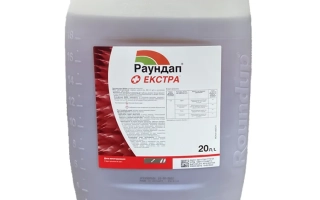
20 L.
Active ingredient: Glyphosate
Chemical group: Phosphoric acid derivatives
Formulation: Aqueous solution containing 540 g/L glyphosate
Packaging: 1 x 20 L
Storage period: at least 5 years
Hazard class: 3
ADVANTAGES
Quick penetration into plants and manifestation of symptoms of their death
Longest duration of weed control
Flexible application rates and possibility of use in tank mixes with other herbicides
Most reliable control of persistent perennial weeds
Best efficacy under a wide range of weather conditions and stress conditions
Reliable performance under a wide variety of climatic and soil conditions, high rainfastness
High concentration reduces packaging and transportation costs.
INTENDED USE
Highly technological concentrated systemic herbicide with broad spectrum of action for controlling annual and perennial broadleaf and grassy weeds in fallow land and prior to crop sowing. Possesses high systemic properties. Universally applicable in crop rotations with any rotation period; the product has no soil residual effect.
Mechanism of action
Roundup Extra® is a systemic herbicide with broad spectrum of action. The herbicide penetrates through leaves and other green plant parts, redistributes throughout the entire plant, including the root system. Glyphosate blocks the synthesis of essential aromatic amino acids in all plant organs (leaves, rhizomes, tubers, bulbs, ...), leading to the death of the entire plant.
Duration of protective effect
Perennial weeds — throughout the entire vegetation period; annuals — for 20 to 60 days and more (until the reappearance of seeds).
Speed of action
Roundup Extra® quickly penetrates plant leaves. Depending on weather conditions, weed species composition, and stage of their development at the time of spraying, visible herbicidal effect appears on annuals within 2–4 days, on perennials — 7–15 days. Complete weed death occurs 30 days and more after treatment.
In hot and dry conditions, weeds slow down their metabolic activity to reduce evaporation, thereby reducing their ability to absorb and translocate herbicide within the plant. The new special blend of surfactants in Roundup Extra® enhances glyphosate uptake through leaves even in harsh summer conditions for difficult-to-kill weeds.
Phytotoxicity
Herbicide with broad spectrum of action (no glyphosate-resistant crops, except transgenic ones).
Potential for resistance development
No cases of resistant weed biotypes were observed in experiments upon long-term use of the product. However, to prevent their emergence, it is recommended to alternate the use of herbicides from different chemical groups with different modes of action in crop rotations.
Compatibility with other pesticides
The product is compatible in tank mixes with salts and esters of 2,4-D, MCPA, dicamba, and other herbicides. Compatibility should be checked before application.
Recommendations for protecting flora and fauna
Hazard class for bees — 3 (low hazard). Practically non-toxic to birds, fish, earthworms, and soil microorganisms. Application is permitted within the water protection zone of fishery water bodies.
When applying, observe the following ecological regulations: spray plants when wind speed is no more than 4–5 m/s; bee protection buffer zone — at least 2–3 km; bee flight restriction — more than 3–24 hours.
Application recommendations
Herbicide is recommended for application to actively growing weeds with well-developed leaf surface, height of 10–15 cm.
No restrictions for crops in crop rotations after using the product; any crop can be sown 7 days after treatment.
The interval between treatment and possible rainfall should be at least 2 hours.
Roundup Extra® works effectively over a wide range of positive temperatures — efficacy decreases when applied during frost periods.
When daytime temperatures are high, spraying should be conducted in early morning or evening hours. In severe drought conditions, spraying is recommended with addition of salts or esters of 2,4-D or external adhesives.
Apply using standard boom sprayers. Working solution application rate for ground sprayers — 80–150 L/ha, for hand-held sprayers in small farms — 58 L/100 m2.
Thoroughly rinse spraying equipment after use.
Storage
Store in dry room designated for pesticide storage at temperatures from -15°C to +30°C.
Composition
Active ingredients
- Glyphosate potassium salt гербицид Глифосат
- Organic Matter гербицид
Application
Used on crops
Specifications
| Last Treatment Interval, Days | 1 |
|---|---|
| By type of action | |
| By Mode of Action | |
| By Application Timing | |
| By application method | |
| Form of the preparation | |
| Application rate | More than 3.0 L/ha, From 2.0 - 3.0 L/ha |
| Desiccant | |
| Danger Class | 3 |
| Catalog | Catalog → Herbicides, Desiccants |
| Manufacturer | MONSANTO |
| Country | USA |
No reviews yet. Be the first to share your experience.
Alternatives
Herbicides, Desiccants · similar preparations




See also
Often considered together with this product






Recently viewed
Products you’ve viewed on this site
Reviews