
Blackbrush
Coleogyne
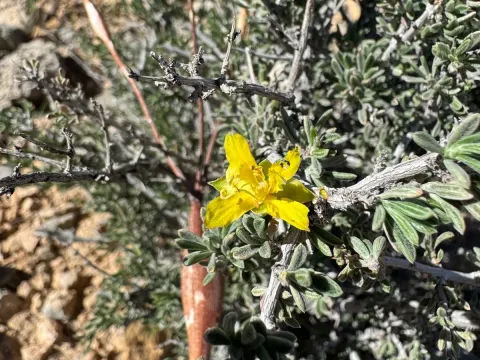
Blackbrush (Coleogyne ramosissima) is the sole species in its genus, belonging to the Rose family (Rosaceae). It is a densely branched, evergreen shrub that is remarkably well-adapted to the harsh conditions of the North American arid zones.
What the section contains

Blackbrush
The plant is native to the southwestern United States, primarily inhabiting the Mojave Desert, the Colorado Plateau, and the Great Basin. It often forms vast, monotypic stands on rocky slopes and high-desert alluvial fans.
In terms of soil requirements, Blackbrush thrives in alkaline, rocky, or gravelly soils with excellent drainage. It is highly intolerant of waterlogged conditions, which can lead to rapid root decay and plant death.
The shrub exhibits extreme drought tolerance, surviving in regions where annual precipitation is very limited. Its growth pattern is slow, reflecting its conservation of energy in nutrient-poor desert soils with long-term water stress.
Economically, this species is essential for watershed management and preventing wind erosion in desert regions. It also serves as a vital forage source for desert bighorn sheep and other wildlife during the dormant winter months.
The most significant threat to Blackbrush communities is the increase in fire frequency. Unlike grasses, this shrub does not resprout effectively after fire, leading to permanent loss of cover and conversion of the landscape into invasive annual grasslands.
Additional threats include potential pathogen attacks, such as root rot fungi if irrigation is mismanaged in landscape settings. Furthermore, overgrazing in restricted areas can hinder the recruitment of new seedlings, impacting long-term population stability.