
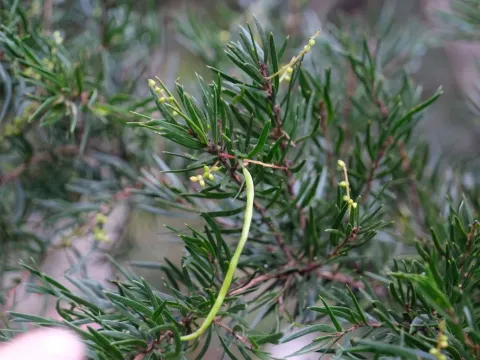
Rice's Wattle
Acacia riceana
Acacia riceana, commonly known as Rice's Wattle, is an elegant evergreen shrub belonging to the Fabaceae family. It is native to the southwestern regions of Australia, where it is highly prized for its unique pendulous growth habit.
What the section contains
Rice's Wattle
The plant features long, drooping branches covered in narrow, needle-like phyllodes. Its botanical structure is adapted to the harsh conditions of its native habitat, allowing it to withstand periods of limited water availability.
To cultivate this species successfully, it is essential to provide well-draining, sandy-loam soils. It does not tolerate heavy or waterlogged soil, which can rapidly lead to the decline of the root system and plant death.
The plant thrives in full sun exposure, which encourages denser foliage and a more prolific blooming cycle in early spring. Protection from freezing temperatures is vital, as the species is sensitive to prolonged frost events.
In landscaping, it is used as an ornamental centerpiece. Its weeping habit makes it ideal for cascading over walls or being planted in open garden spaces where its yellow, rod-like flower spikes can be displayed.
The main pests affecting Acacia riceana include scale insects and spider mites, particularly in environments where humidity is low and airflow is stagnant.
Fungal issues, such as root rot caused by Phytophthora species, are the most significant threat to the plant, usually resulting from excessive irrigation or inadequate soil drainage.
Sooty mold may develop on the foliage as a secondary consequence of infestations by sap-sucking insects, which excrete honeydew that fosters fungal growth.
Regular maintenance practices, including the removal of dead or crossing branches, improve the plant's structural integrity and help to maintain adequate ventilation.
Integrated pest management strategies should focus on early detection through frequent monitoring, avoiding the unnecessary use of harsh chemicals near the plant's sensitive roots.