
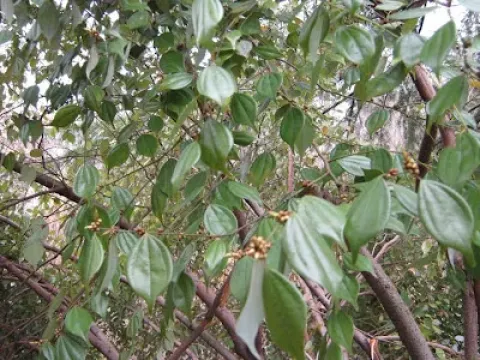
Lindera latifolia
Lindera latifolia
Seeds of Lindera latifolia should be sown in autumn immediately after harvesting to maintain their viability and germination potential.
What the section contains
Lindera latifolia
Stratification in a cool, moist environment for several months is crucial to breaking seed dormancy and ensuring uniform emergence.
Vegetative propagation via hardwood cuttings in late summer is an effective method for maintaining the characteristics of the parent plant.
The seeds should be planted in a light, well-draining substrate at a depth of approximately 1 to 2 centimeters for optimal results.
Consistent moisture levels must be maintained throughout the germination period to ensure the young seedlings become successfully established.
As a member of the Lauraceae family, Lindera latifolia thrives in partial shade and requires protection from harsh direct sunlight.
Deep, fertile, and well-draining loam soils are the most suitable for promoting healthy root development and overall plant vigor.
The plant has moderate water requirements and benefits from regular irrigation during dry spells to prevent drought-induced stress.
An environment with stable temperatures between 18 and 25 degrees Celsius is ideal for supporting active growth during the season.
It is important to provide shelter from strong winds, as this helps to protect the foliage and maintain humidity around the plant.
The primary value of this culture lies in its leaves and young shoots, which are harvested for their rich essential oil content.
Yield depends heavily on plant maturity and the application of organic amendments to support continuous biomass production.
Proper spacing is essential to ensure adequate airflow, which in turn optimizes the plant's metabolic processes and yield potential.
Harvesting should be done using a selective approach, which encourages the plant to generate new, high-quality growth periodically.
Production cycles can be maximized by ensuring the soil remains nutrient-rich throughout the entire life cycle of the crop.
Root rot caused by excessive soil moisture and poor drainage is the most significant threat to the health of the plant.
Fungal leaf spots can occur in crowded plantations, making proper spacing and ventilation key preventative measures for growers.
Spider mites and scale insects are the most common pests that can negatively impact the plant's aesthetic and chemical quality.
Integrated pest management, including the use of biological control agents, is recommended to keep pest populations at bay.
Sanitation practices, such as removing fallen debris, are essential to prevent the overwintering of pathogens near the plants.
Harvesting for essential oil production is typically carried out during the peak flowering stage for maximum chemical efficacy.
Using sharp, sanitized tools is necessary to harvest leaves without causing undue stress or physical damage to the plant limbs.
The harvested material must be dried promptly in a shaded, well-ventilated area to prevent degradation of volatile compounds.
Once dried, the leaves should be stored in airtight, light-protected containers to preserve their aroma and essential oil profile.
Careful handling during transport is vital to prevent leaf bruising, which can lead to quality loss before the final processing.