

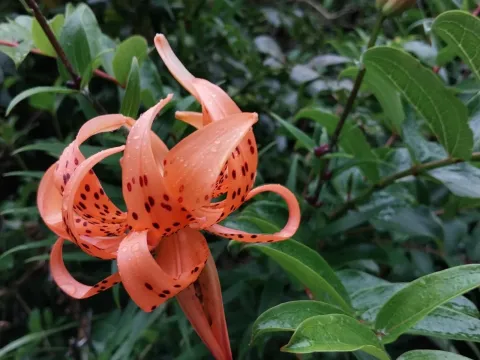
Reference · Crops
Lily
Lilium L.
Planting lilies (Lilium L.), members of the Liliaceae family, is typically performed in early autumn. This timing allows the bulbs to establish a healthy root system while the soil remains warm enough, ensuring strong growth in the following spring.
12
items
What the section contains
 David's lily
Lilium davidii Duch.
David's lily
Lilium davidii Duch.
 Goldband lily
Lilium auratum Lindl.
Goldband lily
Lilium auratum Lindl.
 Hanson's lily
Lilium hansonii Leichtlin ex D. D. T. Moore
Hanson's lily
Lilium hansonii Leichtlin ex D. D. T. Moore
 Lilium pomponium
 L.
Lilium pomponium
Lilium pomponium L.
 Lilium x dalhansonii
 C. B. Powell
Lilium x dalhansonii
Lilium x dalhansonii C. B. Powell
 Longflower lily
Lilium longiflorum Thunb.
Longflower lily
Lilium longiflorum Thunb.
 Madonna lily
Lilium candidum L.
Madonna lily
Lilium candidum L.
 Regal lily
Lilium regale E. H. Wilson
Regal lily
Lilium regale E. H. Wilson
 Showy lily
Lilium speciosum Thunb.
Showy lily
Lilium speciosum Thunb.
 Spotted lily
Lilium maculatum Thunb.
Spotted lily
Lilium maculatum Thunb.
 Taiwan lily
Lilium formosanum Wallace
Tiger lily
Lilium lancifolium Thunb.
Taiwan lily
Lilium formosanum Wallace
Tiger lily
Lilium lancifolium Thunb.
Marketplace
Products in this section · 12


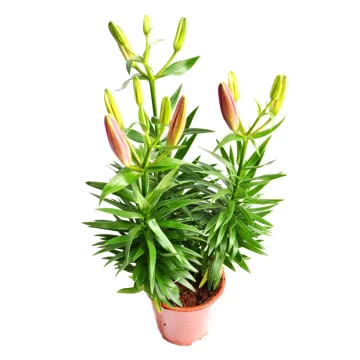


Lily
Spring planting is a recommended alternative for sensitive oriental hybrids, which may struggle with harsh winters. It is crucial to plant these as soon as the ground can be worked to provide sufficient time for root development before the heat of summer.
The planting depth should be approximately three times the diameter of the bulb. Proper depth ensures that stem-rooting lilies have enough space to develop their adventitious roots, which are essential for nutrient uptake.
Commercial multiplication is predominantly vegetative, utilizing bulb scales, bulblets, or offsets. This method ensures genetic consistency and preserves the specific characteristics of the chosen cultivar.
Preparation of the growing site should occur weeks in advance. The soil must be deeply tilled and amended with organic matter; however, growers should strictly avoid fresh manure to prevent bulb rot and fungal pathogens.
Lilies thrive in locations that receive ample sunlight, although many varieties benefit from light shade at their base. Keeping the lower stems cool is essential for maintaining consistent soil moisture levels during the peak growing season.
A well-draining, fertile soil is paramount for lily production. The culture is highly sensitive to waterlogging, which often leads to the death of the bulb base and roots; thus, proper drainage is non-negotiable.
The optimal pH range for most lily species is between 6.0 and 6.5. Deviations from this range can affect nutrient availability, particularly iron and magnesium, leading to chlorosis and stunted development.
Regular irrigation is vital during the budding and flowering phases. Water should be applied at the base of the plant to avoid wetting the foliage, as moisture on leaves significantly increases the risk of fungal infections.
Fertilization programs generally involve a nitrogen-heavy feed in the early spring, followed by balanced fertilizers during growth, and finally, potassium-rich applications after flowering to build bulb reserves.
The scarlet lily beetle is the most prominent pest, causing severe defoliation. Regular monitoring and the application of integrated pest management strategies are necessary to prevent population outbreaks.
Fungal diseases, including Botrytis blight (grey mold) and Fusarium wilt, represent the greatest threats to lily health. These diseases are exacerbated by high humidity and poor air circulation in the fields.
Viral infections are a serious concern in lily cultivation. Symptoms such as color-breaking in flowers or mottled leaves signify irreversible systemic infection, requiring the immediate rogueing of affected plants.
Proactive disease management includes using high-quality, virus-free planting stock and treating bulbs with fungicides prior to planting to inhibit soil-borne pathogens.
Crop rotation remains a fundamental practice; growers should avoid planting lilies in the same field for at least three to four years to break the lifecycle of specific soil-borne pests and diseases.
For the cut flower industry, harvest timing is critical. Stems should be cut when the lower buds on the inflorescence are fully colored but have not yet opened, ensuring a longer vase life for the consumer.
When harvesting, growers must leave at least two-thirds of the foliage on the stem. This foliage is essential for the bulb to perform photosynthesis and store energy for the next growing cycle.
Harvesting the bulbs for sale takes place after the foliage has naturally senesced and turned brown, which indicates that the bulb has reached its maximum nutrient capacity and maturity.
Post-harvest handling requires careful cleaning and sorting by bulb size. Bulbs must be stored in cool, well-ventilated conditions with high humidity or packing material to prevent desiccation.
Storage temperatures should be kept near 0–5°C to suppress respiration rates and prevent premature sprouting, ensuring the planting material remains in high-quality condition until the next season.