
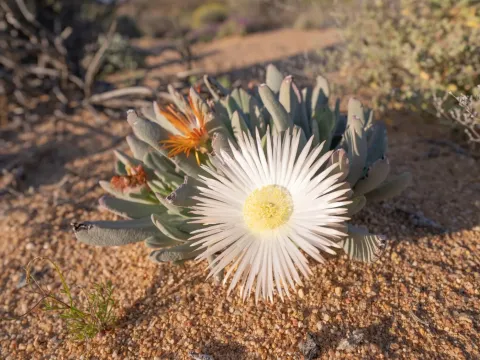
Cheiridopsis
Cheiridopsis
Cheiridopsis is a genus of succulent plants within the Aizoaceae family. These plants are native to the arid regions of Southern Africa and Namibia, where they have evolved to withstand prolonged periods of drought.
What the section contains
 Cheiridopsis acuminata
Cheiridopsis acuminata
Cheiridopsis acuminata
 Cheiridopsis brownii
Cheiridopsis brownii
Cheiridopsis brownii
 Cheiridopsis caroli-schmidtii
Cheiridopsis caroli-schmidtii
Cheiridopsis caroli-schmidtii
 Cheiridopsis denticulata
Cheiridopsis denticulata
Cheiridopsis denticulata
 Cheiridopsis derenbergiana
Cheiridopsis derenbergiana
Cheiridopsis derenbergiana
 Cheiridopsis gamoepensis
Cheiridopsis gamoepensis
Cheiridopsis gamoepensis
 Cheiridopsis pillansii
Cheiridopsis pillansii
Cheiridopsis pillansii
 Cheiridopsis pilosula
Cheiridopsis pilosula
Cheiridopsis pilosula
 Cheiridopsis purpurea
Cheiridopsis purpurea
Cheiridopsis purpurea
 Cheiridopsis rostrata
Cheiridopsis rudis
Cheiridopsis rudis
Cheiridopsis rostrata
Cheiridopsis rostrata
Cheiridopsis rudis
Cheiridopsis rudis
 Cheiridopsis vanbredae
Cheiridopsis vanbredae
Cheiridopsis vanbredae
Cheiridopsis
The plant is known for its distinctive paired leaves, which are often fused at the base. During its growth cycle, the plant produces new leaves from the center of the old ones, which eventually desiccate and form a protective sheath around the new growth.
Cultivation requirements are strict regarding light exposure; the plants thrive in full sun and require high light intensity to maintain their compact shape and natural color. Without sufficient light, they tend to become etiolated and weakened.
The substrate must be highly inorganic and free-draining. A typical mix includes coarse sand, perlite, and a small amount of sandy loam. The goal is to provide a medium that mimics the rocky, nutrient-poor soils of their natural habitat.
Watering requires careful management. During the active growing season, water sparingly, allowing the soil to dry out completely between applications. During the winter dormancy phase, water should be almost entirely withheld to prevent rotting.
The most significant threat to Cheiridopsis is overwatering, particularly during the dormant season, which rapidly leads to root rot and total loss of the specimen.
Mealybugs are the most common pests, often sheltering deep within the crevices between the fleshy leaves. Their presence can be identified by the white, waxy substance they leave behind on the plant surface.
Spider mites may become a problem in environments with poor ventilation and low humidity. Regular inspection and maintaining good air circulation are the best methods for prevention.
Fungal infections can occur if water remains trapped in the leaf axils or if the environment is too humid without sufficient airflow. Careful watering techniques are essential for plant health.
Root nematodes can compromise the plant's health significantly. If an infestation is detected, it is often best to propagate healthy cuttings and dispose of the infected root system, as the damage is usually irreversible.