
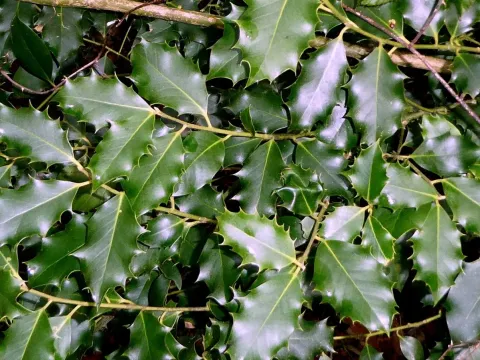
Holly
Ilex L.
Holly is typically propagated through vegetative cuttings, as seeds have a complex dormancy period and can take up to two years to germinate successfully.
What the section contains
 Altaclerensis holly
Ilex x altaclerensis (Loudon) Dallim.
Altaclerensis holly
Ilex x altaclerensis (Loudon) Dallim.
 American holly
Ilex opaca Aiton
American holly
Ilex opaca Aiton
 Broadleaf holly
Ilex latifolia Thunb.
Broadleaf holly
Ilex latifolia Thunb.
 Cape holly
Ilex mitis (L.) Radlk.
Cape holly
Ilex mitis (L.) Radlk.
 Central Chinese holly
Ilex centrochinensis S. Y. Hu
Central Chinese holly
Ilex centrochinensis S. Y. Hu
 Central Chinese hybrid holly
Ilex centrochinensis x ilex aquifolium
Central Chinese hybrid holly
Ilex centrochinensis x ilex aquifolium
 Chinese holly
Ilex cornuta Lindl. & Paxton
Chinese holly
Ilex cornuta Lindl. & Paxton
 Common holly
Ilex aquifolium L.
Common holly
Ilex aquifolium L.
 Hybrids of Ilex crenata, Ilex x aquipernyi and Ilex rugosa
Hybrids between Ilex crenata, Ilex x aquipernyi and Ilex rugosa
Hybrids of Ilex crenata, Ilex x aquipernyi and Ilex rugosa
Hybrids between Ilex crenata, Ilex x aquipernyi and Ilex rugosa
 Ilex aquipernyi
Ilex x aquipernyi Gable ex Whittem.
Ilex aquipernyi
Ilex x aquipernyi Gable ex Whittem.
 Ilex dimorphophylla
 Koidz.
Ilex dimorphophylla
Ilex dimorphophylla Koidz.
 Ilex dumosa
 Reissek
Ilex dumosa
Ilex dumosa Reissek
 Ilex dumosa
 Reissek var. dumosa
Ilex dumosa
Ilex dumosa Reissek var. dumosa
 Ilex integra
 Thunb.
Ilex integra
Ilex integra Thunb.
 Ilex maximowicziana var. kanehirae
Ilex maximowicziana Loes. var. kanehirae (Yamam.) T. Yamaz.
Ilex maximowicziana var. kanehirae
Ilex maximowicziana Loes. var. kanehirae (Yamam.) T. Yamaz.
 Ilex owariensis
Ilex x owariensis Hatus. & M. Kobay.
Ilex x attenuata Topel
Ilex x attenuata Ashe
Ilex owariensis
Ilex x owariensis Hatus. & M. Kobay.
Ilex x attenuata Topel
Ilex x attenuata Ashe
 Inkberry
Ilex glabra (L.) A. Gray
Inkberry
Ilex glabra (L.) A. Gray
 Japanese holly
Ilex crenata x Ilex maximowicziana var. kanehirae
Japanese holly
Ilex crenata Thunb.
Koehne holly
Ilex x koehneana Loes.
Japanese holly
Ilex crenata x Ilex maximowicziana var. kanehirae
Japanese holly
Ilex crenata Thunb.
Koehne holly
Ilex x koehneana Loes.
 Long-stalk holly
Ilex pedunculosa Miq.
Long-stalk holly
Ilex pedunculosa Miq.
 Meserve holly
Ilex x meserveae S. Y. Hu
Meserve holly
Ilex x meserveae S. Y. Hu
 Perny holly
Ilex pernyi Franch.
Perny holly
Ilex pernyi Franch.
 Round holly
Ilex rotunda Thunb.
Round holly
Ilex rotunda Thunb.
 Rugose holly
Ilex rugosa F. Schmidt
Rugose holly
Ilex rugosa F. Schmidt
 Winterberry
Ilex verticillata (L.) A. Gray
Winterberry
Ilex verticillata (L.) A. Gray
 Yaupon holly
Ilex vomitoria Sol. ex Aiton
Yaupon holly
Ilex vomitoria Sol. ex Aiton
 Yerba mate
Ilex paraguariensis A. St.-Hil.
Yerba mate
Ilex paraguariensis A. St.-Hil.
Holly
The optimal time for taking semi-hardwood cuttings is in late summer, which allows the root system to develop adequately before the onset of the winter dormancy period.
For those using seeds, stratification in cold temperatures for several months is essential to overcome natural germination inhibitors found within the seed coat.
Transplanting seedlings to their permanent location is best performed in the spring to ensure the plant can establish itself before experiencing extreme temperature fluctuations.
When planning a cultivation site, providing protection from harsh winter winds is crucial, as young plants are particularly susceptible to leaf desiccation during dormant months.
The genus Ilex, belonging to the Aquifoliaceae family, thrives best in climates with high humidity, moderate temperatures, and well-distributed rainfall throughout the growing season.
Soil requirements include fertile, loamy, and well-drained substrates, with a preference for slightly acidic to neutral pH levels to ensure optimal nutrient uptake.
While known for being shade-tolerant, holly produces denser foliage and more abundant fruit when exposed to sufficient sunlight, provided it is protected from scorching midday heat.
Good agricultural practices necessitate consistent irrigation, especially during the establishment phase and periods of drought, as the root system remains relatively shallow.
Annual fertilization with balanced nutrients in early spring supports vigorous shoot growth and helps the plant maintain a robust immune system against environmental stress.
Holly has diverse economic applications, including its extensive use in landscaping, the florist industry for decorative berries, and the production of specific caffeinated beverages like mate.
In ornamental production, the yield is measured by the density and uniformity of the canopy, which is enhanced through regular pruning and professional topiary management.
For species harvested for leaves, production metrics focus on the biomass yield of foliage per hectare, collected during peak growth periods to ensure high quality and potency.
Fruit yield is highly dependent on having both male and female plants present, as cross-pollination is necessary for the development of the iconic bright red berries.
Proper plant spacing is vital to maximize yield efficiency, ensuring that each individual plant has sufficient access to light and nutrients while maintaining easy access for harvesting.
Root rot caused by overwatering or poor drainage is a common threat to holly, emphasizing the need for well-structured soil and careful monitoring of irrigation schedules.
Scale insects and aphids are significant pests that may infest the leaves and stems, requiring timely intervention with appropriate horticultural oils or systemic insecticides.
Leaf miners can cause unsightly damage to the foliage, which reduces the plant's overall aesthetic value and can weaken it if left untreated over several seasons.
Maintaining good air circulation through proper pruning techniques is the most effective preventative measure against various fungal infections that can plague the canopy.
Regular monitoring and integrated pest management strategies are essential to keep holly plants healthy and productive, especially in high-density nursery conditions.