

Description
Symptoms
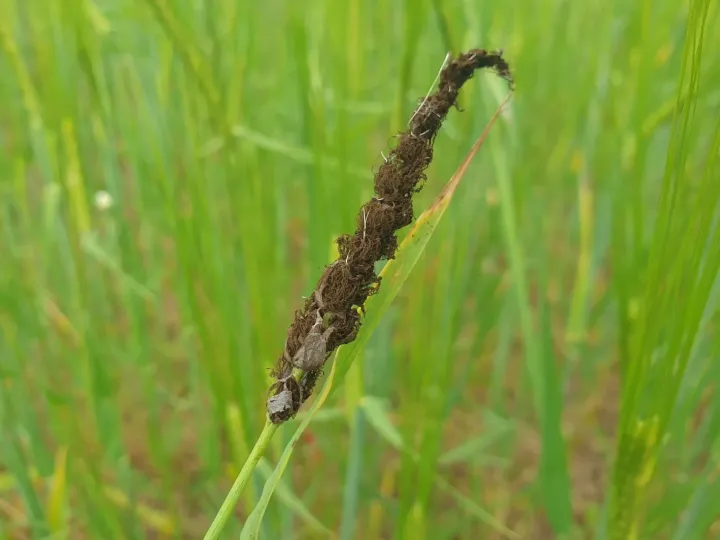
Symptoms appear at the heading stage, when the ears emerge. Instead of healthy grains, the inflorescence is replaced by a mass of black, powdery teliospores.
The spore mass is initially covered by a thin membrane that ruptures shortly after heading, releasing the spores to be dispersed by wind and rain.
After the spores have been dispersed, only the bare rachis of the ear remains visible, which is a diagnostic feature of the disease.
Infected plants may exhibit abnormal growth patterns, such as earlier emergence or altered height compared to healthy plants in the field.
Although the fungus is systemic, symptoms do not always manifest in every tiller of the infected plant, but the infected spikes are always sterile.
Pathogen
Loose smut of barley is caused by the basidiomycete fungus Ustilago nuda. It is a systemic pathogen that specifically affects barley and related species within the Poaceae family.
The infection process occurs during the flowering stage, where spores land on the stigma and grow into the ovary. The fungus resides as dormant mycelium within the embryo of the mature grain, remaining invisible to the naked eye.
Upon germination of the infected seed, the dormant mycelium resumes growth and colonizes the developing shoot. It moves systemically throughout the plant, following the apical meristem.
The fungus is highly specialized, and multiple physiological races exist that can overcome the resistance genes of various commercial barley cultivars.
Because the pathogen is seed-borne, it can easily spread to new regions through international trade and the movement of contaminated seed lots.
Conditions for development
The disease development is heavily dependent on weather conditions during the flowering stage (anthesis) of the barley crop. Cool, moist conditions are optimal for infection.
High relative humidity and temperatures around 18–25°C favor the germination of spores on the stigma and the subsequent penetration into the ovary.
Dry and hot weather during flowering significantly inhibits the infection process, as spores require surface moisture to germinate effectively.
The disease spread is facilitated by wind, which carries spores from infected fields to healthy flowering crops in the vicinity.
Crop density and canopy humidity can also influence the intensity of the disease by maintaining microclimates suitable for fungal activity.
Why it matters
The primary economic impact of loose smut is a direct reduction in yield, as infected spikes produce no grain at all, resulting in a loss proportional to the percentage of infected plants.
In addition to direct yield loss, the quality of the harvested grain is compromised if it is intended to be used as future planting stock.
The systemic infection weakens the host plant, potentially making it more vulnerable to secondary infections or environmental stress factors.
Managing the disease requires recurring investment in chemical control, which increases the overall cost of barley production.
- Total loss of grain in affected ears.
- Contamination of entire seed lots.
- Increased production costs due to fungicide requirements.
Protection
The most effective strategy is the use of healthy, pathogen-free seed sourced from certified seed production fields that have passed rigorous field inspections.
Systemic seed treatments are essential. Fungicides containing active ingredients such as triazoles are highly effective at eradicating the internal mycelium from the embryo.
Breeding and utilizing resistant barley cultivars is the most sustainable approach to managing Ustilago nuda in the long term.
Field sanitation and the removal of infected plants in seed crops during the heading stage can help to reduce the primary inoculum in the field.
Adopting integrated pest management (IPM) practices, including proper crop rotation and the use of certified seed, significantly lowers the incidence of loose smut.
Content graph
Connections · Loose smut of barley
Most often together:
Marketplace
Products · 173


VOLGOGRAD 08
ФГБОУ ВО Омский государственный аграрный университет имени П.А. Столыпина
Barley
0
0
·
41
No offers
—
Details


Boyarin
ФГБНУ Федеральный Аграрный Научный Центр Северо-востока имени Н.В. Рудницкого
Barley
0
0
·
36
No offers
—
Details

Lel
ФГБНУ Федеральный Аграрный Научный Центр Северо-востока имени Н.В. Рудницкого
Barley
0
0
·
36
No offers
—
Details


Community
Discussion
No discussions yet — be the first.