
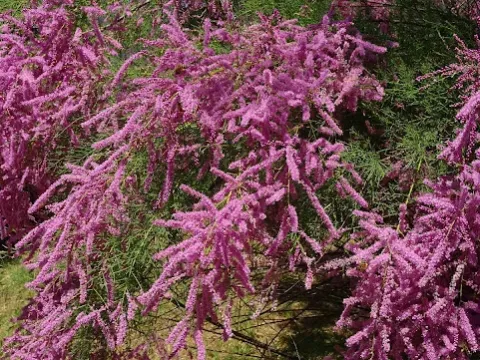
Tamarix hybrids
Tamarix hybrids
Propagation of Tamarix hybrids is primarily achieved through cuttings, which ensures the consistency of the cultivar's traits. Hardwood cuttings should be taken in late winter or very early spring before active growth commences.
What the section contains
Tamarix hybrids
The cuttings, typically 20–30 cm long, are planted in a loose, well-draining substrate. They should be kept in a protected environment, such as a greenhouse or cold frame, until a robust root system has developed.
When transplanting into the field, ensure the site is fully prepared with excellent drainage. Digging a hole twice the size of the root ball and amending the soil with sand can help the plant establish quickly in heavier soils.
The spacing between shrubs should be generous, typically 1.5 to 2 meters, to prevent overcrowding. Proper spacing is essential for good air movement, which significantly reduces the risk of fungal infections in the dense canopy.
Initial irrigation is critical during the first few weeks following transplanting. Once established, these shrubs are exceptionally hardy and require very little supplemental watering, even in harsh conditions.
Tamarix hybrids belong to the Tamaricaceae family and are renowned for their incredible adaptability. These plants thrive in saline soils where many other species would fail, making them ideal for coastal and desert reclamation.
As light-demanding plants, they require full sun to reach their full potential. Exposure to intense sunlight enhances their bloom density and maintains the health of their fine, scale-like foliage throughout the season.
Soil requirements are minimal; they prefer sandy or rocky soils with excellent drainage. While they can survive in poor, infertile soils, a light application of balanced fertilizer in the spring can encourage more vigorous growth.
Climate suitability includes high resistance to drought and strong, drying winds. They are well-adapted to hot, arid summers, but most hybrids benefit from protection during exceptionally severe winter frosts.
A key physiological trait is their ability to excrete salt through their leaves. This allows them to thrive in environments with brackish water or salty air, where few other ornamental species can survive.
The primary utility of Tamarix hybrids lies in soil conservation and erosion control. Their deep and complex root systems are effective at binding shifting sands and stabilizing steep, unstable slopes in arid regions.
In landscaping, their value is found in their spectacular flowering display and fine, feathery texture. They are frequently used in urban planning because they withstand pollution and dust effectively.
As a nectar source, they are highly beneficial for local bee populations during the peak of summer when other forage may be scarce. This makes them a valuable addition to ecological restoration projects.
The biomass produced by these plants can be harvested for ornamental woodwork or mulched for soil improvement. Their wood, while generally small in diameter, is dense and has good resistance to rotting.
As a tool for environmental remediation, Tamarix hybrids help restore soil structure over time by adding organic matter to the topsoil layer, which eventually supports more diverse plant life.
The greatest threat to Tamarix hybrids is waterlogging. Excessive moisture in the root zone quickly leads to root rot, which is often fatal. Ensuring that the planting site has excellent drainage is the primary defense.
While generally pest-resistant, aphids and scale insects can occasionally infest the foliage, particularly if the plant is under stress from drought or malnutrition. Monitoring is recommended during the growing season.
Fungal diseases like verticillium wilt can occur if air circulation is poor or if pruning tools are not cleaned between plants. Always disinfect tools to prevent the spread of soil-borne pathogens.
Vigilant inspection of the inner branches for signs of dieback is crucial. Early detection allows for the removal of affected limbs before the disease spreads to the rest of the shrub.
- Avoid overwatering the root system.
- Prune annually to maintain structural health.
- Use systemic insecticides only for severe infestations.