
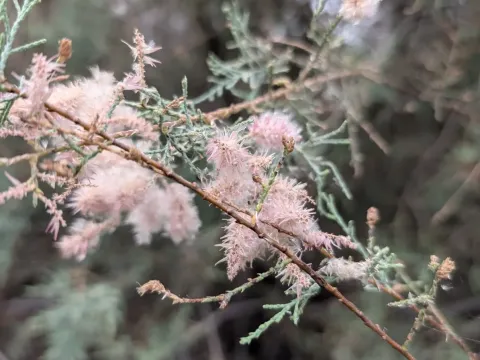
Canary Island tamarisk
Tamarix canariensis
Canary Island tamarisk (Tamarix canariensis) is a hardy shrub belonging to the Tamaricaceae family, native to the Canary Islands and the western Mediterranean region. It is highly valued for its ability to thrive in challenging coastal environments.
What the section contains
Canary Island tamarisk
Botanically, this species is defined by its small, scale-like leaves and plume-like racemes of delicate pink flowers. The plant's structure provides a distinct, airy appearance that remains stable even under high wind conditions.
To ensure optimal growth, this plant requires full exposure to direct sunlight. It is an obligate heliophyte, meaning that even partial shade will drastically reduce its flowering capacity and overall structural integrity.
Regarding soil, the species is remarkably versatile, showing excellent tolerance to saline and alkaline conditions. It prefers well-drained, sandy, or rocky soils, as it cannot tolerate waterlogged conditions that lead to root rot.
Agrotechnical maintenance focuses primarily on the establishment phase. Once the deep root system is formed, the shrub becomes incredibly drought-tolerant and requires minimal intervention, making it a perfect choice for xeriscaping.
The Canary Island tamarisk is naturally resistant to many pests, but it remains susceptible to specific insects if planted in unsuitable conditions or stressed by poor drainage.
Leaf beetles (chrysomelids) can cause significant defoliation, particularly in young shrubs, leading to reduced vigor and aesthetic appeal during the peak summer growing season.
Scale insects are another common threat that may colonize the woody branches, extracting plant sap and potentially causing localized branch dieback if not managed properly.
Fungal diseases, including verticillium wilt, are primarily driven by poor air circulation or overwatering. Maintaining a proper spacing between plants is critical to prevent these pathogens.
Sanitary pruning is the most effective management strategy. By removing dead or diseased wood annually, the grower can sustain plant health and prevent the spread of infections across the plantation.