
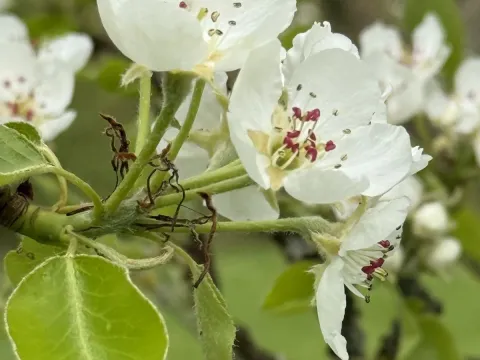
Common pear
Pyrus communis L. var. pyraster L.
The Common pear (Pyrus communis L. var. pyraster L.) is a prominent member of the Rosaceae family, widely recognized for its agricultural significance and role in fruit production.
What the section contains
Common pear
Propagation is primarily achieved through grafting cultivated varieties onto hardy Pyrus communis rootstocks, which provide necessary vigor and environmental adaptability.
Seeds intended for rootstock production must undergo a stratification process for 3–4 months at low temperatures to break dormancy and ensure high germination rates.
In nurseries, seeds are sown at a depth of 3–5 cm in well-prepared soil, requiring consistent irrigation to maintain moisture levels suitable for seedling emergence.
Transplanting of saplings into permanent orchard sites is typically executed during the dormant season, either in early spring before bud break or in late autumn.
Pears thrive in sunny locations with full exposure to light, as sufficient solar radiation is critical for fruit development and the formation of productive buds.
Deep, fertile, well-drained loamy soils are ideal, providing the perfect balance of aeration and water retention required for the tree's deep root system.
Soil pH should ideally range between 6.0 and 7.0; acidic soils may require lime amendments to create the appropriate conditions for nutrient uptake.
While mature trees exhibit moderate drought tolerance, adequate moisture is essential during the flowering and fruit-set stages to prevent premature shedding of the crop.
Protection from severe late-spring frosts is necessary, as sudden drops in temperature can cause irreversible damage to the reproductive organs and budding leaves.
The yield of a Common pear tree is heavily influenced by canopy management, proper pruning techniques, and the presence of compatible cross-pollinators within the orchard.
High-density planting systems, when managed with precision, can significantly improve productivity, allowing for efficient harvesting and consistent fruit quality.
Regular maintenance pruning is necessary to remove dead or diseased wood and to encourage the growth of new fruiting spurs, which are vital for sustained annual yields.
Thinning excess fruitlets in early summer ensures that the tree channels its energy into producing larger, high-quality fruits rather than a larger number of small, inferior ones.
Pears are utilized for fresh consumption, processing into juice, canning, drying, and the production of traditional fermented beverages such as perry.
Scab caused by the fungus Venturia pyrina is a major threat, leading to lesions on leaves and fruit, which significantly diminishes the market value of the produce.
Fire blight, caused by the bacterium Erwinia amylovora, is the most destructive disease, requiring strict sanitation practices to stop it from spreading through the orchard.
Pests such as the pear psylla are highly problematic, as they feed on sap and secrete honeydew, which subsequently promotes the growth of sooty mold.
Codling moth larvae are a primary cause of fruit loss; their damage can be effectively managed through the use of pheromone traps and targeted biological control strategies.
- Scab
- Fire blight
- Pear psylla
- Codling moth
- Powdery mildew
Harvesting should occur when the fruit reaches the appropriate size and the background color begins to change, signaling the end of the growth phase.
Correct timing is crucial; harvesting too early results in poor flavor, while late harvesting reduces storage life and increases susceptibility to internal breakdown.
Fruits must be harvested carefully by hand to avoid bruising, which creates entry points for fungal pathogens during the storage and distribution process.
Post-harvest cooling is vital to slow down the metabolic rate of the fruit, thereby extending its shelf life and preserving its nutritional quality.
Depending on the variety, pears are often stored in temperature-controlled rooms with high humidity to maintain turgor and prevent excessive moisture loss.