
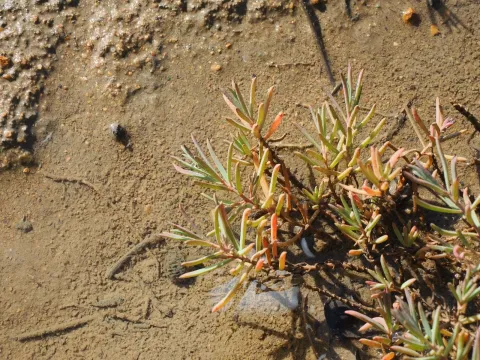
Suaeda
Suaeda
Suaeda belongs to the halophyte group, so optimal sowing times occur when the soil has warmed up and contains sufficient moisture after seasonal rains.
What the section contains
 Japanese seablite
Suaeda japonica
Japanese seablite
Suaeda japonica
 Sea blite
Suaeda maritima
Sea blite
Suaeda maritima
 Spiked seablite
Suaeda spicata
Spiked seablite
Suaeda spicata
 Spreading sea-blite
Suaeda prostrata
Spreading sea-blite
Suaeda prostrata
 Suaeda acuminata
Suaeda acuminata
Suaeda acuminata
 Suaeda aegyptiaca
Suaeda aegyptiaca
Suaeda aegyptiaca
 Suaeda americana
Suaeda americana
Suaeda americana
 Suaeda arguinensis
Suaeda asphaltica
Suaeda asphaltica
Suaeda arguinensis
Suaeda arguinensis
Suaeda asphaltica
Suaeda asphaltica
 Suaeda australis
Suaeda australis
Suaeda australis
 Suaeda confusa
Suaeda confusa
Suaeda confusa
 Suaeda corniculata
Suaeda corniculata
Suaeda corniculata
 Suaeda foliosa
Suaeda glauca
Suaeda glauca
Suaeda foliosa
Suaeda foliosa
Suaeda glauca
Suaeda glauca
 Suaeda ifniensis
Suaeda ifniensis
Suaeda ifniensis
 Suaeda lehmannii
Suaeda lehmannii
Suaeda lehmannii
 Suaeda linearis
Suaeda microsperma
Suaeda microsperma
Suaeda linearis
Suaeda linearis
Suaeda microsperma
Suaeda microsperma
 Suaeda monoica
Suaeda monoica
Suaeda monoica
 Suaeda nudiflora
Suaeda nudiflora
Suaeda nudiflora
 Suaeda palaestina
Suaeda paradoxa
Suaeda paradoxa
Suaeda rigida
Suaeda rigida
Suaeda palaestina
Suaeda palaestina
Suaeda paradoxa
Suaeda paradoxa
Suaeda rigida
Suaeda rigida
 Suaeda splendens
Suaeda splendens
Suaeda splendens
 Suaeda taxifolia
Suaeda taxifolia
Suaeda taxifolia
 Suaeda vermiculata
Suaeda vermiculata
Suaeda vermiculata
Suaeda
Under natural conditions, seeds germinate when soil temperatures reach +12°C to +15°C, which typically corresponds to mid-spring.
Sowing is performed using surface methods or minimal soil cover, as the small seeds require good contact with moist soil for successful germination.
When cultivating on saline lands, it is essential to ensure uniform seed distribution to avoid overcrowding that hinders plant development.
To accelerate germination for agronomic purposes, pre-soaking seeds is sometimes employed to achieve more uniform stands in field conditions.
Suaeda is a genus of annual or perennial herbaceous plants from the Amaranthaceae family, adapted to growth in saline soils.
The crop possesses a unique ability to accumulate salts, making it a promising plant for the reclamation of degraded saline lands.
For full development, the plants require high solar intensity and a stable temperature regime during the summer period.
Although Suaeda is extremely tolerant of salinity, it responds better to moderate moisture, especially during the initial phases of growth and vegetative mass development.
The plant tolerates extremely alkaline conditions well, where most other agricultural crops would perish due to osmotic stress.
The green mass yield of Suaeda depends directly on the level of soil salinity and moisture availability during the active growing season.
In favorable years on plots with optimal salinity, significant volumes of biomass suitable for use as animal feed can be harvested.
The plant's ability to maintain its nutritional value even when grown on marginal lands unsuitable for traditional farming is highly valued.
The biological yield potential is often limited by rainfall deficits; therefore, with irrigation, dry matter output increases significantly.
Data regarding exact yields per hectare vary depending on the specific Suaeda species used in crop rotation for soil restoration.
Suaeda possesses natural immunity to most typical agricultural crop diseases due to the specific chemical composition of its tissues.
The main threat to young seedlings can be soil pests such as wireworms, which damage roots during early sowing periods.
Under conditions of water stagnation, fungal infections of the root zone are possible, though this risk is minimized with proper saline soil drainage.
Large phytophagous insects rarely cause serious damage to mature plants due to the high salt content in Suaeda's aerial organs.
Agronomic pest control in Suaeda fields generally does not require the use of pesticides, making it an environmentally friendly crop.
Harvesting of Suaeda is carried out during the phase of maximum green mass accumulation, before the start of active seed ripening, to preserve feed nutrition.
For mechanized mowing, standard headers are used, adjusted to the appropriate cutting height depending on the density of the plants.
After harvesting, the plant biomass can be used in fresh form or for silage and haylage production after initial wilting.
An important aspect is moisture control during harvesting to prevent spoilage of the biomass during subsequent storage in piles or silos.
Timely harvesting also helps reduce the stress on the soil, which positively affects the cycle of fertility restoration for saline plots.