
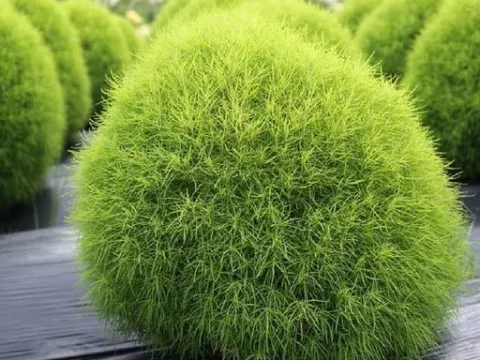
Summer cypress
Bassia
Summer cypress (Bassia scoparia) is an annual herb of the Amaranthaceae family, known for its rapid growth and adaptability to harsh environments.
What the section contains


Summer cypress
Sowing should be performed in early spring once the danger of frost has passed and the soil has reached a temperature of at least 10–12°C.
Seeds are tiny and should be sown close to the surface, requiring light and consistent moisture to facilitate successful germination within 7–12 days.
Proper plant spacing is crucial for biomass production; thinning the crop to 30–50 cm between plants prevents overcrowding and encourages bushier growth.
The plant demonstrates high germination energy and is known for its ability to self-seed, which requires careful management in crop rotation schedules.
This crop is highly prized for its drought tolerance and ability to thrive in poor, saline, or rocky soils where other plants fail to establish.
Summer cypress requires full sun exposure to maintain its structural integrity and reach its maximum potential yield of green foliage.
While extremely hardy, it responds positively to supplemental nitrogen fertilizer and moderate irrigation during the initial establishment phase of growth.
Good soil drainage is essential, as saturated conditions can lead to root system issues, particularly in clay-heavy soil types.
It is sensitive to hard frost, meaning its active growth period is strictly limited to the frost-free months of the year.
Summer cypress is primarily utilized as a nutritious forage crop, offering a high-protein feed source for sheep, goats, and cattle.
In optimal conditions, the crop can yield between 150 to 250 quintals of fresh biomass per hectare, making it a productive forage option.
The plant has excellent regrowth capabilities, allowing for multiple cuttings throughout a single season if managed with proper cutting heights.
As a hay source, it provides essential vitamins and minerals, serving as an important winter supplement for livestock in arid regions.
Its high productivity in nutrient-poor soils provides a sustainable solution for farmers seeking to maximize output on marginal lands.
Bassia scoparia is remarkably resistant to most common agricultural diseases, making it a low-input crop that requires minimal phytosanitary intervention.
Root rot may occur in cases of severe waterlogging or when dense plant populations prevent proper airflow within the canopy.
Pest pressure is generally very low due to the presence of secondary metabolites in the plant that act as natural repellents against many insect species.
Weed control is only critical during the early stages of seedling development, after which the fast-growing crop effectively shades out competing weeds.
Due to its natural health, the plant is an excellent candidate for organic farming and integrated pest management systems.
Harvesting for green fodder should occur at the pre-flowering stage, before the stems begin to lignify, to ensure maximum protein content and digestibility.
For hay production, the cut material should be field-dried carefully to prevent leaf loss, as the foliage contains the highest nutrient density.
Seed harvesting requires precise timing in late autumn when the plant turns brown and seeds reach full maturity to prevent premature shattering.
Mechanical harvesting is effective, provided that combines are calibrated to prevent the loss of small seeds during the threshing process.
The remaining root biomass after harvest contributes significantly to soil structure, enhancing aeration and increasing organic matter content over time.