
Suaeda foliosa
Suaeda foliosa
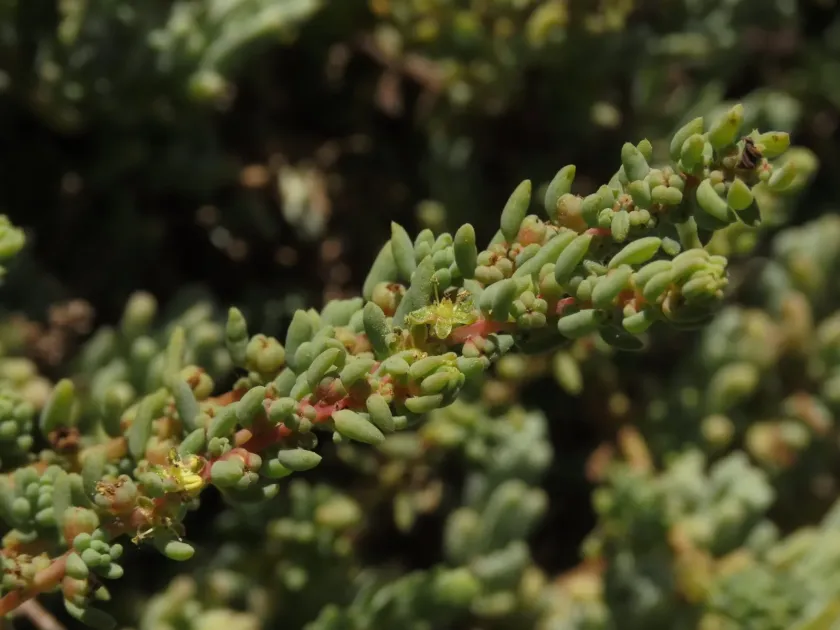
Description
Sowing dates
Sowing of Suaeda foliosa is carried out primarily in the spring, once soil temperatures reach 10–12°C. The optimal timing is immediately after snowmelt, which allows the plant to utilize stored soil moisture for uniform seed germination.
A crucial factor during sowing is the depth of seed placement, which should be between 1 and 2 centimeters. Shallow sowing in saline areas often leads to seed desiccation in the topsoil layer under the influence of direct sunlight and high evaporation rates.
In commercial cultivation, a row-cropping method is employed with spacing between 45–60 centimeters to ensure adequate space for root system development under high-competition conditions in saline soils.
To improve germination, seeds are sometimes subjected to stratification, although the plant typically exhibits high vigor when soil moisture is sufficient. Integrating the crop into a rotation requires initial weed control on the field to ensure successful establishment.
After sowing, light soil compaction is recommended to improve seed-to-soil contact. This is critical in arid climates, where efficient capillary water movement determines the success of the primary seedling emergence.
Growing requirements
Suaeda foliosa belongs to the Amaranthaceae family and is a classic halophyte, highly adapted to growing in soils with extremely high salt concentrations. It thrives in salt flats where other agricultural crops fail due to osmotic stress.
The plant demonstrates a high demand for intense solar radiation and does not tolerate even partial shading. Optimal growth rates are observed in arid zones with high summer temperatures, characteristic of desert and semi-desert regions.
Soil requirements include high levels of mineralized groundwater, which the plant effectively utilizes for its growth. It possesses a unique ability to accumulate salts in its tissues, making it a promising candidate for phytoremediation of degraded lands.
Soil moisture is a critical factor only during the germination stage; during active growth, Suaeda foliosa shows remarkable drought resistance. It survives extended periods of low precipitation due to the succulent structure of its leaves.
Agronomic management involves minimal fertilizer requirements, as the plant is adapted to nutrient-poor saline soils. However, moderate nitrogen fertilization during early stages can significantly accelerate the growth of above-ground biomass.
Yield
The yield of Suaeda foliosa green mass varies significantly depending on the degree of soil salinity and moisture availability during the growing season. Under favorable conditions, it can produce a substantial volume of vegetative matter suitable for livestock feed.
Key performance indicators for the crop include dry matter yield and the accumulation of mineral elements within plant tissues. With intensive cultivation technology and drip irrigation, biological yields can be increased multiple-fold.
The economic use of Suaeda foliosa is aimed not only at forage production but also at soil desalination. Consequently, yield is often measured not just in tons per hectare, but in the plant's capacity to extract excess salts from the topsoil.
The biological characteristics of the plant allow for multiple cuttings per season, provided the biomass recovers sufficiently. This makes the species a valuable reserve forage resource in regions vulnerable to desertification.
Economic efficiency is determined by low production costs, as the crop does not require expensive reclamation projects. Major expenses are associated with mechanical harvesting and the logistics of handling the green mass.
Main diseases and pests
Suaeda foliosa exhibits high resistance to most pathogens that affect traditional agricultural crops. This is attributed to the specific biochemical composition of its sap, which inhibits the growth of harmful fungi and bacteria.
The greatest threat during the early development stage comes from soil-dwelling pests, such as wireworms and larvae of scarab beetles. They can damage young seedlings, leading to thinning of the stand and reduced overall plot productivity.
In certain cases, aphid infestations may occur on tender apical shoots during periods of extreme heat. However, when the crop is grown on a large scale, natural biological control agents usually suffice in managing pest populations.
Diseases caused by phytopathogens are extremely rare and typically localized. Preventing the spread of infection is managed through proper crop rotation and avoiding over-dense planting, which could lead to stagnant moisture conditions.
Phytosanitary monitoring is a primary defensive measure, allowing for the timely detection of damage. Chemical treatments are rarely used, reflecting the ecological focus of utilizing this crop in soil remediation systems.
Harvesting
Harvesting Suaeda foliosa is conducted during the mass flowering phase, when the concentration of nutrients in the tissues reaches its peak. At this time, the plant has the optimal structure for producing high-quality hay or silage.
Mechanization of the harvesting process is achieved using standard mowers, followed by windrowing for drying. The cutting height must be sufficient to avoid damaging the root crown, which is vital for the recovery and regrowth of subsequent cuttings.
When using the plant as a forage supplement, it is important to monitor the drying process to preserve the mineral balance. Over-drying can result in the loss of valuable components stored within the succulent leaves.
Harvesting schedules are strictly dependent on regional weather patterns; work should ideally be carried out during dry, sunny days to accelerate biomass dehydration and minimize the risk of mold growth during storage.
Post-harvest processing involves chopping the mass, which improves digestibility for livestock. Properly stored Suaeda is an indispensable dietary component for cattle in arid regions, where other forage crops possess low nutritional value.