
Suaeda splendens
Suaeda splendens
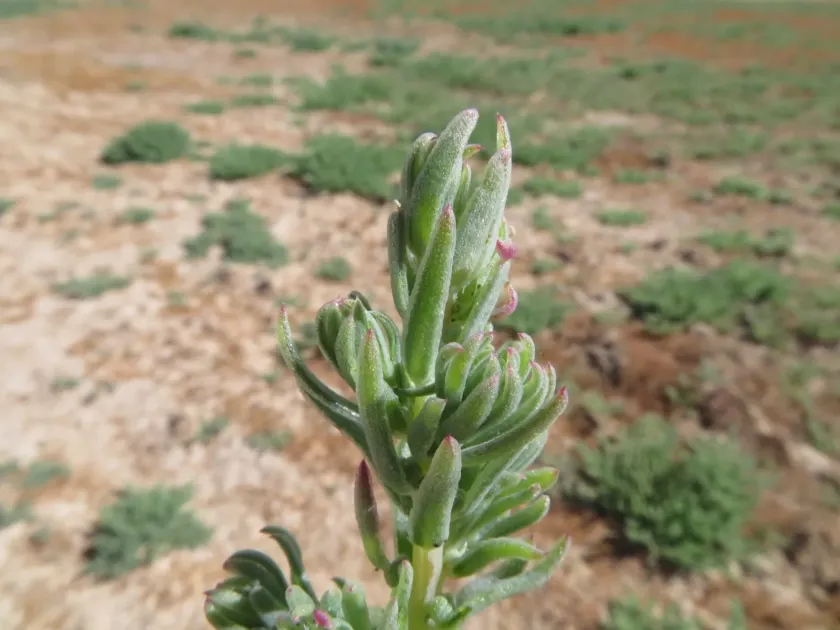
Description
Sowing dates
The sowing of Suaeda splendens is primarily carried out in the spring period, once the soil has warmed to a temperature of 12–15 degrees Celsius. The optimal timing depends on the climatic zone, but in southern regions, this typically occurs from late March to early April.
Sufficient soil moisture in the top layer is crucial for high-quality seed germination; therefore, overhead irrigation is applied if necessary. In the saline soil conditions to which this crop is adapted, it is important to ensure a uniform seeding depth, usually between 1 and 2 centimeters.
Suaeda features very fine seeds, which requires the use of specialized precision seeders with calibrated sowing rates. Excessive planting density negatively impacts productivity, making it essential to adhere to recommended spacing patterns.
A biological characteristic of this crop is its slow initial growth, which makes effective weed management during the seedling stage highly important. Once established, the crop rapidly accumulates vegetative mass, covering the soil surface and suppressing competition.
Experience shows that autumn sowing in southern regions is also feasible, though it requires consideration of risks related to premature germination during short-lived winter thaws.
Growing requirements
Suaeda splendens is a classic halophyte belonging to the Amaranthaceae family. This plant has evolutionarily adapted to thrive on highly saline soils and salt marshes where most traditional agricultural crops fail to survive.
The crop is highly light-demanding and categorized as a long-day plant. It exhibits exceptional tolerance to direct solar radiation and is capable of developing under conditions of intense ultraviolet exposure.
Suaeda is relatively undemanding regarding soil texture, though it shows the best growth performance in sandy loam and light loamy soils with a pronounced alkaline reaction. Its ability to accumulate salts in cell vacuoles allows the plant to maintain turgor pressure even at high osmotic soil solution pressure.
Minimal water supply is critical in the first weeks post-germination, but the plant subsequently demonstrates exceptional tolerance to soil moisture deficits. It effectively utilizes internal water reserves stored in its succulent leaves and stems.
The optimal temperature range for vegetation is between 20 and 30 degrees Celsius. The plant can withstand significant diurnal temperature fluctuations, making it a promising candidate for cultivation in arid climate regions.
Yield
The green mass yield of Suaeda splendens varies significantly depending on the level of soil salinity and mineral nutrition. Under favorable conditions with regular irrigation, it can form substantial biomass volumes comparable to mid-level forage grasses.
The value of the crop lies not only in quantity but also in the nutritional profile of the raw material. The protein content in Suaeda leaves makes it a promising component for the development of compound feeds for livestock.
Yield potential can be enhanced through the use of nitrogen-phosphorus fertilizers, which activate photosynthetic processes. However, excessive fertilization can lead to a decrease in the plant's natural resilience to extreme saline conditions.
Long-term studies indicate that multi-cut management significantly increases total seasonal productivity. It is vital to maintain an appropriate cutting height to avoid damaging growth points and ensure rapid regrowth of shoots.
The economic efficiency of the crop lies in its ability to bring lands unsuitable for traditional farming into production, which automatically makes the harvest economically justified under specific environmental constraints.
Main diseases and pests
Due to its unique cellular structure, Suaeda splendens is affected by a limited range of specialized pests. Insects that damage the plant's growth point pose the primary threat during the initial stages of vegetation.
Among typical diseases, fungal infections such as root rot are noted, often resulting from waterlogged soil and poor drainage. Under conditions of stagnant water and high humidity, powdery mildew may develop.
Larvae of certain moth species may cause damage by gnawing on the stems of young plants. Pest population monitoring should be conducted weekly, especially during periods of abnormally high temperatures.
An important factor in phytosanitary control is the management of generalist pests common to the Amaranthaceae family. Timely destruction of weeds around the plot significantly reduces the risk of insect migration.
Chemical control requires caution, as many insecticides can negatively affect the development of halophytic plants. Priority should be given to biological control methods and strict adherence to crop rotation practices.
Harvesting
Harvesting Suaeda is conducted during the phase of active vegetative growth, before the onset of flowering, when the concentration of nutrients in the plant is at its peak. During this period, the vegetation is most succulent and palatable for livestock.
For mechanized harvesting, forage harvesters are used to prepare the green mass for ensiling. The cutting height should be no less than 10–12 centimeters from the soil surface to ensure the subsequent regrowth of the crop.
If seed production is the objective, harvesting is performed at the phase of full fruit maturity when they acquire their characteristic color. Careful harvester operation is required at this stage to minimize losses of the tiny seeds.
Post-harvest processing includes drying and cleaning the raw material if it is intended for long-term storage. Thanks to its specific chemical composition, Suaeda possesses natural preservative properties, which simplifies the ensiling process.
Harvest timing depends on the intended use: for forage, harvesting can be done 2–3 times per season, whereas for seed production, the plant is left in the field until its biological cycle is complete.