

Reference · Crops
Yucca
Yucca L.
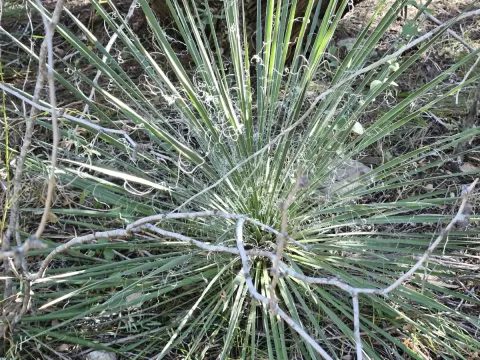
Yucca (Yucca L.) is a genus of evergreen perennials belonging to the Asparagaceae family. These plants are native to the arid and semi-arid regions of the Americas, having evolved unique physiological traits to survive in harsh, high-temperature environments.
15
items
What the section contains
 Adam's needle
Yucca filamentosa L.
Adam's needle
Yucca filamentosa L.
 Beaked yucca
Yucca rostrata Engelm. ex Trel.
Beaked yucca
Yucca rostrata Engelm. ex Trel.
 Curveleaf Yucca
Yucca gloriosa L. var. recurvifolia (Salisb.) Engelm.
Filamentous x Pale Yucca
Yucca filamentosa x Yucca pallida
Curveleaf Yucca
Yucca gloriosa L. var. recurvifolia (Salisb.) Engelm.
Filamentous x Pale Yucca
Yucca filamentosa x Yucca pallida
 Giant yucca
Yucca guatemalensis Baker
Giant yucca
Yucca guatemalensis Baker
 Linear-leaf yucca
Yucca linearifolia Clary
Moundlily yucca
Yucca gloriosa L. var. recurvifolia (Salisb.) Engelm. x Y. linearifolia Clary
Moundlily yucca
Yucca gloriosa L.
Moundlily yucca
Yucca gloriosa L. var. tristis Carrière
Linear-leaf yucca
Yucca linearifolia Clary
Moundlily yucca
Yucca gloriosa L. var. recurvifolia (Salisb.) Engelm. x Y. linearifolia Clary
Moundlily yucca
Yucca gloriosa L.
Moundlily yucca
Yucca gloriosa L. var. tristis Carrière
 Pale yucca
Yucca pallida McKelvey
Pale yucca
Yucca pallida McKelvey
 Whipple's yucca
Yucca whipplei Torr.
Whipple's yucca
Yucca whipplei Torr.
 Yucca aloifolia
 L.
Yucca aloifolia
Yucca aloifolia L.
 Yucca baccata
 Torr.
Yucca baccata
Yucca baccata Torr.
 Yucca desmetiana
 Baker
Yucca filamentosa x Yucca rostrata
Yucca filamentosa L. x Y. rostrata Engelm. ex Trel.
Yucca desmetiana
Yucca desmetiana Baker
Yucca filamentosa x Yucca rostrata
Yucca filamentosa L. x Y. rostrata Engelm. ex Trel.
Marketplace
Products in this section · 2

Yucca
The agricultural cultivation of Yucca requires well-draining, sandy-loam soils. Excess moisture is the primary enemy of the crop, as waterlogged conditions lead to rapid root decay and the development of fungal pathogens, which can destroy an entire plantation.
Botanically, the plant is characterized by tough, sword-shaped leaves with a waxy cuticle. This structure is an evolutionary adaptation that prevents excessive transpiration, allowing the plant to maintain its metabolic functions during prolonged drought.
Yucca requires high levels of solar radiation to reach peak biomass production. While it is hardy in many respects, the accumulation of structural fibers is significantly improved in climates with a long, warm, and sunny growing season.
Propagation is primarily done vegetatively using offshoots or root cuttings. This method is preferred in commercial agriculture to ensure genetic uniformity and to maintain the specific quality of the fiber produced by the selected cultivar.
The primary agricultural utility of Yucca lies in its high-quality natural fiber, which is extracted from the leaves. This fiber is renowned for its tensile strength, resistance to salt water, and durability, making it ideal for marine and heavy-duty industrial applications.
In addition to industrial fibers, Yucca is a valuable source of steroid saponins. These compounds are widely used in the pharmaceutical industry to synthesize corticosteroids and are also utilized in the production of natural detergents and foaming agents.
Yields are largely dependent on the density of the plantation and the irrigation management strategy. Under optimal conditions, plantations are highly productive and can be harvested repeatedly over many years without requiring frequent replanting.
The harvesting process involves cutting the mature, outer leaves while leaving the growing crown intact. This sustainable harvesting approach ensures that the plant continues to produce new foliage for several seasons, optimizing the long-term ROI.
Advancements in processing technology allow for a higher extraction rate of fiber. By implementing automated mechanical decortication, producers can achieve greater efficiency and maintain consistent quality standards for textile and manufacturing markets.
Fungal diseases are the most significant threat to Yucca crops. Leaf spot and crown rot are common in environments with inadequate air circulation or poor soil drainage. Proactive field management is essential to mitigate these risks.
Common pests affecting Yucca plantations include scales, spider mites, and mealybugs. These sap-sucking insects target the younger, more tender leaves, significantly reducing the vigor of the plant and degrading the structural integrity of the leaf fibers.
Effective pest and disease control requires a combination of sanitation and chemical management. Removing debris from around the base of the plants and ensuring proper spacing between individuals are critical cultural practices for disease prevention.
Biological controls are increasingly used in modern plantations to combat pest outbreaks. Introducing predatory insects or using environmentally friendly botanical pesticides helps manage populations without causing extensive chemical residues on the fibers.
Environmental stress, particularly sudden drops in temperature during the wet season, can predispose the plants to infections. Selecting site-specific cultivars that are acclimated to local frost patterns is a vital strategy for protecting commercial yields.