
Moundlily yucca
Yucca gloriosa L. var. recurvifolia (Salisb.) Engelm. x Y. linearifolia Clary
Description
Growing requirements
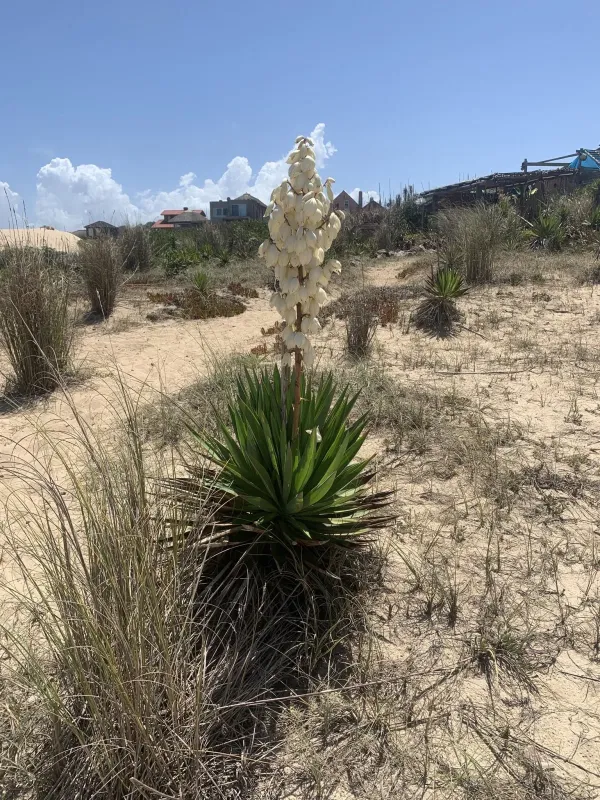
Moundlily yucca (Yucca gloriosa) belongs to the Asparagaceae family and is a perennial evergreen plant known for its dramatic architectural appearance. Originating from the southeastern United States, it is naturally adapted to coastal dunes and sandy woodland environments.
The plant features stiff, sword-shaped leaves arranged in a dense rosette, which may develop into a woody stem over several years. The foliage often exhibits a blue-green color with sharp terminal spines, making it a distinctive ornamental choice for gardens and landscaping projects.
Successful cultivation requires well-draining soil, ideally sandy or loamy with a neutral pH. Because yucca is highly susceptible to root rot, drainage is the most critical factor; planting in raised beds or on slopes is recommended to ensure that water does not accumulate around the roots.
The culture is extremely light-demanding, thriving best in full sun. While it can tolerate partial shade, insufficient light will cause the plant to lose its compact, upright structure and may prevent the development of its impressive, tall flower spikes.
In terms of climate, Moundlily yucca is moderately cold-hardy, surviving temperatures down to -15 degrees Celsius if the soil remains relatively dry during winter. In regions with severe winters, it should be grown in containers and moved to a frost-free, cool location during the dormant season.
Main diseases and pests
Fungal diseases are the primary threat to this species, usually arising from excessive moisture in the root zone. Root rot is a common issue that manifests as a collapse of the crown or the base of the leaves, eventually leading to the death of the entire plant.
Pests such as mealybugs and spider mites are frequent invaders of yucca plants, particularly in environments with low humidity. These pests thrive in hidden spaces like leaf axils, draining the plant's resources and causing yellowing or stunted growth.
Leaf spot diseases, caused by various pathogens, can compromise the aesthetic appeal of the foliage. These infections typically appear as darkened, sunken lesions and require immediate removal of infected tissues and the application of appropriate systemic fungicides.
Scale insects are another common problem, appearing as small, waxy bumps on the leaf surface. They feed on plant sap and can weaken the yucca, making it more vulnerable to secondary infections or environmental stress.
To maintain a healthy plant, it is essential to practice proper sanitation, including the removal of dead leaves, ensuring adequate airflow around the rosette, and avoiding overhead watering, which can trap moisture in the center of the leaf clump.