
Yucca carnerosana
Yucca carnerosana
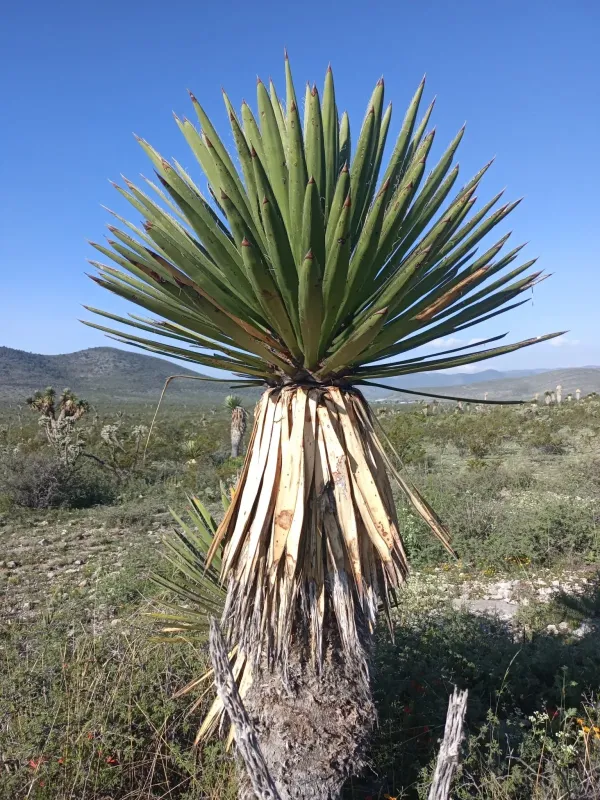
Description
Sowing dates
Propagation of Yucca carnerosana in industrial settings is primarily achieved through seeds or vegetative reproduction using root offsets. Sowing is conducted in well-draining substrates during the spring when soil temperatures consistently remain above 20°C.
Seeds require stratification to improve germination rates and should be sown at a depth of 1–2 centimeters. When using cuttings or basal offsets, it is crucial to ensure a dry environment for the cut site to prevent rot during the critical establishment period.
Cultivation of young plants requires greenhouse conditions for the first 1–2 years. Once sufficient vegetative mass is attained, the plants can be gradually acclimated to open field conditions in suitable climatic regions.
Planting patterns must account for the slow growth rate and the significant physical volume of mature plants. An optimal spacing of 3 to 4 meters between rows is recommended to facilitate maintenance machinery and ensure proper airflow.
Growth intensity is extremely low during the early years, making weed control the most critical operation to prevent competition for resources during the initial root system development phase.
Growing requirements
Yucca carnerosana is a tree-like perennial of the Asparagaceae family, characterized by high xerophytic tolerance. It originates from the arid regions of Northern Mexico, perfectly adapted to extreme temperature fluctuations and water scarcity.
Successful cultivation requires open, sunny locations as any shade promotes stem elongation and reduces fiber quality. The plant prefers rocky or sandy calcareous soils with neutral to slightly alkaline pH levels.
The most important soil requirement is perfect drainage, as waterlogging in the root zone inevitably leads to fungal infections. While the plant can tolerate short frosts, regions with mild winters are optimal for biomass production.
In its natural habitat, the plant withstands intense solar radiation and prolonged droughts without losing turgor. Artificial irrigation is only necessary during the establishment of the plantation and during periods of extreme rainfall deficit.
As a slow-growing species, the formation of a mature 3–5 meter trunk spans several decades. Its resistance to saline and nutrient-poor soils makes it a promising crop for the restoration of degraded arid lands.
Yield
The primary economic product of this crop is the durable natural fiber extracted from the leaves. Commercial exploitation begins only after the plant reaches maturity, which limits the harvest cycles significantly.
Biomass yield depends on plant density and management practices. Annual leaf growth is modest; therefore, harvesting is selective, removing only the lower, fully mature leaves without damaging the central growing point.
In addition to fiber, Yucca carnerosana serves as a source of steroidal saponins, which are highly valued in the pharmaceutical industry. The concentration of these bioactive compounds varies based on the specific environmental growth conditions.
Traditional harvest methods in Mexico rely on manual tools, ensuring precision and promoting the longevity of the plantation. Mechanized harvesting at scale is challenging due to the architectural structure of the plant.
Total plantation productivity is measured not only by fiber yield but also by the potential for secondary products, such as cosmetic extracts or technical components derived from the woody trunk.
Main diseases and pests
The main health threats to the plantation include fungal infections of the root system caused by excessive moisture and high humidity. Root rot (Phytophthora) is the most destructive disease affecting this species.
Among pests, lepidopteran larvae and scale insects cause significant damage by feeding on young leaf tissues. These injuries often provide entry points for pathogens to infiltrate the deeper fibrous structures.
High-density planting can lead to outbreaks of bacterial soft rot, which liquefies the base of the leaves. Prevention relies on ensuring optimal aeration and avoiding waterlogged soil conditions at all times.
Pests such as weevils may target the growing point, which can result in plant death or the permanent cessation of vertical growth. Early detection and the removal of affected plants are essential control measures.
To reduce pathogen risks, it is recommended to maintain a clean environment around the base of the plants and remove plant debris, which often serves as a shelter for various harmful insects.
Harvesting
Harvesting the leaves of Yucca carnerosana is a specialized process requiring careful handling to ensure long-term plant viability. Leaves must be cut near the base, taking care to protect the central rosette.
Harvested leaves are processed immediately to extract the fiber. Delaying processing leads to a loss of raw material quality due to early fermentation or the fiber drying out prematurely within the leaf.
Industrial fiber extraction involves decortication machinery that separates the coarse fibers from the soft leaf tissues. The resulting fiber is washed and sun-dried in natural conditions to preserve its mechanical strength.
The harvest process generates significant quantities of organic waste, which can be composted and returned to the field as fertilizer. This practice helps minimize the need for external mineral inputs.
The harvesting interval for a single plant is typically 2 to 3 years, making Yucca carnerosana a long-term investment in the agricultural sector of arid zones.