
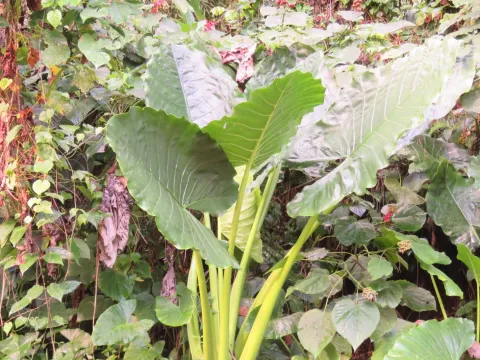
Alocasia
Alocasia (Schott) G. Don
Alocasia is a genus of rhizomatous or tuberous broad-leaved perennial flowering aroids from the family Araceae. Native to tropical and subtropical regions of Asia and eastern Australia, these plants are well-adapted to the humid understory of dense forests.
What the section contains
 Alocasia Azlanii
Alocasia azlanii K. M. Wong & P. C. Boyce
Alocasia Azlanii
Alocasia azlanii K. M. Wong & P. C. Boyce
 Alocasia azlanii x baginda
Alocasia azlanii K. M. Wong & P. C. Boyce x A. baginda Kurniawan & P. C. Boyce
Alocasia azlanii x baginda
Alocasia azlanii K. M. Wong & P. C. Boyce x A. baginda Kurniawan & P. C. Boyce
 Alocasia Baginda
Alocasia baginda Kurniawan & P. C. Boyce
Alocasia Baginda
Alocasia baginda Kurniawan & P. C. Boyce
 Alocasia brancifolia
 (Schott) A. Hay
Alocasia brancifolia
Alocasia brancifolia (Schott) A. Hay
 Alocasia brisbanensis x Alocasia odora
Alocasia brisbanensis x Alocasia odora
Alocasia brisbanensis x Alocasia odora
 Alocasia cucullata
 (Lour.) G. Don
Alocasia cucullata
Alocasia cucullata (Lour.) G. Don
 Alocasia cuprea
 K. Koch
Alocasia cuprea
Alocasia cuprea K. Koch
 Alocasia infernalis
 P. C. Boyce
Alocasia infernalis
Alocasia infernalis P. C. Boyce
 Alocasia lauterbachiana
 (Engl.) A. Hay
Alocasia lauterbachiana
Alocasia lauterbachiana (Engl.) A. Hay
 Alocasia longiloba
 Miq.
Alocasia longiloba
Alocasia longiloba Miq.
 Alocasia micholitziana
 Sander
Alocasia micholitziana
Alocasia micholitziana Sander
 Alocasia nebula
 A. Hay
Alocasia nebula
Alocasia nebula A. Hay
 Alocasia odora
 (Lodd. et al.) Spach
Alocasia odora
Alocasia odora x Alocasia reginula
Alocasia odora
Alocasia odora (Lodd. et al.) Spach
Alocasia odora
Alocasia odora x Alocasia reginula
 Alocasia Putzeysii
Alocasia longiloba x Alocasia sanderiana
Alocasia Putzeysii
Alocasia longiloba x Alocasia sanderiana
 Alocasia reginula
 A. Hay
Alocasia reginula
Alocasia reginula A. Hay
 Alocasia sanderiana
 W. Bull
Alocasia sanderiana
Alocasia sanderiana W. Bull
 Alocasia scalprum
 A. Hay
Alocasia scalprum
Alocasia scalprum A. Hay
 Alocasia wentii
Alocasia wentii
Alocasia wentii
 Alocasia Zebrina
Alocasia zebrina Schott ex Van Houtte
Alocasia Zebrina
Alocasia zebrina Schott ex Van Houtte
 Brisbane taro
Alocasia brisbanensis (F. M. Bailey) Domin
Brisbane taro
Alocasia brisbanensis (F. M. Bailey) Domin
 Giant taro
Alocasia macrorrhizos (L.) G. Don
Giant taro
Alocasia macrorrhizos (L.) G. Don x A. odora (Lodd. et al.) Spach
Giant taro
Alocasia macrorrhizos (L.) G. Don
Giant taro
Alocasia macrorrhizos (L.) G. Don x A. odora (Lodd. et al.) Spach
Alocasia
The agricultural climate requirement for Alocasia centers on maintaining consistent warmth, ideally between 20°C and 28°C throughout the year. The crop is highly sensitive to cold stress, and exposure to temperatures below 15°C can cause significant metabolic disruption.
Soil management for Alocasia necessitates a highly porous and aerated medium. Growers typically utilize a mixture containing peat, bark, perlite, and coarse sand to ensure a pH range of 5.5–6.5, which optimizes nutrient availability for the plant's root system.
Water requirements are significant, yet the plant demands a delicate balance between moisture and drainage. Continuous substrate saturation is detrimental, leading to hypoxia in the root zone, whereas moderate soil drying between irrigation cycles is recommended to maintain vigor.
Lighting conditions should simulate the dappled sunlight of a forest canopy. Direct high-intensity light can cause leaf scorching, while prolonged low light levels result in leaf abscission and a decrease in the overall photosynthetic capacity of the plant.
Spider mites are the most common agricultural pest affecting Alocasia, particularly in controlled greenhouse environments with low humidity. Integrated pest management using biological controls or targeted miticides is necessary to prevent significant yield losses.
Root rot caused by Oomycetes, specifically Pythium species, remains the primary pathological threat to Alocasia production. Overwatering combined with poor ventilation creates the ideal environmental conditions for these pathogens to proliferate.
Bacterial leaf spot, often caused by Xanthomonas, presents as water-soaked lesions that eventually turn brown. Strict sanitation protocols and the avoidance of overhead irrigation are essential cultural practices to prevent the spread of bacterial infections.
Mealybugs can cluster in the sheltered leaf axils and undersides of the foliage, extracting sap and weakening the plant structure. Systemic insecticides or horticultural oils are typically employed to manage these infestations without damaging the delicate waxy leaf cuticle.
Nutrient deficiency or toxicity can often be mistaken for biological diseases, emphasizing the need for regular soil testing and precise fertigation. Managing the electrical conductivity (EC) of the irrigation water is vital to avoid chemical damage to the plant tissue.