

Description
How to tell it apart
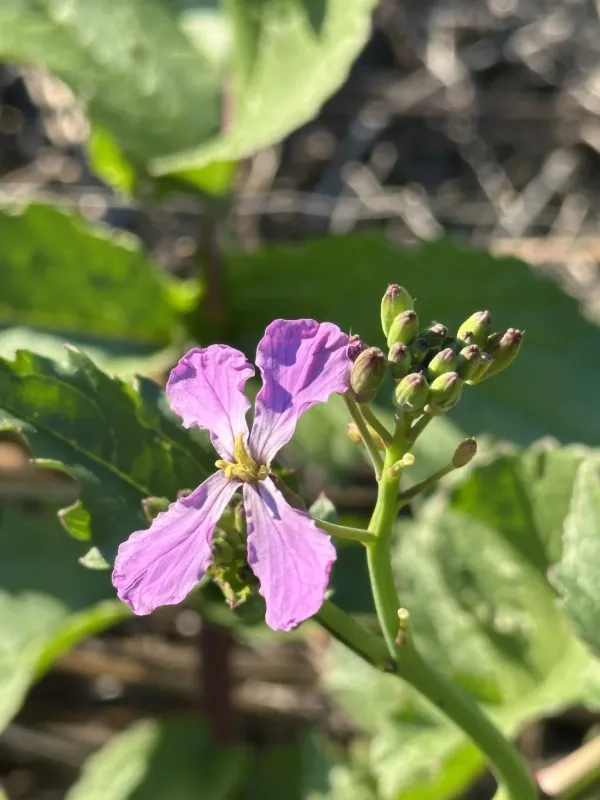
Wild radish (Raphanus raphanistrum) is a winter or summer annual plant belonging to the Brassicaceae family. It typically grows with branched stems reaching 15 to 60 centimeters in height.
The leaves are lyrate-pinnatifid and covered with stiff hairs. The flowers possess four petals, which can range in color from white to yellow or light purple, often featuring dark veins.
It produces siliques (seed pods) that break into distinct segments at maturity. Each segment contains a seed, allowing the plant to spread effectively across cultivated fields.
The plant features a deep taproot system, which grants it excellent access to soil moisture and nutrients, making it highly competitive against slower-growing crop seedlings.
Wild radish seedlings are resilient and emerge early in the season, establishing a dominant presence in the field before crops have reached their full growth potential.
Where it grows
This weed is globally distributed in temperate regions. It frequently infests cereals, oilseed rape, pulse crops, and various vegetable farms across various soil types.
It thrives in fertile, moist environments but demonstrates high tolerance for poor or disturbed soils, allowing it to colonize roadsides and field margins easily.
The species is highly adaptable, often found in fallow lands, pastures, and orchards, where it maintains a stable seed bank that can germinate over several years.
Human activities, including the movement of farm machinery and the use of contaminated seeds, are primary drivers for the long-distance dispersal of wild radish seeds.
The weed's ability to withstand various climatic conditions ensures that it remains a persistent challenge for farmers in diverse geographic locations worldwide.
Harm it causes
Wild radish acts as a strong competitor, depleting vital nitrogen, water, and sunlight that would otherwise support crop development and maximize yields.
Significant infestations can lead to heavy economic losses in grain and oilseed production, often reducing yield by 20% to 50% depending on density.
It serves as an alternative host for numerous agricultural pests, including flea beetles and various aphids, which can then migrate to damage cash crops.
The presence of wild radish complicates harvesting operations, as the plant's tough stems can interfere with equipment and increase moisture levels in the harvested grain.
Furthermore, wild radish seeds can contaminate crop shipments, leading to reduced market grade and higher costs for cleaning, drying, and storage of agricultural products.
How to control
Effective control requires an integrated approach starting with crop rotation, specifically avoiding sequences that involve multiple susceptible Brassica crops.
Mechanical cultivation, such as shallow tillage and harrowing, is essential for eliminating early-emerging seedlings before they establish strong root systems.
Chemical control with selective herbicides is the primary method for managing this weed in cereals. Commonly used chemicals include synthetic auxins or ALS inhibitors.
- Regular field scouting to detect populations early in the season.
- Ensuring the use of certified, weed-free crop seeds for planting.
- Application of pre-emergence herbicides to suppress early spring germination.
Timely herbicide application during the rosette stage of the plant is critical for preventing seed set and reducing the weed seed bank in the soil for future seasons.
Content graph
Connections · Wild radish
Most often together:
Marketplace
Products · 226


Dublon Gold
ЗАТ Фірма Август, Росія.,селище Вурнари,
Herbicides
2
2
·
5.4K
6 offers
117.01 €per 1 l
Buy


Alfa-Prometrin
Zhejiang Zhongshan Chemical Industry Group Co., Ltd.
Herbicides
1
1
·
3K
14 offers
4.41 €per 1 l
Buy


Biceps Guarant
ЗАТ Фірма Август, Росія.,селище Вурнари,
Herbicides
0
0
·
2.4K
8 offers
0.64 €per 1 l
Buy

Gold Star
ТОВ «Фабрика агрохімікатів», Черкаси, Україна
Herbicides
0
3
·
2.4K
15 offers
28.75 €per 1 l
Buy





Picador
ТОВ «Фабрика агрохімікатів», Черкаси, Україна
Herbicides
0
0
·
1.5K
8 offers
5.46 €per 1 l
Buy


Miladar
«Нанджин Ессенс Файн-Кемікал Ко. Лтд» (Китай)
Herbicides
0
0
·
1.3K
15 offers
5.07 €per 1 l
Buy


Flagman
«Нанджин Ессенс Файн-Кемікал Ко. Лтд» (Китай)
Herbicides
0
0
·
1.2K
3 offers
23.17 €per 1 l
Buy


Terramidin
Nanjing No.1 Pesticide Factory of Red Sun Group Co., Ltd.
Herbicides
0
0
·
1.1K
1 offer
7.61 €per 1 l
Buy


TriO Lux
Ф.Суперус Ко ., Лтд., Гонг-Конг, Шанхай, Китай.
Herbicides
0
0
·
920
2 offers
150.8 €per pack
Buy

Segment
Три Дельта Компані Інтернешнл, Гонконг, Китай.
Herbicides
0
0
·
898
2 offers
4.44 €per 1 l
Buy


Controller
Ф.Меатон Лімітед, Лондон, Великобританія.
Herbicides
0
0
·
748
2 offers
40.69 €per pack
Buy


NOPASARAN K.S.
ф.БАСФ СЕ, Німечина на заводі м.Гравелін
Herbicides
0
0
·
101
2 offers
26.38 €per 1 l
Buy


Bentazone 480 g/l, (Bentazone 480 g/l)
Sharda Worldwide Exports Pvt Ltd, Sharda World
Herbicides
0
0
·
72
2 offers
8.64 €per 1 l
Buy


Alpha-Maïs, WG, herbicide + PAR «Alfalip»
Alpha Smart Agro
Herbicides
0
0
·
65
14 offers
2.99 €per 1 l
Buy


Biology
Taxonomy
- Latin name
- Raphanus raphanistrum
- Family
- Однолетние двудольные сорняки