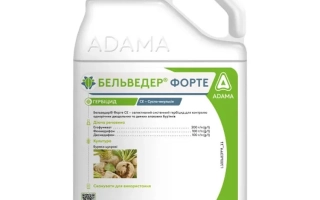
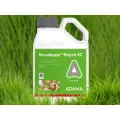
BELLEVER® SC
Post-emergence herbicide for protection of sugar beet
Classic protection for sugar beet
Active ingredients: 160 g/l desmedifam, 160 g/l fenmedifam
State registration number: № 2028-10-108-232-0-1-3-0 until 14.09.2020
Manufacturer: Agan Chemical Manufacturers Ltd. PIA 262, Northern Industrial Zone Ashdod 77102, Israel
Shelf life: 3 years from the date of manufacture of the preparation (under storage conditions).
Guaranteed storage period: 3 years from the date of manufacture of the preparation (under storage conditions).
Package volume: 5 L
MAIN ADVANTAGES:
Bellever® controls a wide spectrum of major broadleaf weeds during sugar beet cultivation, its active ingredients are a classic tool for protecting this crop.
Bellever® combines well with other Agan Makteshim products in the integrated sugar beet protection system (Goltix®, Shogun®, Bellever® Forte).
The Bellever® formulation as a suspension concentrate allows reducing the phytotoxic effect of the preparation on the crop even at the earliest stages of its development.
SPECTRUM OF ACTION (selective):
Persian Veronica (Veronica persica), Knotgrass (Polygonum spp.), Field mustard (Sinapis arvensis), Fumitory (Fumaria officinalis), Common chickweed (Stellaria media), Common ragwort (Senecio vulgaris), Broadleaf dock (Atriplex patula), Self-seeding poppy (Papaver rhoes), Common lambsquarters (Chenopodium album), Field forget-me-not (Myosotis arvensis), Black nightshade (Solanum nigrum), Galeopsis spp., Goosegrass (Galium aparine), Wild radish (Raphanus raphanistrum), Chamomile, Galeopsis spp., Field violet (Viola arvensis), Amaranth (Amaranthus retroflexus), Field pennycress (Thlaspi arvense), Dead-nettle, Lamium spp.)
APPLICATION REGIMES:
Working liquid rate 200-300 L/ha
Rate, L/ha Crop Target weed Application features Number of treatments
1.0 Sugar beet and fodder beet Annual broadleaf weeds, including amaranth Spraying seedlings in the cotyledon stage (first, second, and third weed waves) 3
1.5 Spraying seedlings in the 2-4 leaf stage of weeds during the first and second weed waves. 2
The manufacturer declares that this information cannot be considered as an instruction.
Before use, please read the contents of the container label.
Makteshim Agan Industries Ltd. received its first registration for a preparation based on desmedifam and fenmedifam in Russia
BELLEVER, SC (160 g/l desmedifam and 160 g/l fenmedifam)
LLC "MARUS", a subsidiary of Makteshim Agan Industries Ltd., announces the completion of the State Registration process for the preparation Bellever, SC and provides some results of tests conducted as part of the registration.
In 2008-2009, experiments were conducted in three soil-climate zones of Russia to establish biological application regimes for the herbicide Bellever, SC on sugar beet crops of four different hybrids.
The efficacy of the preparation in controlling annual broadleaf weeds was evaluated at three applications during the first, second, and third weed waves in the cotyledon stage (1.0 + 1.0 + 1.0 L/ha) and at two applications during the 2-4 true leaf stage of weeds (1.5 + 1.5 L/ha). Betanal Expert OF, KE was used as the standard.
In Zone I, the weed infestation level of the experimental plot with broadleaf annual weeds ranged from 51-60 plants/m2. The weeds were represented by amaranth, common lambsquarters, common galeopsis, common chickweed, and goosegrass.
Fifteen days after the last application, the reduction in the total number of annual broadleaf weeds in the treatment variants was similar: 80 and 83%, reduction in fresh weight was 71% (after three applications) and 81% (after two applications). After two more weeks, the efficacy of the preparation increased to 87-92% (both mortality and reduction in weight). At harvest, the infestation level of plots treated with the herbicide Bellever, SC was 93-95% lower than the control.
The standard herbicide was equally effective in reducing the number of broadleaf annual weeds at two applications, while at three applications, it was slightly less effective (by 5-6%) than the herbicide Bellever, SC.
The most sensitive plants to the herbicide Bellever, SC were common galeopsis and common chickweed: their mortality in both treated variants reached 100%. Complete elimination of amaranth was achieved with two applications of the herbicide Bellever, SC, while with three applications, mortality reached 75-96%. Goosegrass plants after three applications of the herbicide Bellever, SC were suppressed by 80-91%, and after two applications — by 75-81%.
The average yield of sugar beet roots in the control plots was 243.7 and 250.0 t/ha. In treated plots, the crop yield increased significantly: by 22.4-23.4% in triple applications, and by 29.2-33.8% in double applications.
In Zone II, the experimental plot was predominantly infested by amaranth, knotgrass, goosegrass, field violet, and annual knotweed. Perennial broadleaf weeds were represented by occasional field bindweed, with a total infestation level of 104-155 plants/m2.
Both split applications of the herbicide Bellever, SC showed good biological efficacy. Fifteen days after the last spraying, the mortality of weeds in the test variants was at 81-85%, in the control — 87-89%; reduction in fresh weight of weeds reached 96-97%. After 30 days, in all variants with herbicides, mortality of broadleaf weeds was 95-97% and reduction in fresh weight — 98-99%. Three applications of the herbicide Bellever, SC showed higher efficacy against field bindweed and field violet — by 7-10%.
At harvest time, no weeds were found on plots treated with herbicides. In the control, large, overgrown amaranth, field bindweed, and common lambsquarters plants were observed.
The average yield of sugar beet roots in the control plots was 345 and 360.3 t/ha. In treated plots, the yield increased by 25.7-26.7% — with three applications, and by 32-35.2% — with two applications.
In Zone III, the infestation level of the experimental plot with broadleaf annual weeds ranged from 98-108 plants/m2. They belonged to species: amaranth (76% of the total), bindweed, and common lambsquarters (12% each).
The biological efficacy of the herbicide Bellever, SC with both application methods was quite high and similar. Fifteen days after the last application and until harvest, the total number of annual broadleaf weeds in the treatment variants was reduced by 88.7-93.9%. Reduction in fresh weight of weeds 15 and 30 days after the last application was 88.6-94.3%, which was at the level of the standard.
Mortality of amaranth and bindweed plants after split applications of the test herbicide reached 91-96%, reduction in number of common lambsquarters plants was at 78-86%.
Effective elimination of competition from annual broadleaf weeds in herbicide-treated variants contributed to a significant increase in sugar beet yield. In variants with three applications of the herbicide Bellever, SC and the standard, yield increases were 284.5 and 291.7% compared to the control; in double applications — significantly higher — 310.2 and 315.6%.
Based on test results in all three soil-climate zones of agricultural crop cultivation, the herbicide Bellever, SC at two and three applications was not inferior to the standard Betanal Expert OF, KE in its effect on annual broadleaf weeds. Application of the herbicide Bellever, SC in both regimes did not negatively affect sugar beet plants and contributed to obtaining reliable yield increases of the root crop, with double application, as with the standard, showing higher economic efficiency.