Post-emergence herbicide for controlling a broad spectrum of weeds on corn crops.
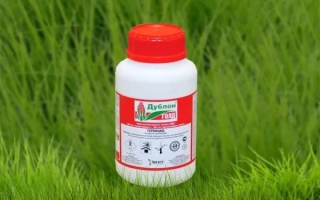
Dublon Gold
For agricultural producers
Nicosulfuron + Tifen sulfuron-methyl (600 g/kg + 150 g/kg)
Post-emergence herbicide for controlling a broad spectrum of weeds on corn crops
GOLD FOR CLEAN FIELDS
ADVANTAGES:
eradication of most grasses and broadleaf weeds
long-lasting protective effect against weeds
wide application range from 2 to 6 corn leaves
low application rate and ease of use
USE:
Combined systemic herbicide for controlling many species of annual and perennial grasses and annual and some perennial broadleaf weeds in corn crops.
ACTIVE INGREDIENTS:
Nicosulfuron, 600 g/kg and Tifen sulfuron-methyl, 150 g/kg.
FORMULATION:
Water-dispersible granules.
CHARACTERISTICS OF ACTIVE INGREDIENTS:
Nicosulfuron and Tifen sulfuron-methyl belong to the class of sulfonylurea derivatives.
HERBICIDE SPECTRUM:
Annual grasses: Common barnyard grass (wild millet), crabgrass, species, redroot pigweed, foxtail (wild oats), weed millet (cultivated millet), branched millet, hairy millet, Indian eleusine.
Perennial grasses: Quackgrass, Aleppo sorghum (Gumay).
Annual broadleaf weeds: Cucumbertree, Ambrosia artemisiifolia, blue violet, hairy vetch (pea), burnet, species, field mustard, goosegrass, species, Dicranopteris sofiae, annual chicory, yellow ragwort, wild cabbage, common chickweed, mare, species, medicinal dandelion, garden sorrel, common cowpea, piquet, species, wild radish, daisy, species, annual knapweed, inverted chickweed, field knotweed, purple speedwell.
Perennial broadleaf weeds: Field dock, Tatar dandelion (blue sorrel, milkweed), field sorrel (yellow).
MODE OF ACTION OF THE PREPARATION:
Dublon Gold has a systemic selective action. The active ingredients penetrate into weeds through leaves and roots, are absorbed by them and move through the plant via xylem and phloem. They inhibit the enzyme acetolactate synthase, which is involved in the synthesis of essential amino acids leucine, isoleucine and valine. As a result, the plant develops a deficiency of these acids, which causes disruption of cell division, growth cessation and subsequent death of weed plants.
RATE OF ACTION:
The herbicide enters plants fairly quickly (approximately within 4 hours after application). Growth retardation of weeds occurs within a few hours after absorption, but visible symptoms are observed 5–10 days after application. Complete death of weed plants occurs 15 days or more after application. The speed of growth inhibition depends on weather conditions at the time of application (humidity, temperature), weed species and their developmental stage.
SYMPTOMS OF ACTION:
The first symptoms of Dublon Gold activity are a sharp slowdown in weed growth. Subsequently, anthocyanin pigmentation appears, veins bleach, chlorosis of leaves, death of growth points, chlorosis, tissue necrosis. Weed leaves turn chlorotic within 1–3 weeks after application, growth points die sequentially and weeds die. Overgrown or less sensitive weeds do not die, but are suppressed, stop further development and do not affect crop yield.
DURATION OF PROTECTIVE EFFECT:
Dublon Gold usually effectively kills only those weed plants that have already germinated or are germinating at the time of application.
FACTORS AFFECTING THE EFFICACY OF THE PREPARATION:
In humid conditions, soil activity of the herbicide increases, and it controls weeds at emergence for up to three weeks due to rapid absorption through the root system.
PHYTOXICITY, CROP TOLERANCE:
Dublon Gold is not phytotoxic to corn when applied according to instructions. It is rapidly metabolized in corn plants, so the crop exhibits high tolerance to the preparation.
POSSIBILITY OF RESISTANCE DEVELOPMENT:
Cases of resistance development to the preparation have not been identified, but to avoid its emergence, it is recommended to alternate the use of Dublon Gold with herbicides of different chemical classes with different modes of action.
STORAGE CONDITIONS:
Storage of the preparation is carried out in specially designated pesticide storage rooms, in hermetically sealed, undamaged factory packaging at a storage temperature from minus 25°C to plus 35°C.
SHELF LIFE:
2 years from the date of manufacture, provided storage conditions are met (in unopened factory packaging).
PACKAGING:
Bottles of 1 kg.
APPLICATION FREQUENCY:
Used for single application on crops.
APPLICATION PERIOD:
Spraying crops in the 2–6 leaf stage of corn, when creeping crabgrass is 10–15 cm tall, in the 1–4 leaf stage of annual broadleaf and grass weeds.
APPLICATION RECOMMENDATIONS:
Dublon Gold is registered for use on corn crops (except corn for oil).
It is undesirable to use the preparation on sugar and popcorn corn, on parental lines for seed production.
APPLICATION RATES:
Recommended 50–70 g/ha Dublon Gold with addition of 200 ml/ha surfactant Adjuvant.
WORKER EXPOSURE PERIOD:
Worker exposure period for mechanized work — 3 days, for manual — not regulated.
ROTATION RESTRICTIONS:
Possible damage to subsequent crops in rotation on alkaline soils, as well as if dry weather predominated between herbicide application and sowing of the subsequent crop. Under normal crop rotation, there are no restrictions for subsequent crops. However, if reseeding of areas treated with Dublon Gold is necessary, reseeding should be done only with corn.
PREPARATION OF WORKING SOLUTION:
The working solution is prepared immediately before spraying. Measure the required amount of Dublon Gold for one tank of sprayer. To prepare the mother solution, fill a container (bucket) with 1/4 water, add the measured amount of herbicide, mix thoroughly, then add water to 3/4 volume. Next, prepare the working solution as follows: fill the sprayer tank approximately half with water, turn on the mixer, pour the herbicide mother solution into it, add the appropriate amount of surfactant Adjuvant, top up with water to full volume. Wash the mother solution container several times with water and pour into the sprayer tank.
Important! Adjuvant must be added to the sprayer tank last, otherwise, due to excessive foam formation when adding the surfactant, part of the solution may spill out of the sprayer tank.
COMPATIBILITY:
Dublon Gold is compatible with dicamba-based herbicides and pyrethroid insecticides. Do not mix Dublon Gold with 2,4-D-based herbicides to avoid weakening of action on monocots, and with organophosphorus insecticides to avoid damage to crop plants.
Do not mix the preparation with pesticides having strongly alkaline or strongly acidic reactions.
WORKING LIQUID CONSUMPTION:
200–300 l/ha.
HAZARD CLASS:
3rd (moderately hazardous compound). When working with the preparation, it is necessary to comply with requirements and safety measures according to SanPiN 1.2.1077-01. Individual protective equipment for respiratory, visual, and skin protection must be used.
FIRST AID IN CASE OF POISONING:
Upon appearance of early signs of illness, remove the affected person from the area of action, remove protective clothing, and ensure access to fresh air.
In case of skin contact — remove contamination with a cotton swab or piece of cloth (carefully, without rubbing), then thoroughly wash with plenty of water and soap.
In case of eye contact — immediately rinse eyes with plenty of clean running water, keeping eyelids open, and seek medical attention.
In case of accidental ingestion — rinse mouth with water. If the affected person is conscious — immediately give several glasses of water with activated charcoal at a rate of 1 g sorbent per 1 kg body weight.
In case of inhalation — remove the affected person to fresh air, change contaminated clothing, and call a doctor.
INFORMATION FOR DOCTORS:
Treatment is symptomatic. Specific antidotes are not available.
In case of need, consult a toxicology center: 129010, Moscow, Suharevskaya Square, 3. MNIIE Emergency Care named after Sklifosovsky. Toxicology Information and Consultation Center. Tel.: (495) 928-16-87, fax: (495) 921-68-85 (24 hours).
SAFETY MEASURES DURING WORK, TRANSPORT AND STORAGE:
During work, comply with requirements and safety measures according to GOST 12.3.041-86 and SanPiN 1.2.1077-01 «Hygienic Requirements for Storage, Application and Transportation of Pesticides and Agrochemicals», Moscow, 2002. Work with the preparation without individual protective equipment for respiratory, visual, and skin protection is prohibited.
Transport of the preparation is carried out only in factory packaging with factory labeling by all types of transport vehicles in accordance with the rules for transporting hazardous goods applicable to the given type of transport.
Transport and storage of the preparation together with food products and feed mixtures are strictly prohibited!
METHODS FOR DECONTAMINATION OF SPILLED OR SCATTERED PESTICIDE, METHODS FOR DECONTAMINATION AND DISPOSAL OF CONTAINERS AND REMNANTS OF PESTICIDE:
To decontaminate spilled working solution, sprinkle the contaminated area with sand or another non-combustible material capable of adsorbing the contamination. Collect dirty sand in containers for disposal according to local instructions. The contaminated area should be washed with water and soap or soda (200 g soda per bucket of water) and tilled.
Decontamination and disposal of containers, pesticide remnants, and rinse waters must be carried out in accordance with SanPiN 1.2.1077-01 (Moscow, 2002) and «Temporary Instructions for Preparing for Disposal of Prohibited and Unsuitable Pesticides and Their Containers» (VNIPIagrokhim, Ryazan, 1989).
It is not allowed to contaminate water bodies designated for household and fishery purposes directly with the preparation or used containers. Disposal of the preparation into sewers or any water bodies is prohibited!
RECOMMENDATIONS FOR PROTECTING USEFUL FLORA AND FAUNA:
At recommended application rates, Dublon Gold is practically non-toxic to mammals, birds, earthworms and soil microorganisms. The active ingredients of the preparation, nicosulfuron, are moderately persistent in soil, and tifen sulfuron-methyl is not persistent.
The preparation belongs to the 3rd class of hazard for bees (low hazard).
REQUIRED GENERAL SAFETY MEASURES:
Apply treatments early in the morning or in the evening after sunset;
wind speed not exceeding 4–5 m/s;
protective zone for bees — at least 2–3 km;
bee flight restriction — at least 3–4 hours.
Use of pesticides requires compliance with the main provisions of the «Instructions for Preventing Bee Poisoning by Pesticides» (Moscow, GAPP USSR, 1989), in particular, mandatory prior notification of local beekeepers (via print media and radio) about the type of plant protection product planned for use, application dates and zones.
FISHING INDUSTRY ASSESSMENT:
Use of the preparation is prohibited in sanitary zones of fishery water bodies.