


SKU #348
·
2 077 views
Lornet
Herbicides, Desiccants
ЗАТ Щелково Агрохім , Росія.User rating
0 votes0% positive reviews
No ratings yet — be the first.
Last Processing Date, Days
1
By type of action
Systemic herbicide
By application method
Foliar herbicide, Soil herbicide
By Mode of Action
Selective herbicide
Prices in stores
from2.77 €per 1 l
pack from 28.28 € per pack
4 offers from 3 stores
Store offers · 4 from 3 stores
Prices are updated on loadLoading offers…
Available at: Agrotovar · Agrovista · Ahrotsentr · Yablukom
Aggregator catalog: prices are collected automatically from store websites, normalized by AI and converted at the current exchange rate. Before ordering, confirm the price and availability on the store's website. This block is not indexed by search engines — the data is loaded after the page opens.
About product

A reliable systemic herbicide for selective control of persistent broad-leaved weeds in fodder beet crops.
Last Processing Date, Days
1
By type of action
Systemic herbicide
By application method
Foliar herbicide, Soil herbicide
By Mode of Action
Selective herbicide
Description
Efficient Weed Control in Beet Crops
"Lornet" by ZAT Shchelkovo Agrokhim (Russia) is a targeted systemic herbicide designed for the protection of fodder beet crops. Based on clopyralid, this selective herbicide has established a solid reputation for its ability to eliminate the most stubborn perennial and annual broad-leaved weeds that often plague beet fields.
Unlike broad-spectrum herbicides, Lornet is highly selective. Its primary strength lies in controlling persistent weeds such as creeping thistle (Cirsium arvense) and field bindweed (Convolvulus arvensis). It is also highly effective against common lamb's quarters, pigweed, goosefoot, field mustard, and wild radish, ensuring that the crop receives the necessary resources to develop without competition from invasive flora.
Mechanism of Action and Application
As a systemic post-emergence (insurance) herbicide, Lornet is absorbed through the leaf surface and moves rapidly to the growing points and root system, resulting in the complete cessation of weed development. While primarily used as a foliar treatment, its characteristics also allow for ground application under specific conditions.
- Active Ingredient: Clopyralid.
- Formulation: Aqueous solution, optimized for easy preparation of tank mixtures.
- Application Rate: Economical, up to 0.5 L/ha.
- Safety Class: 3, meeting standard regulatory requirements for agrochemical safety.
A significant practical advantage is the short pre-harvest interval—just 1 day after the final application. This provides farmers with the flexibility needed in intensive agricultural scheduling.
Market Positioning
Products from Shchelkovo Agrokhim are known for addressing complex agricultural challenges. Lornet occupies a niche as a high-precision tool used when basic herbicides fail to provide complete field clearance. By leveraging systemic action, it remains a reliable choice for large-scale operations focused on maximizing fodder yield and maintaining field health throughout the growing season.
Composition
Active ingredients
- Clopyralid гербицид
Application
Used on crops
Against weeds
Annual broadleaf weeds
Black nightshade
Cleavers
Cocklebur
Common chickweed
Common fumitory
Common poppy
Common purslane
Common ragweed
Cornflower
Dandelion
Euphorbiaceae
Field forget-me-not
Field pennycress
Hemp-nettle
Knotweed
Lamiaceae
Mugwort
Perennial dicots
Perennial root crops
Perennial sow thistle
Polygonaceae
Redroot pigweed
Resistant to 2,4-D
Scentless mayweed
Shepherd's purse
Spreading orache
Veronica
Wild mustard
Wild radish
Specifications hover over for a hint about the specification
|
Last Processing Date, Days
Last Processing Date, Days
Number of days from processing to harvest cleanup |
1 |
|---|---|
|
By type of action
By type of action
Depending on their ability to move through living tissues, herbicides are divided into contact and systemic. Contact herbicides cause local damage to plant tissue upon contact, which dies or gradually degrades. This action does not always completely destroy the plant; often, its... |
|
|
By application method
By application method
Based on the method of application, herbicides are divided into foliar, soil, and root herbicides. Foliar herbicides are applied to vegetative plants and act through their above-ground organs. The main method of application for such preparations is spraying using sprayers or airp... |
|
|
By Mode of Action
By Mode of Action
Herbicides are divided into two groups according to their mode of action: Non-selective herbicides — intended for the destruction of all plant species. They are applied in agricultural fields during the absence of the main crop (after harvest, before crop emergence, on fallow lan... |
|
|
By Application Timing
By Application Timing
Herbicides are classified according to application timing into pre-emergent and post-emergent herbicides. Pre-emergent herbicides are mostly soil-applied or granular formulations applied before the emergence of crop plants. They are applied either pre-sowing (during pre-sowing cu... |
|
| Form of the preparation | |
|
Drug Consumption
Drug Consumption
Mass of the preparation per unit of treated area. It is customary to express the dosage rate in kilograms per hectare. The dosage rate is most often given in terms of 100% active ingredient, although sometimes it is calculated based on the preparation in the form of application w... |
Up to 0.5 L/ha |
| Danger Class | 3 |
| Registration year | 2008 |
| Catalog | Catalog → Herbicides, Desiccants |
| Manufacturer | ЗАТ Щелково Агрохім , Росія. |
| Legal data |
Show · 1
|
| Country | Russia |
Not yet комментариев. Be the first!
Alternatives
Herbicides, Desiccants · similar preparations


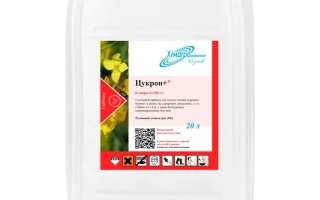


CUKRON + V.R., (CLOPIRACLID, 300 G/L)
Sunrise Agrochemical Co., Ltd.
044 7 offers
17.35 €per 1 l ≈ 894 ₴
See also
Often considered together with this product




Recently viewed
Products you’ve viewed on this site
Reviews · 0