

Description
How to identify
The potato cyst nematode (Globodera rostochiensis) belongs to the phylum Nematoda, family Heteroderidae. It is a microscopic roundworm considered a serious quarantine pest worldwide.
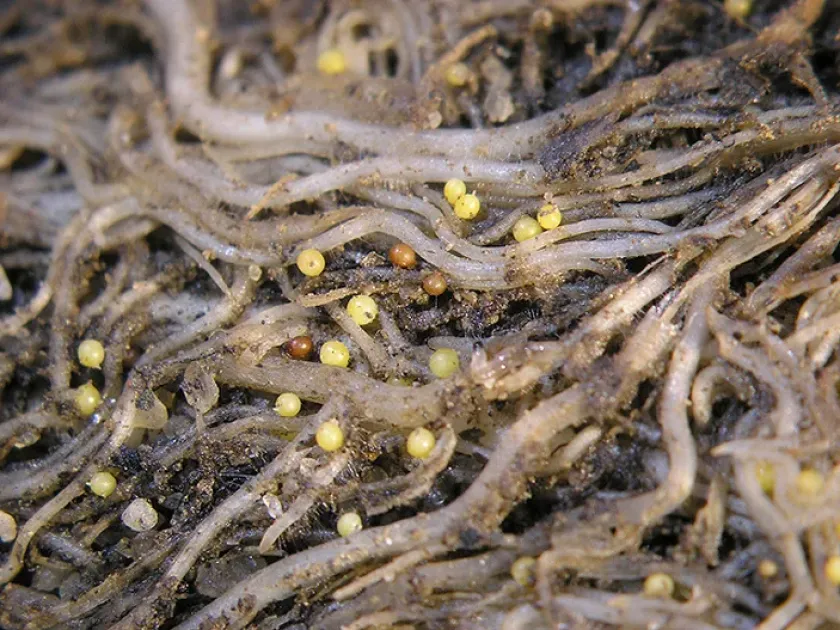
Adult females are globose and eventually transform into protective cysts. These cysts are brown or golden in color and serve as a durable housing for hundreds of eggs.
Larvae are the infective stage, being mobile and able to move through the soil to locate a host plant's root system, triggered by specific root exudates of solanaceous plants.
The cysts are extremely resilient, capable of surviving for over a decade in the soil without any host plants. They can withstand severe winter frosts and dry conditions.
Field identification is difficult due to the microscopic size of the worms. Detection usually requires soil sampling and laboratory analysis to find and quantify the number of cysts.
What it damages
Potatoes are the primary host of this nematode. Additionally, it causes significant yield reduction in tomatoes and eggplants, which are also members of the Solanaceae family.
Certain solanaceous weeds can serve as alternative hosts, which may maintain the nematode population in a field even during years when commercial crops are not grown.
The damage is caused by larvae invading the root cortex, which disrupts the plant's nutrient and water uptake. This results in severe physiological stress to the crop.
Infested plants show significantly reduced tuber development. In heavy infestations, the yield loss can exceed 80%, making the crop economically unviable for the farmer.
Because the nematode is a quarantine organism, its presence often restricts the trade of potatoes and seed tubers from infested areas to prevent further spread.
When it appears
The life cycle begins in spring when soil temperatures reach about 10–12°C. The exudates from emerging potato roots stimulate the hatching of larvae from the cysts.
Infection of the root system occurs during the early vegetative stage. Larvae penetrate the roots, settle, and begin to feed, causing the characteristic root symptoms.
During the flowering period of the potato crop, female nematodes become mature and visible on the root surface, after which they develop into the hardened brown cysts.
A single generation typically completes its cycle in 40–50 days, depending on environmental factors like moisture and soil temperature, allowing for population growth.
After the potato harvest, the dormant cysts remain in the soil horizon. They wait for the following season, showing no further activity until the cycle is triggered again.
Signs of infestation
The most common symptom is patchy growth in the field. Infested areas show plants that are significantly shorter and less vigorous compared to the surrounding healthy crop.
Foliage often exhibits yellowing (chlorosis), wilting, and premature senescence. This wilting often persists even when soil moisture levels are adequate for healthy plants.
Root systems may appear stunted or exhibit excessive branching, as the plant attempts to overcome the damage caused by the nematode feeding on its tissues.
Close inspection during the flowering stage might reveal tiny, white to golden-colored specks attached to the roots, which are the mature female nematodes.
At harvest, there is a marked reduction in the size and number of tubers. Instead of marketable potatoes, the plants often produce only small, unmarketable tubers.
Control measures
The most effective strategy is a long-term crop rotation. Rotating potatoes with non-host crops for 5 to 7 years can significantly reduce the population of viable cysts.
The use of resistant potato varieties is essential in areas where the pest is present. These varieties allow the larvae to hatch but prevent the females from developing into mature cysts.
Implementing strict hygiene practices is necessary. This includes cleaning farm machinery and tools between fields to prevent the movement of infested soil to clean land.
- Utilizing green manure crops can improve soil health and suppress nematode development through biological activities.
- Soil solarization or the application of specialized nematicides may be used in intensive farming, though these methods have limitations.
Integrated Pest Management (IPM) is the recommended approach, combining sanitation, resistant cultivars, and cultural practices to keep the nematode population below damage thresholds.
Content graph
Connections · Potato cyst nematode
Most often together:
Marketplace
Products · 2

Biology
Taxonomy
- Latin name
- Globodera rostochiensis
- Order
- Nematodes
- Family
- Heteroderidae
- EPPO code
- HETDRO
Community
Discussion
No discussions yet — be the first.