
Description
How to identify
The pea cyst nematode (Heterodera goettingiana) is a member of the Heteroderidae family. This microscopic organism is characterized by its ability to form cysts, which serve as highly resistant survival structures in the soil.
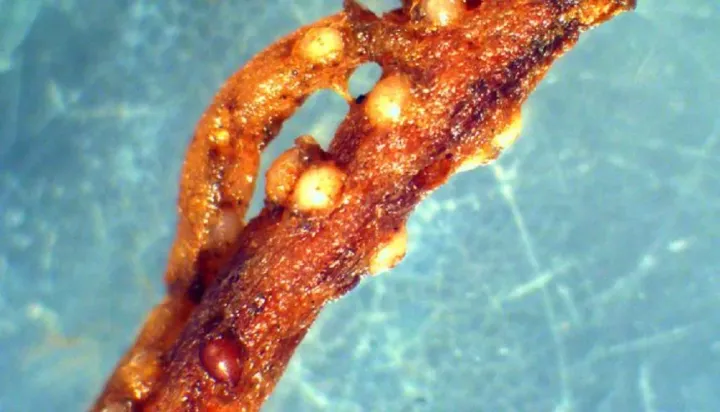
Identification is challenging due to the organism's size. During the growing season, farmers may observe small, white or lemon-yellow females attached to the root systems of pea plants. These are the active feeding stage of the nematode.
As the females die, their bodies harden and turn into brown, leathery cysts. These cysts contain eggs and larvae, providing a protective environment that allows the nematode to survive in the soil for many years without a host.
The life cycle begins when soil temperatures rise to 10–12°C, triggering the larvae to emerge from the cysts. They move through the soil film to locate and penetrate the roots of host plants, initiating the infection cycle.
Because the cysts are extremely hardy, they represent a long-term threat. Once established in a field, the pea cyst nematode is very difficult to eradicate, necessitating long-term agricultural planning.
What it damages
The primary hosts for this pest include peas, vetch, lentils, and field beans. These legumes are susceptible to significant root damage, which restricts the plant's ability to uptake water and essential minerals.
The damage caused by the nematode leads to poor plant growth and reduced vigor. Affected crops fail to develop properly, leading to sparse plant stands and stunted stems, which dramatically lowers the overall crop biomass.
Yield loss is the most severe economic impact. Depending on the soil infestation level, producers may experience yield reductions of over 50%. In extreme cases, the crop may fail to produce marketable grain entirely.
Beyond direct damage, the root lesions created by the nematodes provide entry points for soil-borne pathogens. This often leads to increased incidences of root rot and other fungal diseases, complicating the diagnosis and management.
The persistence of the nematode in the soil affects land value and future crop rotation options. Producers are forced to avoid growing susceptible legumes, which limits the flexibility of their farming systems for several years.
Signs of infestation
In the field, symptoms often appear in patches rather than uniformly. These localized areas of stunted, chlorotic plants are typical indicators of nematode clusters within the soil.
Affected plants often show premature yellowing of the lower leaves. The entire plant may appear weak and smaller than its healthy counterparts, with a noticeable delay in flowering and pod development.
Upon examination of the root system, one will notice a lack of healthy root growth. The roots may appear thick, stubby, or excessively branched, which is the plant's physiological reaction to the nematode infestation.
The presence of cysts is the ultimate diagnostic sign. Using a magnifying glass, you can see small, spherical bodies attached to the roots, which confirm the presence of Heterodera goettingiana.
- Patchy growth and stunted height.
- Chlorosis and premature senescence of leaves.
- Deformed, poorly developed root systems.
- Reduced nodulation (nitrogen fixation) on roots.
- Significant decrease in pod count and seed weight.
Control measures
The most effective management strategy is a strict crop rotation policy. Keeping peas and other legumes out of a field for 5 to 7 years is critical to reduce the cyst population to non-damaging levels.
Weed management is equally important. Many wild legumes act as host plants for the nematode, allowing the population to persist even when the main crop is rotated out of the field.
Integrated Pest Management (IPM) involves using resistant varieties when available and maintaining optimal soil fertility. Strong, well-nourished plants are better able to withstand the stress caused by the nematodes.
Green manure or cover crops, such as specific brassica species, can be used to suppress nematode activity. These plants produce compounds that interfere with the nematode's life cycle, helping to lower the soil pressure.
Pre-planting soil sampling and lab analysis are essential for fields with a history of infestation. This data allows for informed decision-making regarding which crops to plant, effectively preventing large-scale economic losses.
Reference
Connections · Pea cyst nematode
Most often together:
Marketplace
Products · 1
Biology
Taxonomy
- Latin name
- Heterodera goettingiana
- Order
- Nematodes
- Family
- Heteroderidae
- EPPO code
- HETDGO
Community
Discussion
No discussions yet — be the first.