
Atalodera
Atalodera
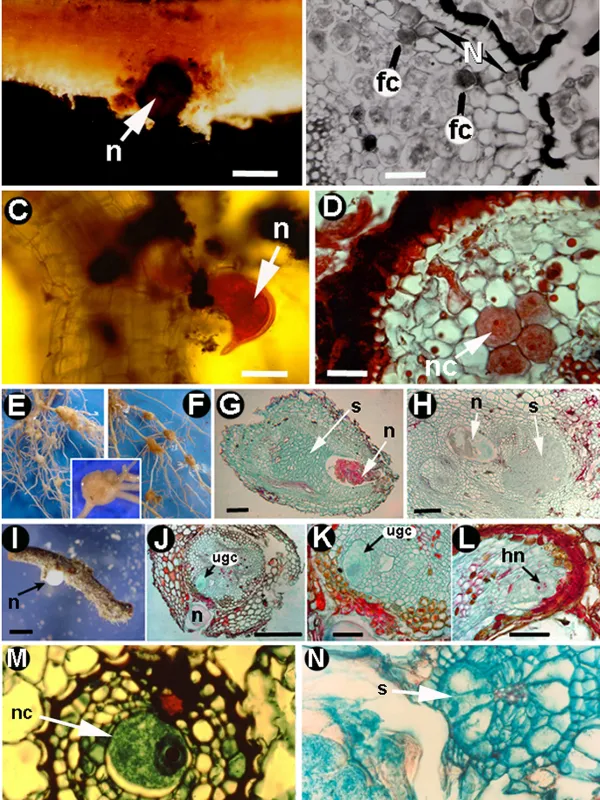
Description
How to identify
Atalodera belongs to the Heteroderidae family within the order Tylenchida. These are highly specialized microscopic parasitic worms commonly known as cyst-forming nematodes.
During development, the female's body undergoes significant changes, adopting a lemon-shaped or globular form. Upon the female's death, her cuticle hardens into a protective cyst, shielding the eggs from adverse environmental conditions.
Males are filiform in shape, allowing them to move actively through the soil substrate in search of mature females. These nematodes possess sensory organs that allow them to detect chemical signals from host plant roots.
Identification at the genus level is challenging due to their microscopic size, requiring laboratory analysis involving light microscopy and cyst morphometrics.
Second-stage juveniles are the invasive form: they actively penetrate root tissues, selecting sites for permanent parasitism near the vascular bundles.
What it damages
Atalodera primarily affects wild and cultivated plant species, often specializing in members of the Caryophyllaceae family and other specific host plants.
The nematode parasitizes the root system directly. Upon invading the root, the larva triggers the formation of specialized feeding sites, known as syncytia, from which it extracts essential nutrients.
Disruption of root tissue integrity and constant nutrient drain cause the plant to suffer from water and mineral deficiencies, significantly impacting overall crop yields.
Severe root system damage leads to stunted growth of the plant's aerial parts, leaf chlorosis, and premature wilting even when irrigation is sufficient.
Secondary fungal and bacterial infections often develop at the nematode entry sites, which can further destroy the root system and lead to plant death.
When it appears
The pest's lifecycle is closely tied to soil temperature. Juvenile activity typically begins once soil temperatures exceed 10-12 degrees Celsius.
Multiple generations can occur throughout a single growing season, provided that moisture conditions and host plant availability remain favorable.
In autumn, as temperatures drop, development slows, and the pest enters a resting phase within the cysts, which overwinter in the upper soil layers.
Initial signs of infestation often become visible in mid-summer, when plants hit their peak water requirements and damaged roots fail to cope with the demand.
The duration of the lifecycle varies depending on the host species and regional climatic conditions, ranging from several weeks to several months.
Signs of infestation
One of the primary external signs is patchy plant growth and development, which becomes apparent compared to the surrounding healthy crop.
Leaf chlorosis is a common symptom, often mistaken for micronutrient deficiency, though fertilizer application typically fails to correct the issue.
When infected plants are excavated, one can observe weak root development, necrotic spots, and gall-like swellings on the roots.
Upon close inspection, small cysts can be found in the soil surrounding the roots, appearing as tiny, dark-colored granules clinging to the rootlets.
Plants infested with Atalodera become extremely sensitive to drought, causing them to be the first to lose turgor and wilt during hot weather.
Control measures
The foundation of management is crop rotation, involving non-host plants to break the nematode's reproductive cycle effectively.
Using certified, disease-free planting material prevents the introduction of the pest into new areas, which is critical for successful long-term prevention.
Planting cover crops with nematicidal properties, such as white mustard or oilseed radish, helps reduce the nematode population density in the soil.
In intensive farming systems, the use of chemical nematicides is possible, though it requires strict adherence to safety regulations and application protocols.
Regular disinfection of agricultural machinery and tools is a vital element of control, as nematode cysts are easily transported through moist soil particles.
Taxonomy
- Latin name
- Atalodera
- Order
- Nematodes
- Family
- Heteroderidae
- EPPO code
- ATADSP
Discussion
No discussions yet — be the first.