
Description
Symptoms
The initial signs of Didymella infection often appear as water-soaked lesions on the stems, particularly at the nodes or near the soil line. As the infection progresses, these lesions expand and become necrotic, often turning dark brown or gray.
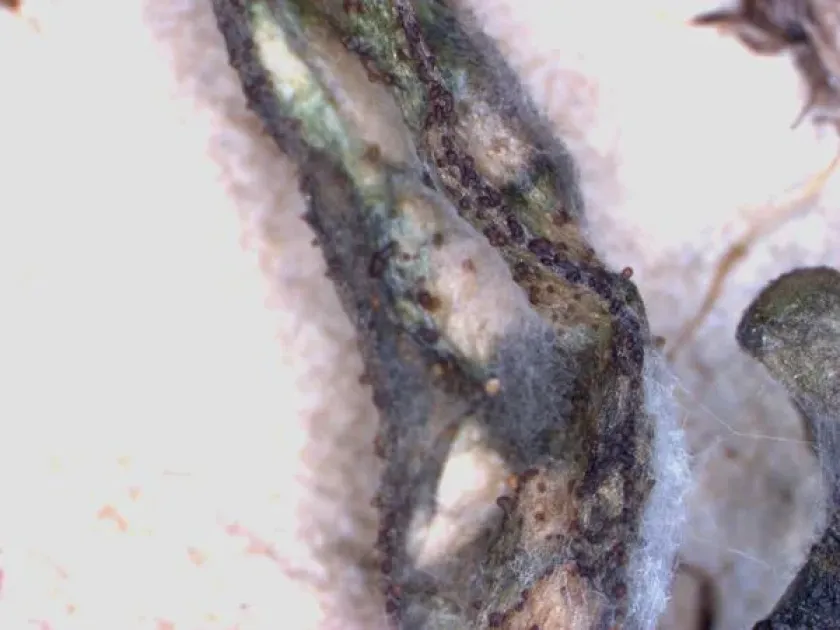
A hallmark of the disease is the emergence of small, black, pin-head-sized structures called pycnidia within the lesions. These are the fungal fruiting bodies that release large quantities of spores under humid conditions.
On leaves, the disease manifests as irregular or circular spots surrounded by a yellow halo. As the infection spreads, the leaves wither, turn yellow, and eventually drop off, significantly reducing the plant's photosynthetic capacity.
Fruit symptoms are common in severe infections, presenting as sunken, dark lesions that can lead to rapid decay. This stage is particularly damaging during post-harvest storage, where infected fruits become sources of secondary contamination.
- Water-soaked lesions on stems and nodes.
- Visible black pycnidia (fruiting bodies) within lesions.
- Stem cracking and gummy exudate.
- Chlorotic leaves followed by tissue necrosis.
Pathogen
Didymella is a genus of fungi belonging to the Ascomycota phylum. It includes several highly destructive species that cause serious diseases in a wide range of horticultural and agricultural crops, with Didymella bryoniae being the most notorious pathogen affecting cucurbits.
This fungus acts as a necrotrophic pathogen, colonizing host tissues and causing cell death. It possesses a complex life cycle, utilizing both sexual (ascospores) and asexual (pycnidia) stages to ensure survival and rapid dispersal throughout the growing season.
The pathogen can persist in the soil for several years and survives on infected crop residues or weed hosts. It can also be transmitted via contaminated seeds, making it a critical threat to nursery production and international seed trade.
Once introduced into a crop, the fungus penetrates through wounds, leaf stomata, or hydathodes. The hyphae aggressively colonize the vascular tissues, leading to systemic structural damage within the plant stems and leaves.
Its ability to remain latent until environmental conditions become optimal makes it a challenging pathogen to detect early. Effective disease management depends heavily on understanding its biological cycle and limiting its entry into the field or greenhouse.
Conditions for development
High relative humidity, typically exceeding 85%, is the primary factor driving the development of Didymella. The disease thrives in poorly ventilated greenhouses where condensation persists on plant surfaces for long durations.
Temperatures ranging from 20 to 25 degrees Celsius are considered optimal for the rapid germination and colonization of the fungus. Fluctuations in temperature can also stress the host plants, increasing their susceptibility to infection.
Crowded planting schemes are highly conducive to the spread of the pathogen, as they restrict airflow and increase the duration of leaf wetness. Proper spacing is essential to ensure that foliage dries quickly after irrigation or rain events.
Overhead irrigation is a major risk factor, as it acts as a primary vehicle for moving spores from the soil onto the foliage and stems. Drip irrigation is strongly recommended to maintain a dry canopy.
Improper sanitation and the accumulation of infected plant debris create a continuous reservoir of inoculum. If residues are not removed promptly, the fungus can quickly re-infect the next planting cycle.
Why it matters
The damage caused by Didymella is primarily due to the destruction of the vascular system, which hinders the plant's ability to transport water and nutrients. This inevitably leads to wilting and, in extreme cases, the total collapse of the plant.
In terms of agricultural productivity, the disease causes significant yield losses by reducing the number of viable fruits. Infected plants show stunted growth and poor fruit development, often failing to reach market quality.
The presence of Didymella significantly increases labor costs, as infected plants must be carefully managed or removed to prevent wider contamination. Frequent fungicide applications are often necessary, adding to the overall cost of production.
Because the fungus is seed-borne, outbreaks can be devastating for seed producers and nurseries, leading to the rejection of batches and long-term reputational damage.
The longevity of the fungal spores in the soil necessitates the implementation of long-term fallow periods or soil sterilization techniques, which are both economically burdensome for growers.
Protection
The most effective strategy is the use of long-term crop rotation to break the survival cycle of the fungus in the soil. Non-host crops should be planted for a minimum of three years following an outbreak.
Strict sanitation protocols must be enforced, including the thorough removal and destruction of all infected biomass. Composting is often insufficient, so incineration or disposal away from production areas is preferred.
Environmental management remains a priority; growers should prioritize greenhouses with advanced ventilation systems to keep humidity levels within a safe range. Reducing the moisture on leaves is a key preventative measure.
Chemical control involves the preventative application of registered fungicides, particularly during periods of high disease pressure. Rotation of different chemical modes of action is crucial to delay the development of fungicide resistance.
Integrated Pest Management (IPM) practices, such as the use of biological control agents (e.g., Trichoderma species) and the selection of resistant cultivars, provide sustainable solutions for long-term disease mitigation.
Content graph
Connections · Didymella
Most often together:
Marketplace
Products · 40


PRIOBSKAYA
ФГУП Новосибирская зональная станция садоводства Россельхозакадемии
Raspberry
0
0
·
33
1 offer
3.69 €per pack
Buy





Community
Discussion
No discussions yet — be the first.