
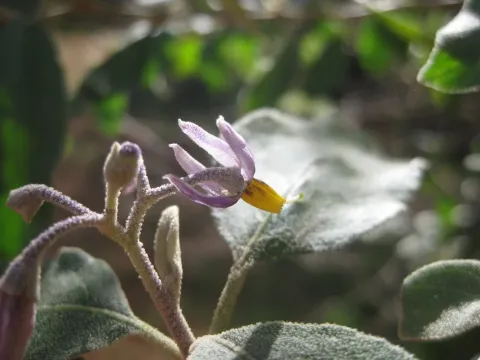
Solanum kwebense
Solanum kwebense
Solanum kwebense is a perennial herbaceous plant belonging to the diverse Solanaceae family. As a wild relative of cultivated crops, it possesses unique genetic traits that allow it to thrive in arid environments where other species would struggle to survive.
What the section contains
Solanum kwebense
The origin of this species is traced to the semi-arid regions of Southern Africa, particularly Botswana and the Kalahari Desert area. The plant has naturally adapted to intense solar radiation and irregular rainfall patterns typical of these savanna and shrubland ecosystems.
Botanically, it is characterized by its semi-shrub structure and pubescent foliage. The fine hairs on the leaves serve as a thermal insulator and a moisture-retention mechanism, which is a classic adaptation for plants inhabiting high-temperature, water-scarce landscapes.
The cultivation requirements for Solanum kwebense are strictly centered on soil structure and drainage. It requires well-draining, sandy-loam soils that prevent root rot, as the plant is highly susceptible to fungal issues caused by excessive humidity or waterlogging in the root zone.
In terms of agricultural management, this species requires a warm climate with significant daily temperature fluctuations to mimic its natural habitat. Proper care includes regulated irrigation, substantial light exposure, and the maintenance of a stable environment if grown under protection in temperate climates.