
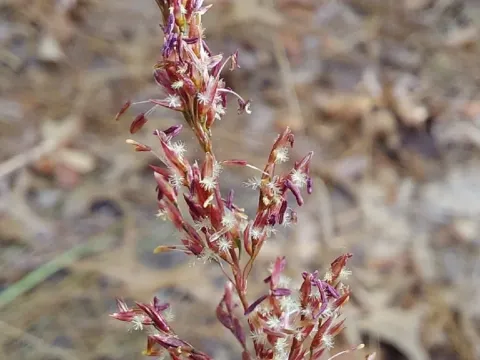
Smutgrass
Sporobolus poiretii
Smutgrass (Sporobolus poiretii) is a perennial grass species belonging to the Poaceae family. While it often serves as a native forage component, it is widely recognized for its invasive potential in pasture and range management settings.
What the section contains
Smutgrass
Originating from the Americas, this species has successfully colonized diverse environments worldwide. Its primary distribution includes areas with warm climates, where it thrives in disturbed soil and abandoned agricultural fields.
The botanical structure of the plant features dense, bunch-type growth patterns and fibrous, deep-reaching roots. These structural characteristics allow the plant to withstand significant environmental stress and outcompete less robust vegetation.
Soil requirements for Smutgrass are remarkably low; it displays high tolerance for compacted, acidic, and nutritionally poor soil conditions. These traits allow the plant to colonize areas where other more desirable forage species fail to establish.
Agricultural management of the species requires constant attention to grazing pressure and soil fertility. Because the plant rapidly matures and becomes unpalatable to livestock, rotational grazing and timely mowing are essential for maintaining pasture quality.
The plant is notoriously susceptible to a fungal pathogen known as ergot, which infects the seed heads. This disease gives the plant its common name and renders the forage toxic or unpalatable to grazing animals.
Insect threats include various grass-feeding larvae and aphids, although the plant's high silica content in the foliage provides a natural defense mechanism. This structural toughness limits the effectiveness of typical natural insect population controls.
As a competitive species, Smutgrass can rapidly dominate degraded rangelands, reducing the overall biodiversity and nutritional density of the forage. This expansion poses a direct threat to livestock productivity on infested farms.
Effective management against the plant requires a multi-year strategy involving herbicide application, controlled burning, and rigorous soil nutrient optimization. Mechanical removal is rarely successful unless it includes complete extraction of the root crown.
Proper pasture management, including the prevention of overgrazing, is the most effective biological defense. Maintaining a dense stand of healthy, competitive forage grasses is crucial to prevent Smutgrass from establishing in open soil patches.