
Juniper mistletoe
Phoradendron juniperum
Description
Growing requirements
Juniper mistletoe is a semi-parasitic plant belonging to the Santalaceae family. It is not an agricultural crop in the traditional sense, but it is a critical botanical subject for studying forest health and ecological dynamics in North American arid zones.
The plant is native to the Southwestern United States and Northern Mexico. Its distribution is strictly limited by the presence of host trees, primarily species of the genus Juniperus, which provide the essential moisture and nutrients for the mistletoe.
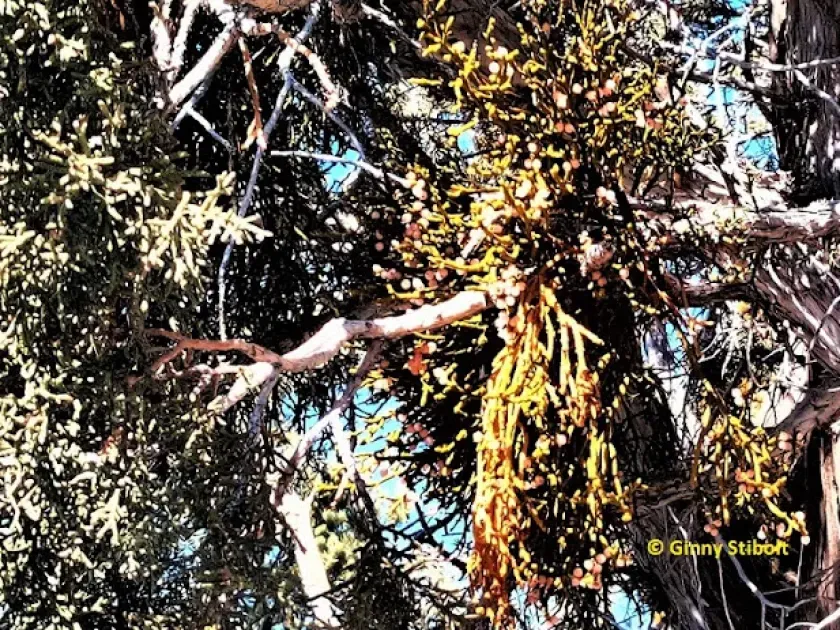
The species is a dioecious evergreen shrub that lacks true leaves or has them reduced to small scales. It relies on haustoria, root-like structures, to penetrate the host's bark and xylem, effectively hijacking the host tree's circulatory system.
Environmental requirements include high exposure to sunlight and heat. Despite being a parasite, it performs photosynthesis, but it cannot survive without the water supply extracted from the host, especially in desert climates.
Propagation is facilitated by birds that consume the white berries. The sticky seeds pass through the digestive tract or are wiped off onto branches, allowing the germinating embryo to securely attach to the host wood.
Main diseases and pests
The primary threat posed by Juniper mistletoe is the physiological decline of the host juniper trees. By continuously diverting water and nutrients, the parasite stunts the growth of the host and significantly reduces its lifespan in stressful conditions.
There are no major insect pests that specifically target the mistletoe, which allows its populations to remain stable in undisturbed ecosystems. However, severe infestations can lead to the death of the host tree, eventually killing the parasite too.
In forest management, the standard procedure to control the parasite is physical pruning of the infected limbs. This is effective if detected early and prevents the further spread of seeds throughout the forest canopy.
Disease pressure on the mistletoe itself is minimal. Its main challenge is finding a suitable host branch that provides enough hydration to support the parasite’s own survival through long, arid seasons in its native desert habitats.
The ecological interaction between the mistletoe and the juniper represents a complex symbiotic balance. While the mistletoe acts as a parasite, it serves as a crucial food source for birds, thereby playing a role in local biodiversity maintenance.